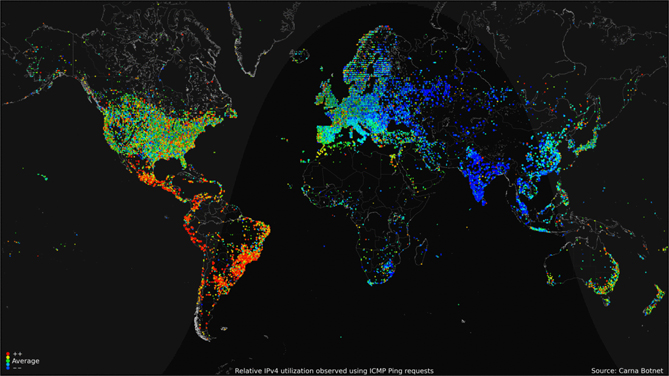
QUOTE: On a continent where only 7 percent of its inhabitants are online, this map is an eye-opening illustration of the digital divide. With the internet comes improved access to information, communication and ideas — and organizations need to make sure to bridge the gap. The good news is that Africa's telecommunications market is one of the fastest growing in the world.
Phi Beta Iota: We would add Amazonia, First Nation (North), and Central Asia.
If you track Big Data, you will want to read “Why Big Data Is Stillborn (for Now).” The write up hits the highlights of the flickering hyperbole machine that sells fancy math to the government and organizations desperate for a Silver Bullet.
The article asserts:
Most “big data” has to be moved in physical containers. Most data centers do not have excess capacity to handle petabyte level simultaneous search and pattern discovery.
Believe in real time and high speed access? Consider this statement:
Bandwidth, throughput, and how “real time” is defined all come down to the weak link in the chain and we have many ***very weak*** links across the chain and especially in Washington, D.C. The bottom line is always “who benefits?” The FCC decision to destroy net neutrality is in error. The citizen, not the corporation, is “root” in a Smart Nation.
If you wonder why your Big Data investments have yet to deliver a golden goose pumping out 24 caret eggs everyday, check out this write up. Worth reading.
Someone is once again raining on the big data parade, urging us to consider carefully before jumping on the bandwagon. FT Magazine warns, “Big Data: Are We Making a Big Mistake?” Writer Tim Harford points to Google’s much-lauded Google Flu Trends as an emblematic example in the field. That project notes an increase in certain search terms, like “flu symptoms” or “pharmacies near me”, by point of origin. With those data points, its algorithm extrapolates the spread of the disease. In fact, it does so with only one day’s delay, compared to a week or more for the CDC’s analysis based on doctors’ reports.
The thing is, this successful project is also an example of the blind faith many are putting into the results of data analysis. The scientists behind it aren’t afraid to admit they don’t know which search terms are most fruitful or how, exactly, its algorithm is constructing its correlations—it’s all about the results. Correlation over causation, as Harford puts it. However, Google Flu Trends hit a speed bump in 2012: it greatly over-estimated the flu’s spread, unnecessarily alarming the public. Correlation is much, much easier to determine than causation, but we must not let ourselves believe it is just as good.
Jargon confuses people interested in enterprise search. I gave a version of this talk at the Boston Search Conference several years ago. The video identifies the principal terms that mean “search.” — Stephen E Arnold, april 2014
Terabyte a day from a single sensor is a big deal. Put enough of them together and you get a petabyte that would take three years to transfor over existing legacy pipes. The “cloud” is fiction — picture using a straw to suck on the ocean.
01 Most pipes are in the gigabyte range. There are number in the terabyte range but they tend to be hogged by either secret intelligence or secret finance (e.g. between UK and US). Most “big data” has to be moved in physical containers. Most data centers do not have excess capacity to handle petabyte level simultaneous search and pattern discovery.
02 The big data endeavors that ARE successful at distributing massive amounts of data (in the multi terabyte range per day) over legacy networks are successful because they were designed from sratch to do exactly that. This cannot be said of most if not all intelligence collection programs.
03 Persistent surveillance is a pig. A really big pig. Most persistent surveillance offerings have software optimized for the one pig, not for many little pigs contributing to one big pig pen. Quality source-independent software is a HUGE differentiator and most Contracting Officers and their Technical Representatives (COTR) do not appear to understand this. On top of that is the analytic mindset and training that goes with making the most of many little pigs penned together under one analytic software umbrella.
It’s not often in this day and age that a Fortune 500 company rattles any political cages. In most cases, companies keep their noses out of Washington, or at least disguise their motives behind lobbyists. However, Google seems to be making some striking political waves, as we discovered in a recent NBC News story: “Google Exec: Technology is Not a Silver Bullet to Solve the World’s Problems.”
According to Jared Coen, director of Google Ideas:
[T]echnology is not a silver bullet answer to the world’s problems.
It generates awareness, it gives us visibility, it offers enormous opportunity – but at the end of the day, the world is still run by states and their military apparatus. States are going to continue to be the dominate unit in our lifetime and likely lifetimes to come.
Wow, we were shocked at the candor here. Even if this is just an independent view, it is still attached to the search giant, so it’s a gutsy thing to say anything political. We were impressed and then found other Googlers, like Eric Schmitt telling the Guardian that “politicians are failing us.” This is not the canned, public relations speak we are used to and applaud Google for standing for something of value, instead of just concerning itself with the company’s value.
Apparently net neutrality is officially dead. The Wall Street Journal reports today that the FCC has given up on finding a legal avenue to enforce equal access and will instead propose rules that explicitly allow broadband suppliers to favor companies that pay them for faster pipes:
The Federal Communications Commission plans to propose new open Internet rules on Thursday that would allow content companies to pay Internet service providers for special access to consumers, according to a person familiar with the proposal.
. . . . . . .
So Google and Microsoft and Netflix and other large, well-capitalized incumbents will pay for speedy service. Smaller companies that can't—or that ISPs just aren't interested in dealing with—will get whatever plodding service is left for everyone else. ISPs won't be allowed to deliberately slow down traffic from specific sites, but that's about all that's left of net neutrality. Once you've approved the notion of two-tier service, it hardly matters whether you're speeding up some of the sites or slowing down others.