One hundred billion dollars annually is one White House estimate of the cost to U.S. businesses imposed by economic espionage carried out predominantly by our allies-France, Israel, Germany, South Korea, and Japan being among the top culprits. Peter Schweizer was the first to really put this issue on the table, and he deserves a lot of credit. Neither Congress nor the Administration are yet prepared to take this issue seriously, and this is a grave mistake, for in the 21st Century information is the seed corn of prosperity, and our allies are eating our seed corn.
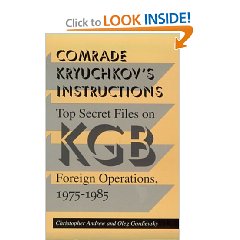
Imagine the CIA clandestine mentality and U.S. bureaucracy, as operated by a Soviet-style controlled regime. This is an eye-glazing but very professionally put together testimonial to the fact that much of what the KGB did was pedestrian, pointless, very expensive, and as weak on understanding foreign countries as the US.
The best current reference on Chinese intelligence,
April 8, 2000
Nicholas Eftimiades
Nick is an experienced sinologist who has worked at the Department of State, CIA, and DIA, and is also a naval reserve officer. His book is well-organized, well-researched, and essential reading for those who would understand how comprehensively the Chinese seek out scientific, technical, and military information in the United States, with a special emphasis on open sources of intelligence.
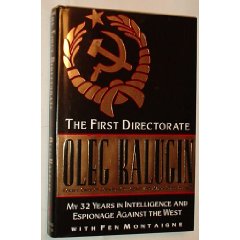
Oleg, now a green-card resident of the U.S. is our most personable and enjoyable former opponent on the intelligence speaking circuit, and both Bill Colby and I supported him in his efforts to move permanently to America. His book is a marvelous account on the general details of his formidable career that culminated in his being elected to the Russian Parliament. Page 222, “Kill the dog!”, has a special meaning for professionals the world over.
Credible Useful Insights Into Israeli Intelligence,
April 8, 2000
Victor Ostrovsky
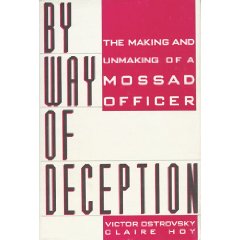
One of my atmospherics books, enjoyable for its description of Mossad training exercises for new Career Trainees, and for its insights into how Israeli fully integrates military assistance carrots and clandestine intelligence follow-ups. Some insights into Mossad's deliberate manipulation of U.S. intelligence and a few allegations regarding U.S. hostage situations where Mossad might have done more but chose not to.
This book is fun. It provides a look at the career of a KGB officer with a level of detail that makes one thing abundantly clear: the KGB and CIA are more alike than one might think, for the simply reason that they are both bureaucracies. Smoothly presented, enjoyable throughout.
Very special history highly relevant to present operations,
April 8, 2000
George C. Chalou
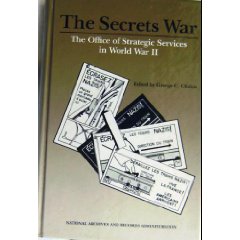
Twenty four distinguished authors, including Sir Robin Brook from England and William Colby, an original serving member of the OSS and later DCI, provide a really well-developed history of the OSS with special sections on OSS records and OSS research, as well as grouped contributions on OSS operations in various regional areas and reflections on today's circumstances. One contributor, Robin Winks, concludes that US intelligence (CIA) is not getting “the right stuff” now for four interlocking reasons: 1) academia by and large no longer cooperates with the intelligence community; 2) academia lost its interest in being helpful when it became apparent that the covert action tail was wagging the intelligence dog; 3) the intelligence community, apprehensive about recruiting from open institutions permitting violent war protests, made the clearance process so convoluted that it began averaging eighteen months; and 4) the agency began to recruit people who badly wanted to join and were willing to put up with a recruitment and clearance process that the best Yale students, the ones who withdrew from consideration, described as “curious, stupid, degrading, and off-putting”, with the result that the agency ultimate lost access to “the self-assured, the confident, the questioning, and the adventurous-precisely the qualities that has been so attractive to the OSS-in the process.” I myself know from discussions with the head of the office responsible for evaluating incoming Career Trainees, that the standard profile of a desirable candidate has always been “the company man” who goes along, except in two years-1979 and 1982-when they went after “self-starters.” Within five years, both those classes lost fifty percent of their numbers to resignation, and I believe that this problem continues to persist. I was in the 1979 class, and hung in there for nine years.
Vote on Review
Twenty four distinguished authors, including Sir Robin Brook from England and William Colby, an original serving member of the OSS and later DCI, provide a really well-developed history of the OSS with special sections on OSS records and OSS research, as well as grouped contributions on OSS operations in various regional areas and reflections on today's circumstances. One contributor, Robin Winks, concludes that US intelligence (CIA) is not getting “the right stuff” now for four interlocking reasons: 1) academia by and large no longer cooperates with the intelligence community; 2) academia lost its interest in being helpful when it became apparent that the covert action tail was wagging the intelligence dog; 3) the intelligence community, apprehensive about recruiting from open institutions permitting violent war protests, made the clearance process so convoluted that it began averaging eighteen months; and 4) the agency began to recruit people who badly wanted to join and were willing to put up with a recruitment and clearance process that the best Yale students, the ones who withdrew from consideration, described as “curious, stupid, degrading, and off-putting”, with the result that the agency ultimate lost access to “the self-assured, the confident, the questioning, and the adventurous-precisely the qualities that has been so attractive to the OSS-in the process.” I myself know from discussions with the head of the office responsible for evaluating incoming Career Trainees, that the standard profile of a desirable candidate has always been “the company man” who goes along, except in two years-1979 and 1982-when they went after “self-starters.” Within five years, both those classes lost fifty percent of their numbers to resignation, and I believe that this problem continues to persist. I was in the 1979 class, and hung in there for nine years.