

Chuck Spinney: Emile Nakhleh on Saudi Anger over Losing Influence — Iran Ascendant

05 Iran, 08 Wild Cards, Cultural Intelligence, Peace Intelligence
Chuck Spinney
Chuck Spinney

Saudi Anger Masks Concern About Loss of Influence

by Emile Nakhleh via IPS News, 13 November 2013

Saudi Arabia’s public anger against the United States masks the kingdom’s growing concern about its diminishing influence in the Persian Gulf and the wider Arab world.

It has nothing to do with U.S. policy toward the Palestinians, Washington’s seeming oscillation toward Syria, or President Barack Obama’s support for democratic transitions in “Arab Spring” countries and his hesitancy to support Mohamed Morsi’s removal from Egypt’s presidency through a military coup.

The Saudis are lashing out because they fear a possible U.S.-Iranian rapprochement would elevate Iran’s rightful position as the key power in the Persian Gulf and correspondingly reduce Saudi Arabia to a secondary role. The Saudi Kingdom would resist playing a second fiddle to Iran.

Continue reading “Chuck Spinney: Emile Nakhleh on Saudi Anger over Losing Influence — Iran Ascendant”

Chuck Spinney: Kurdistan Emergent

05 Iran, 08 Wild Cards, Cultural Intelligence, Peace Intelligence, Strategy
Chuck Spinney
Chuck Spinney

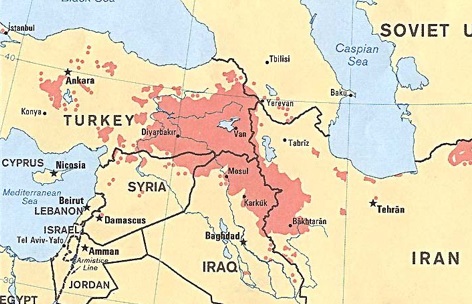
The below Reuters report describes one of the emerging regional complexities being unleashed by the Syrian civil war.  At issue is Syria's Kurdish Question — yet another legacy of the dissolution of the Ottoman Empire that continues to haunt the Middle East and the world after almost 100 years.  President Wilson's reckless promises of nationhood to all minorities in his 14 Points were not fulfilled by the machinations and back room deals of the Versailles Peace Conference in 1919.  Today the Kurds, with a population of about 25 million, are the world's largest ethnic group without a state.  But this population sits astride the modern borders Turkey, Iraq, Iran, and Syria, as the map below shows.  And so, the Kurdish Question is grounded in the tectonic fault lines of (1) Turkish-Arab-Persian-Kurdish cultures, (2) the shared Fertile Crescent water resources of the Tigris/Euphrates watershed, (3) the larger Sunni-Shia religious schism (most Kurds are Sunni, but some Kurds in Iran are Shia), (4) the wealth and poverty of the northern tier of the Persian Gulf oil basin, and (5) the toxic legacy of Western colonialism (including the Israeli poison pill inserted into the region by an opportunistic then guilt ridden West).  In recent years, most of the world's attention has been focused on the Kurdish subquestions in Turkey and Iraq, and to a lesser extent in Iran (don't forget the US sellout of the Iraqi Kurds with the help of the Shah of Iran, who had his own Kurdish problem), while Syria's Kurds have been the most forgotten of these minority questions — but as the attached report shows, the Syrian civil war has unleashed a new dimension to active Kurdish separatism that greatly complicates an already complicated regional situation.

Click on Image to Enlarge

Syrian Kurds' military gains stir unease

BY ERIKA SOLOMON AND ISABEL COLES

BEIRUT/ARBIL Mon Nov 11, 2013

(Reuters) – With a string of military gains across northeastern Syria, a Kurdish militia is solidifying a geographic and political presence in the war-torn country, posing a dilemma for regional powers.

Long oppressed under Syrian President Bashar al-Assad and his father before him, Kurds view the civil war as an opportunity to gain the kind of autonomy enjoyed by their ethnic kin in neighboring Iraq.

But their offensive has stirred mixed feelings, globally, regionally and locally, even among some fellow Kurds, who say the Kurdish fighters have drifted into a regional axis supporting Assad, something they deny.

Continue reading “Chuck Spinney: Kurdistan Emergent”

Berto Jongman: Bits, Bytes, & Stuff

Cultural Intelligence, Peace Intelligence
Berto Jongman
Berto Jongman

60 Terrorists Plots (Allegedly) Foiled in USA

Air Force of the Jihad

Blocking China with Land-Based Anti-Ship Missile Alliance

Chemical Warfare – Destroying the Last 20%

Cyberattacks Timeline (1-16 OCT 13)

Cybersecurity Threats Rising

Data Science Field Guide

Dataset of Political Regimes

DEBATE: Hayden versus Gellman on Leaderks versus Whistleblowers

DoD Chemtrail Handbook

Egyptian Intelligence

Gambling with Security

Global Human Right to Privacy

Invisible Bike Helmet (Swedish Women Invent)

Kennedy and Space Cooperation – 50th Anniversary

Stuxnet Infects Russian Nuclear Facility

Untold Story of War: US Veterans Face Staggering Epidemic of Unemployment, Trauma, & Suicide

US Military Suicide Rate

Viet-Nam Veteran Stereotype

Chuck Spinney: Bill Polk Primer on Syria

Cultural Intelligence, Peace Intelligence
Chuck Spinney
Chuck Spinney

Below is an excellent primer on Syria — its history, culture, and the ongoing civil war. It is written by my friend and historian William R. Polk. He has given his correspondents permission to distribute it … I strongly recommend it.

PDF (21 Pages): UNDERSTANDING SYRIA -PART I – POLK

William R. Polk was a Member of the Policy Planning Council, responsible for North Africa, the Middle East and West Asia, for 4 years under Presidents Kennedy and Johnson, Professor of History at the University of Chicago and President of the Adlai Stevenson Institute of International Affairs. He is the author of some 17 books on world affairs, including The United States and the Arab World; The Elusive Peace, the Middle East in the Twentieth Century; Understanding Iraq; Understanding Iran; Violent Politics: A History of Insurgency and Terrorism; Neighbors and Strangers: The Fundamentals of Foreign Affairs and numerous articles in Foreign Affairs, The Atlantic, Harpers, The Bulletin of the Atomic Scientists and Le Monde Diplomatique . He has lectured at many universities and at the Council on Foreign Relations, Chatham House, Sciences Po, the Soviet Academy of Sciences and has appeared frequently on NPR, the BBC, CBS and other networks.

NIGHTWATCH: Syria-Saudi Arabia – New “Fighting Force” Funded by Saudis, Trained by Pakistanis

04 Inter-State Conflict, 05 Civil War, Peace Intelligence

Syria-Saudi Arabia: Two western news services reported this week that Saudi Arabia is preparing to finance the training and arming of a new Syrian non-jihadi rebel force. The force is to be built around the Jaish al-Islam (Army of Islam) which was created in September 2013 by a merger of 43 fighting groups.

According to the news services, Saudi Arabia reportedly has hired Pakistan to help train the re-purposed force. It supposedly would start as two brigades and would be supplied through Jordan. It would not be jihadist, but also would not be a secular force.

Comment: If this information is accurate, it implies that the Saudis judge the fighting will go one for two more years because that is about how long it would take to develop an effective fighting force. By that time, the Syrian government is likely to have stabilized the security situation or, less likely, to have fallen to the jihadists.

The amount of time, energy and multi-national coordination required in this effort, with highly uncertain prospects for a return on the investment, plus the direct involvement of Jordan as pivotal to the logistics raise suspicions that this is not a serious initiative. Rather it looks like a perception management stratagem to prompt more US assistance, if not intervention.

Berto Jongman: Foreign Affairs on Causes of Civil War

Cultural Intelligence, Peace Intelligence
Berto Jongman
Berto Jongman

States of War

How the Nation-State Made Modern Conflict

Andreas Wimmer

Foreign Affairs, 7 November 2014

To explain recent conflicts in countries such as Syria or Sudan, observers have been quick to point their fingers at proximate causes specific to our times: the power vacuum created by the end of the Cold War offered opportunities for rebels to fill the void; the recent globalization of trade flooded the developing world with cheap arms; rising global consumer demand generated new struggles over oil and minerals; jihadist groups spread using networks of fighters trained in Afghanistan and Pakistan.

Yet such explanations miss a bigger picture. If we extend the time horizon beyond the Cold War to include the entire modern period — from the American and French revolutions to today — we can see repeating patterns of war and conflict. These patterns are related to the formation and development of independent nation-states.

Read full article.

Continue reading “Berto Jongman: Foreign Affairs on Causes of Civil War”

Marcus Aurelius: Five Takeaways from a Decade of War [Defense One] Plus Blistering Alternative View from Phi Beta Iota Editors

Ethics, Military, Peace Intelligence, Strategy
Marcus Aurelius
Marcus Aurelius

Five Takeaways from a Decade of War

Secretary of Defense Chuck Hagel, in a keynote address at the Center for Strategic and International Studies this week, signaled to military commanders that they should assume the across-the-board, automatic spending cuts imposed by sequester over the next decade will remain in place indefinitely. “We do not have the option of ignoring reality, or assuming something will change.” Before they decide how to shrink U.S. military forces and allocate scarce resources, however, uniformed leaders will have to decipher the lessons of the wars in Iraq and Afghanistan and how to apply them to the coming era of austerity and global instability.

Hagel gave a preview of his own thinking when he argued that the Pentagon should protect investments in cutting edge technologies that are central to the evolving, network-centric model of warfare honed in those conflicts — to include space systems, cyber capabilities, “ISR” (intelligence, surveillance, and reconnaissance), and special operations forces (SOF).

Following Hagel’s speech, three senior retired generals offered their own thoughts on battlefield lessons. Here are five takeaways from the discussion by Gen. James Cartwright, former vice chairman of the Joint Chiefs of Staff; Gen. Peter Chiarelli, former vice chief of the Army; and Gen. Ronald Fogleman, former chief of staff of the Air Force.

Continue reading “Marcus Aurelius: Five Takeaways from a Decade of War [Defense One] Plus Blistering Alternative View from Phi Beta Iota Editors”

noble gold
