In May 2012 Caesar Acellam, a commander of the Lord's Resistance Army (LRA) and military strategist for the extremist group's leader Joseph Kony, was captured by the Ugandan army. The act appeared to be a coup for local forces that had for nearly three decades — along with multiple regional governments and the 100 US special forces soldiers sent in 2012 — failed to thwart the militant group's leader, a man wanted by the International Criminal Court for crimes against humanity including the abduction of tens of thousands of children.
The capture of one of his top-ranking commanders was made possible, in part, because local forces suddenly knew where to look. Kony's men could not hide from a constellation of five ever-watchful satellites put into orbit by satellite imagery and geospatial analytics firm DigitalGlobe.
The Internet of Things is coming, but so far it's a fragmented mess. In order for it to work the way it's envisioned, some coopetition may be in order. The business models that reward innovation, that are open, and that are fully interoperable at all levels are the ones that will be successful. The Internet of Things will come into being only when the interoperability challenges are conquered.
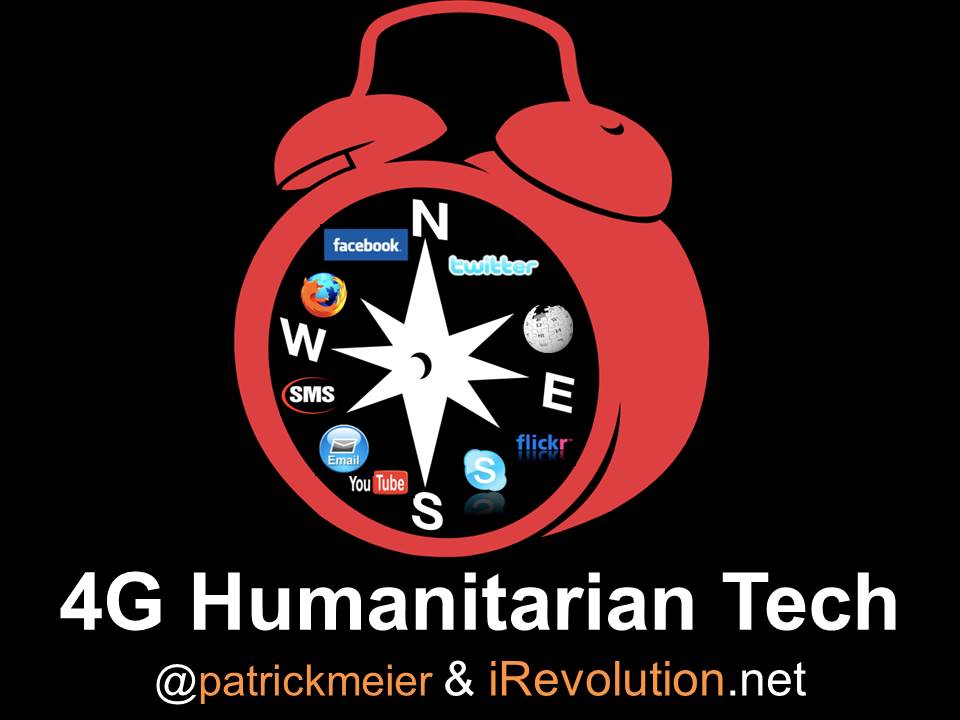
ROBERT STEELE: I had the pleasure of listening to Dr. Patrick Meier speak at the National Defense University (NDU) this past Thursday. He is based in Qatar because the US Government is not very good at spotting, assessing, recruiting, and respecting world-class individual talents. Patrick is a global asset. What he knows about humanitarian technology is priceless. Below is Patrick's “long” briefing, 99 slides, with words in Notes format.
During the Q&A one of the NDU staff asked Dr. Meier if he had considered asking NSA for help [I don't make this stuff up.] In the ensuing discussion what was really clear to me is that the the pioneers in humanitarian technology not only do not need anything NSA has to offer, but they are far advanced — vastly advanced — beyond anything the US secret intelligence community is capable of doing. CLARIFICATION BY DR. MEIER: Point is we don't need half as advanced tech/methods to do what we currently need to do, much of this commercially available already and slowly coming to open source world as well.
Among the highlights for me personally:
01 Every image taken by a cell phone is capable of having the geospatial coordinates and the time and date stamped within the image. This feature is turned off on most cell phones. We need to find a way for individuals to be able to easily activate the feature. If we can ever get The Virgin Truth off the ground, I'd like to see the OpenBTS cell phones given out free pre-set to this function — its value in relation to early warning on crop or animal disease as well as very rapid situational awareness when many images are coming is, cannot be exaggerated.
02 When humanitarian technologist talk about geo-tagging, they are talking about hash-tags and words added by the sender they are NOT talking about embedded geospatial code. Some in the audience did not appear to understand this distinction, at least one clearly did.
03 Some — at least as represented in this room by the most talkative among a small handful — are spectacularly ignorant about what NSA cannot and does not do, and about the limitations of big data (legacy) versus big data (real time). They are particularly limited in understanding that one human brain is vastly more powerful than any single NSA computer, and that a thousand or ten thousand or a hundred thousand human minds, organized voluntarily and coherently
There are very few people that I consider spectacularly gifted and relevant to the creation of a World Brain and Global Game. Medard Gabel is one of them. Patrick Meier is another.
The article titled How an Entirely New, Autistic Way of Thinking Powers Silicon Valley on Wired discusses the possibility of a new way of thinking. “Pattern thinkers”, those who think in patterns, whether consciously or unconsciously, are separated from “picture thinkers”, who are more aware of aesthetics. The article cites such famous examples from history as Van Gogh, whose paintings of the stormy night sky matches the formula later discovered for turbulence in liquid and Jackson Pollock, whose abstract painting style involved flinging streaks of paint onto massive canvases which were later found to be coherent fractal patterns. The article explains,
“Michael Shermer, a psychologist, historian of science, and professional skeptic – he founded Skepticmagazine — called this property of the human mind patternicity. He defined patternicity as “the tendency to find meaningful patterns in both meaningful and meaningless data.” …The three kinds of minds — visual, verbal, pattern thinkers — naturally complement one another. When I recall collaborations in which I’ve successfully participated, I can see how different kinds of thinkers worked together to create a product that was greater than the sum of its parts.”
The article argues that it is finding the balance of these three types that has made for the great innovations, such as Pixar– and the lack of balance that has spelled out disaster for other projects, (the article cites the IPhone 4 antennae). We are not sure if this is a positive or a negative approach.
By creating a new and innovative way to look at massive amounts of patient data worldwide, one man hopes he can change the way public health crises are managed, as Cynthia Graber reports.
Imagine you are a foreign aid worker trying to persuade a senior politician in a developing world country to introduce a pneumococcus vaccination programme. It’s not just a case of stressing how the bacterium causes diseases including pneumonia, meningitis, and sinusitis, and kills over a million children under the age of five every year worldwide. The politician has to decide how to allocate scant resources. How does the death toll compare with malaria and AIDS? Aren't road traffic accidents a bigger problem? Has vaccination been a success in neighbouring countries?
These statistics exist, but you don't have the relevant reports and academic papers to hand. And even when you do have the information, a list of numbers may not the best way to express the strength of your case.
By creating new and innovative visual displays out of oceans of data, Christopher Murray hopes his tool can change this situation for the better. Called GBD Compare, users can rapidly determine which diseases are most harmful to children in Africa, or view how the developing and developed worlds compare in terms of heart disease, all with a few clicks of a computer mouse.
The data viz tool processes data from the Global Burden of Disease (GBD) report, which compiles statistics, charts and graphs on causes of death and disease. “The thing that’s really neat about the visualisations is they allow people to see the problem in context – in the context of all the other problems, how it’s changing over time, how it compares to other countries,” says Murray, director of the Institute for Health Metrics Evaluation (IMHE), based in Seattle.
When Murray shows this tool to people outside the academic world of public health, Murray says, they immediately get it. “That just totally changes who you can engage in a thoughtful discussion about what are the key health problems and where they’re going,” he says.
The new tool has the enthusiastic backing of no less an advocate than Bill Gates, and, just three months after its launch, it's already leading to changes in health policies.
Samsung’s millimeter-wave transceiver technology could enable ultrafast mobile broadband by 2020
By Ariel Bleicher
IEEE Spectrum, 13 Jun 2013
Clothes, cars, trains, tractors, body sensors, and tracking tags. By the end of this decade, analysts say, 50 billion things such as these will connect to mobile networks. They’ll consume 1000 times as much data as today’s mobile gadgets, at rates 10 to 100 times as fast as existing networks can support. So as carriers rush to roll out 4G equipment, engineers are already beginning to define a fifth generation of wireless standards.
What will these “5G” technologies look like? It’s too early to know for sure, but engineers at Samsung and at New York University say they’re onto a promising solution. The South Korea–based electronics giant generated some buzz when it announced a new 5G beam-forming antenna that could send and receive mobile data faster than 1 gigabit per second over distances as great as 2 kilometers. Although the 5G label is premature, the technology could help pave the road to more-advanced mobile applications and faster data transfers.
MACDILL AIR FORCE BASE, Fla., June 3, 2013 – About 100 people are hard at work at the U.S. Special Operations Command headquarters here on a new plan that will operationalize the way the command provides manpower and capability in support of the new defense strategic guidance.
Click on Image to Enlarge
The plan, due to the Joint Staff in late August, is part of the Special Operations Command 2020 vision Navy Adm. William H. McRaven introduced shortly after taking the helm as Socom commander in 2011.The building of a global network of special operations forces, as well as U.S. government partners and partner nations, is a major component of Socom 2020, McRaven explained during the Special Operations Forces Industry Conference in Tampa, Fla., earlier this month.
McRaven’s Socom 2020 vision calls for a globally networked force of special operations forces, interagency representatives, allies and partners, with aligned structures processes and authorities to enable its operations. Globally networked forces, he said, will provide geographic combatant commanders and chiefs of mission with an unprecedented unity of effort and an enhance ability to respond to regional contingencies and threats to stability.
McRaven noted his own experience working with the Joint Special Operations Command in Afghanistan. “It has been interesting to work in a network like that, and we do that very, very well on the direct action side,” he said. “We need to figure out — and it is part of the Socom plan — how do we take that network, and be able to extend that out to the theater special operations commands,” down to special operations forward elements and forces assigned to them.