World IA Day 2012 is about bringing the Information Architecture community together. We’re fostering links within local communities and on a global scale. We’re sharing information, ideas and research. And we’re doing it through unconventional, exciting and engaging IA events this February.
The first ever World IA Day focuses on Designing Structures for Understanding. On February 11, 2012, we’re hosting WIAD events in 14 cities across all corners of the globe. Learn from world-class IA minds, network, showcase new ideas and attend events tailored specifically to your community. We hope you’ll join us at an event near you this February!
Local Connections. Global Impact. World IA Day 2012
For entities around the globe, identifying potential fraud and corruption activities in large volumes of data has historically been difficult and quite costly. More often than not, the rich insights within that data may be difficult to identify by traditional means and remain hidden.
Against this backdrop, practitioners are turning to visual analytic tools and techniques. Graphically representing and exploring data can bring clarity to executives’ concerns and to performance improvement opportunities.
Visual analytics tools and techniques, including social networking diagrams, link analysis, geospatial analysis and tree maps, can help to focus investigations on particular activities and connect disparate pieces of information to form a cohesive story. Entities should consider equipping their personnel to employ these techniques to meet the growing challenge of reducing corruption, fraud, waste and abuse in the enterprise.
Download the PDF below to learn more. Two versions are provided to accommodate your viewing preferences: a standard version for printing and a screen version for reading on your computer or mobile device.
Phi Beta Iota: This is not new–they are roughly fifteen years behind Dr. Bert Little, who pioneered this work for the Department of Agriculture, virtually eradicating crop insurance fraud ($4 million invested stopped $80 million a year in fraud). Dr. Little received a Golden Candle Award at OSS '94 and continues to do extraordinary detection of corruption with clever computing across the Texas A&M University System.
The proliferation of drones throughout the military — and into civilian law enforcement — can make it feel like we’re living in an airborne panopticon. But flying robots are agnostic about who they train their gaze upon, and can spy on cops as easily as they can spy on civilians.
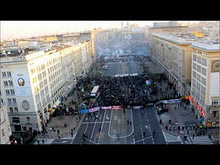
In the video above, protesters in Warsaw got a drone’s eye view of a phalanx of police in riot gear during a heated Saturday demonstration. The drone — spotted by Wired editor-in-chief and drone-builder Chris Anderson — was a tiny Polish RoboKopter equipped with a videocamera.
As Chris observes, no more do citizens need to wait for news choppers to get aerial footage of a major event. With drones, they can shoot their own overhead video. But the implications run deeper than that.
The Occupy events around the country gained initial notoriety by filming and uploading incidents of apparent police brutality. Anyone with a cellphone camera and a YouTube account could become a videographer, focusing attention on behavior that cops or banks might not want broadcasted or that the media might not transmit. When the New York Police Department cleared out Zuccotti Park on Tuesday, out came the cellphones to document it.
Bzzztttpppow
Getting an aerial view is the next step in compelling DIY citizen video.
Phi Beta Iota: The expensive stupid solution for anti-UAV countermeasures is gattling guns, lasers, and other such military-industrial crap. Clever people build their own electro-magnetic pulse umbrellas, here is just one of the options, see more at EMP/HERF/Shock Pulse Generators from Information Unlimited.
UNESCO Global Open Access Portal launched “The Global Open Access Portal (GOAP) presents a snapshot of the status of Open Access (OA) to scientific information around the world. For countries that have been more successful in implementing Open Access, the portal highlights critical success factors and aspects of the enabling environment. For countries and regions that are still in the early stages of Open Access development, the portal identifies key players, potential barriers and opportunities. The portal has country reports from over 148 countries with weblinks to over 2000 initiatives/projects in Member States. The portal is supported by an existing Community of Practice (CoP) on Open Access on the WSIS Knowledge Communities Platform that has over 1400 members.”
Quantcast makes it easy to see the largest one million sites in the US (by traffic). There's a signficant consolidation going on, with the vast majority of popular sites being owned and controlled by larger, public companies.
Because onine traffic follows, as most things do, a power law curve, the top 100 sites account for a huge amount of overall web traffic–probably more than the next 900 sites combined.
After removing public companies and those that only do commerce, here are the thirty independent companies on the top 100:
Do new information and communication technologies (ICTs) empower repressive regimes at the expense of civil society, or vice versa? For example, does access to the Internet and mobile phones alter the balance of power between repressive regimes and civil society? These questions are especially pertinent today given the role that ICTs played during this year’s uprisings in Tunisia, Egypt and beyond. Indeed, as one Egyptian activist stated, “We use Facebook to schedule our protests, Twitter to coordinate and YouTube to tell the world.” But do these new ICTs—so called “liberation technologies”—really threaten repressive rule? The purpose of this dissertation is to use mixed-methods research to answer these questions.
We live in the Information Age. But I’ve never heard — nor would any sane person suggest — that we live in the Useful Information Age. The modern downpour of data is largely worthless distraction, and the sheer amount is drowning us. Of all of the ways in which the contemporary environment is mismatched with our genes and harms our emotional health, I believe the revolution in information delivery is the one most responsible for epidemic depression. Research so far is sparse but indicative: a 2005 Swedish study, for example, found associations between heavy communications technology use and “prolonged stress,” sleep disturbances and depressive symptoms in young adults.
. . . . . .
When the amount of low-quality information coming at people exceeds certain real but difficult-to-quantify limits, they suffer. They are likely to ignore or forget information they need and to be less in control of their lives as a result. Neuroscientist Torkel Klingberg’s excellent 2008 book, The Overflowing Brain: Information Overload and the Limits of Working Memory, cites research showing that “there is a fixed capacity for human beings to receive information, and that this limit lies at around seven items,” a number routinely exceeded in the modern workplace, leading to forgetfulness, distractability and disorganization. In the long term, bad-information overload increases stress, with many negative consequences for physical and emotional health.