SchwartzReport: Why Is US Internet So Bad?

IO Impotency
Stephan A. Schwartz
Stephan A. Schwartz

One of America's central myths is that we lead the world technologically. Anyone who travels out of the country knows how bogus this is and how, in so many ways — roads, bridges, airports, healthcare, education, childcare, life-expectancy, happiness, high speed trains and, yes, internet — Americans live a second world quality of life. This is an excellent assessment of the internet situation and it explains why it has h! appened. Once again monopolistic corporate interests that control the government have blocked the well-being of the many in order to maintain the profit for the few.

Why Is American Internet So Slow?

JOHN AZIZ , Business and Economics Correspondent – The Week

The country that literally invented the internet is now behind Estonia in terms of download speeds

According to a recent study by Ookla Speedtest, the U.S. ranks a shocking 31st in the world in terms of average download speeds. The leaders in the world are Hong Kong at 72.49 Mbps and Singapore on 58.84 Mbps. And America? Averaging speeds of 20.77 Mbps, it falls behind countries like Estonia, Hungary, Slovakia, and Uruguay.

Its upload speeds are even worse. Globally, the U.S. ranks 42nd with an average upload speed of 6.31 Mbps, behind Lesotho, Belarus, Slovenia, and other countries you only hear mentioned on Jeopardy.

Read full article.

Berto Jongman: EU Intelligence Analysis Centre (Interview)

IO Impotency, Peace Intelligence
Berto Jongman
Berto Jongman

Ilkka Salmi, the EU’s spymaster

Information on the latest developments in Ukraine is of utmost importance for European policy makers. A crucial player in this field is the EU Intelligence Analysis Centre (INTCEN), the EU’s own intelligence hub in Brussels. Director Ilkka Salmi: ‘Our reporting helps the European External Action Service and other European institutions to formulate policies towards crisis hotspots in the world today.’

Read full interview

Continue reading “Berto Jongman: EU Intelligence Analysis Centre (Interview)”

Berto Jongman: Project Censored 2014

Corruption, Cultural Intelligence, IO Impotency, Media
Berto Jongman
Berto Jongman

Every year since 1976, Project Censored, our nation's oldest news-monitoring group–a university-wide project at Sonoma State University founded by Carl Jensen, directed for many years by Peter Phillips, and now under the leadership of Mickey Huff–has produced a Top-25 list of underreported news stories and a book, Censored, dedicated to the stories that ought to be top features on the nightly news, but that are missing because of media bias and self-censorship.

Censored 2014: Fearless Speech in Fateful Times; The Top Censored Stories and Media Analysis of 2012-13

Stephen E. Arnold: People Share Without Reading….

Cultural Intelligence, IO Impotency
Stephen E. Arnold
Stephen E. Arnold

People Are Too Busy To Read

The Internet is good for many things, especially generating tera-quads of content. News, social media content, videos, etc. pop up every second and people simply do not have the time to read it. The Verge posted the tongue-in-cheek article, “You’re Not Going To Read This” and it talks about the skyrocketing amount of content. The CEO of Chartbeat Tony Haile dropped a bomb for companies that specialize in content, “We’ve found effectively no correlation between social shares and people actually reading [an article].”

What a smack in the face!

People wear tweet and shared numbers like Girl Scout badges. If this has no value, what is the point of having a social media specialist? It’s not that generating content is bad, but people do not have the time to read every article. They usually skim the headlines and tweet without reading what they send. It really is a data overload.

Continue reading “Stephen E. Arnold: People Share Without Reading….”

Berto Jongman: Springer & IEEE Quality Control? No. 120 Computer-Generated Gibberish Papers

IO Impotency
Berto Jongman
Berto Jongman

Publishers withdraw more than 120 gibberish papers

Conference proceedings removed from subscription databases after scientist reveals that they were computer-generated.

Richard Van Noorden

Nature,

The publishers Springer and IEEE are removing more than 120 papers from their subscription services after a French researcher discovered that the works were computer-generated nonsense.

Continue reading “Berto Jongman: Springer & IEEE Quality Control? No. 120 Computer-Generated Gibberish Papers”

Stephen E. Arnold: Quote to Note: Open Source Is a Little Pregnant as in Sort of but Not Really

IO Impotency
Stephen E. Arnold
Stephen E. Arnold

Quote to Note: Open Source Is a Little Pregnant

I came across “Why Is Atom Closed Source?” The thread had a very interesting statement from mojombo. I quote:

Atom won’t be closed source, but it won’t be open source either. It will be somewhere inbetween, making it easy for us to charge for Atom while still making the source available under a restrictive license so you can see how everything works. We haven’t finalized exactly how this will work yet. We will have full details ready for the official launch.

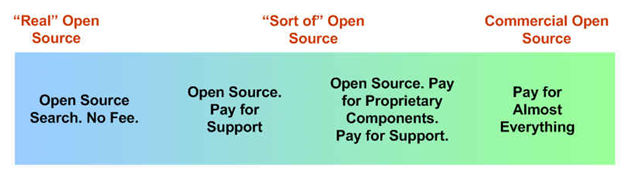
Several years ago I gave a talk and used this diagram to illustrate the spectrum of open source search software:

open source range

Some of my information explaining the diagram turned up in an azure chip consulting firm report. Well, that’s how the semi straight consulting firms work.

Continue reading “Stephen E. Arnold: Quote to Note: Open Source Is a Little Pregnant as in Sort of but Not Really”

Richard Clarke: 10 Observations on US Intelligence Gathering – Robert Steele on What Clarke Does Not Mention

IO Impotency
Richard Clarke
Richard Clarke

Richard Clarke at RSA Conference: 10 Observations on US Intelligence Gathering

A veteran counter-terrorism advisor and Presidential Review Group member on Intelligence gives his executive summary

I'm in San Francisco this week to attend the RSA security conference, and to cover the Cloud Security Alliance summit for security professionals. The CSA is a terrific organization, a non-profit founded with the purpose of promoting best security practices for cloud computing. I've watched this summit grow over the years commensurate with the increase in visibility of cloud security concerns, and once again attendees filled up the largest venue yet.

The opening keynote speaker was Richard A. Clarke, chairman and CEO of Good Harbor and former advisor to several presidents on counter-terrorism subjects. His keynote was based on his tenure last fall on the highly select Review Group on Intelligence and Communications Technology requested by President Obama in the wake of the Snowden revelations. (There were only five men in this group.) Given carte blanche intelligence clearance to every program, this group issued a 300-page unclassified report*, with 46 recommendations on intelligence collection, specifically how the United States should improve privacy and civil liberties while continuing to protect national security. Clarke’s short but very interesting keynote focused on his takeaways and his top 10  observations in the 46 recommendations.

His big-picture takeaway was that “In terms of collecting intelligence, (the NSA and other intelligence agencies) are very good – far better than you can imagine. But they have created the potential for a police surveillance state.” As a result, the task of controlling them is more urgent than it ever was. The group found that the intelligence agencies were full of very talented individuals dedicated to the protection of the United States and its allies. What they did not find “was a bunch of people randomly (reading) your emails.” But the potential is there.

Here are 10 key observations from a Washington veteran who had the opportunity to see everything under the intelligence kimono.

Continue reading “Richard Clarke: 10 Observations on US Intelligence Gathering – Robert Steele on What Clarke Does Not Mention”

noble gold