
Comprehensive yet crafted concise solutions to restore democracy and the Republic.
20120702 Open Source Everything Highlights
Highlights
Open Source Everything
—
Open Source
How Red Hat Decides Which Open Source Companies To Buy
Continue reading “20120702 Open Source Everything Highlights”
The Open Source Everything Manifesto: Chapter 7 Public Intelligence and the Citizen Extract II
Manifesto Extracts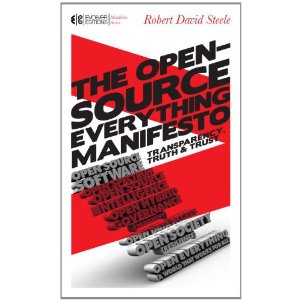
The Open Source Everything Manifesto: Chapter 7 Public Intelligence and the Citizen Extract II
The U.S. Government has been controlled by a two-party tyranny that has always been corrupt, but this corruption went nuclear in the 1990's when both parties conspired to start borrowing one trillion dollars a year–one third of the federal budget–so as to keep on handing out taxpayer funds (or taxpayer obligations for borrowed funds) to the special interests funding their perpetual grip on power to the exclusion of Independents and the other four accredited but excluded active national political parties (Constitution, Green, Libertarian, Reform).
[This book provides the analytic model developed by the Earth Intelligence Network, a 501c3 dedicated to the ideal of public intelligence in the public interest.]
Note that fifty percent or more of our national resources are being wasted for lack of both intelligence (sound decision-making) and integrity (massive corruption across all three branches of the federal government–Congress, the Executive, and more most recently the Supreme Court). For this short manifesto, I will only comment generally, with examples centered in three areas:
1. Corruption
2. Analytic Ignorance
3. True-Cost Ignorance
By the Case: The Open Source Everything Manifesto
Review of the Book by Ralph Peters … Manifesto Extracts at Phi Beta Iota … Book Page at Amazon . Book Page at Barnes & Noble . Book Page at McNallyRobinson . Book Page at North Atlantic Books (Publisher) . Book Page at Powell’s Books . Book Page at Random House . Book Page at Super Book Depot
DefDog: Karl Popper’s Open Society as “Root”
Knowledge, Politics
There are a lot of pearls of wisdom in here. If I find the list or good notes, will build on this.
Karl Popper-OpenSociety-804 Pages
GoodReads/Karl R. Popper > Quotes
Extracts & Critical Commentary Volume I
Extracts & Critical Commentary Volume II
Ron Powell with Michael Saylor: The Impact of the Mobile Wave
Advanced Cyber/IO, Knowledge
The Impact of the Mobile Wave: A Spotlight Q&A with Michael Saylor of MicroStrategy
This BeyeNETWORK Spotlight features Ron Powell's interview with Michael Saylor, Chairman of the Board, President and CEO of MicroStrategy, and author of the recently released book, The Mobile Wave. Ron and Michael discuss the changes we will experience – and benefit from – as the mobile wave advances throughout the world.
BeyeNETWORK Spotlights focus on news, events and products in the business intelligence ecosystem that are poised to have a significant impact on the industry as a whole; on the enterprises that rely on business intelligence, analytics, performance management, data warehousing and/or data governance products to understand and act on the vital information that can be gleaned from their data; or on the providers of these mission-critical products.
Presented as Q&A-style articles, these interviews conducted by the BeyeNETWORK present the behind-the-scene view that you won’t read in press releases.
Michael, congratulations on your new book The Mobile Wave. Why did you feel it was time to write this book?
Michael Saylor: Ron, I think every ten years or so there's something really exciting in the information technology business. We’ve had the mainframe wave, the mini-computer wave, the personal computer (PC) wave, and then the Internet wave. I thought about writing a book around the Internet wave, but I was busy taking my company public and I didn't really have the time.
Now, along comes the mobile wave. It’s the fifth wave, I think, of computing. I feel this is my chance to actually put down in book form my thoughts about the history of science and how things all relate to this current mobile wave, and I may not get another chance in my lifetime. It's my first book, and I'm excited about it.
For readers of The Mobile Wave, what is the most surprising thing they will learn?
Continue reading “Ron Powell with Michael Saylor: The Impact of the Mobile Wave”
Patrick Meier: Evolution in Live Mapping: The 2012 Egyptian Presidential Elections
Geospatial, Knowledge
Evolution in Live Mapping: The 2012 Egyptian Presidential Elections
My doctoral dissertation compared the use of live mapping technology in Egypt and the Sudan during 2010. That year was the first time that Ushahidi was deployed in those two countries. So it is particularly interesting to see the technology used again in both countries in 2012. Sudanese activists are currently using the platform to map #SudanRevolts while Egyptian colleagues have just used the tool to monitor the recent elections in their country.
Analyzing the evolution of live mapping technology use in non-permissive environments ought to make for a very interesting piece of research (any takers?). In the case of Egypt, one could compare the use of the same technology and methods before and after the fall of Mubarak. In 2010, the project was called U-Shahid. This year, the initiative was branded as the “Egypt Elections Project.”
According to my colleagues in Cairo who managed the interactive map, “more than 15 trainers and 75 coordinators were trained to work in the ‘operation room' supporting 2200 trained observers scattered all over Egypt. More than 17,000 reports, up to 25000 short messages were sent by the observers and shown on Ushahid’s interactive map. Although most reports received shown a minimum amount of serious violations, and most of them were indicating the success of the electoral process, our biggest joy was being able to monitor freely and to report the whole process with full transparency.”
Contrast this situation with how Egyptian activists struggled to keep their Ushahidi project alive under Mubarak in 2010. Last week, the team behind the current live map was actually interviewed by state television (picture above), which was formerly controlled by the old regime. Interestingly, the actual map is no longer the centerpiece of the project when compared to the U-Shahid deploy-ment. The team has included and integrated a lot more rich multimedia content in addition to data, statistics and trends analysis. Moreover, there appears to be a shift towards bounded crowdsourcing rather than open crowd-sourcing as far as election mapping projects go.
Berto Jongman: Top 40 Useful Sites to Learn New Skills
Knowledge, P2P / Panarchy
Top 40 Useful Sites To Learn New Skills
The web is a powerful resource that can easily help you learn new skills. You just have to know where to look. Sure, you can use Google, Yahoo, or Bing to search for sites where you can learn new skills
Here are the top 40 sites I have personally used over the last few years when I want to learn something new.
- Hack a Day – Hack a Day serves up fresh hacks (short tutorials) every day from around the web and one in-depth ‘How-To hack’ guide each week.
- eHow – eHow is an online community dedicated to providing visitors the ability to research, share, and discuss solutions and tips for completing day-to-day tasks and projects.
- Wired How-To Wiki – Collaborate with Wired editors and help them build their extensive library of projects, hacks, tricks and tips. Browse through hundreds how-to articles and then add to them, or start a new one.
- MAKE Magazine – Brings the do-it-yourself (DIY) mindset to all of the technology in your life. MAKE is loaded with cool DIY projects that help you make the most of the technology you already own.
- 50 Things Everyone Should Know How To Do – While not totally comprehensive, here is a list of 50 things everyone should know how to do. It’s a great starting point to learn new skills.
- wikiHow – A user based collaboration to build and share the world’s largest, highest quality how-to manual.
- Lifehacker – An award-winning daily blog that features tips, shortcuts, and downloads that help you get things done smarter and more efficiently.
- 100+ Google Tricks That Will Save You Time – Today, knowing how to use Google effectively is a vital skill. This list links out to enough Google related resources to make you an elite Google hacker.
- Instructables – Similar to MAKE, Instructables is a web-based documentation platform where passionate people share what they do and how they do it, and learn from and collaborate with others as the tackle new projects and learn new skills.
- Merriam-Webster Online – In this digital age, your ability to communicate with written English is paramount skill. And M-W.com is the perfect resource to improve your English now.
