Build Power & Show Power through Mass Participatory Bold Action
To show our power, on May 1st, 2012, we will be organizing for such a mass participatory and bold collective action: a national general strike, mass boycott, student strike/ walk-out and mass day of action. We will be organizing within our unions- or informal workplace organizations where there’s no union or the union isn’t supportive- to hold a one-day general strike. Where a strike is not possible, we will be organizing people to call in sick, or take a personal day, as part of a coordinated “sick-out”. Those who are students will be walking-out of their schools (or not showing up in the first place). In the community, we will be holding a mass boycott and refusing to make any purchase on that day.
We, the 99%, will build our power and show our power until we've occupied our workplaces, our communities, our schools, our lives, our world… until we've occupied everything!
IN 1984, after serving three terms in the House of Representatives, Ron Paul was defeated by Phil Gramm in Texas’s Republican Senate primary. Paul left Congress, and a few years later he left the Republican Party entirely to run for president on the Libertarian line. In the 1988 election, after a campaign that Texas Monthly compared to something “out of Robert Altman’s movie ‘Nashville,’ ” he took home just 0.47 percent of the popular vote.
Thus marginalized by the public, the former congressman proceeded to marginalize himself. Through the various newsletters that bore his name — most notably the Ron Paul Political Report and the Ron Paul Survival Report — he spent the early 1990s as a peddler of far-right paranoia. In an exhaustive 2008 piece for Reason magazine, Dave Weigel and Julian Sanchez argued that the most abhorrent language in Paul’s eponymous newsletters — the claims that the Rev. Martin Luther King Jr. “seduced under-age girls and boys,” that AIDS sufferers “enjoy the attention and pity,” and so on — weren’t actually written by the man himself. But the fact that they had Paul’s imprimatur suggests that the former congressman had grown comfortable way out on the xenophobic fringe.
THE FUTURE IS A KIND OF HISTORY THAT HASN'T HAPPENED YET
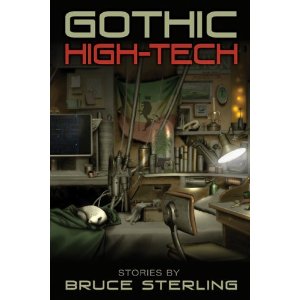
“He’s the legendary Cyberpunk Guru. He roams our postmodern planet, from the polychrome tinsel of Los Angeles to the chicken-fried cyberculture of Austin… From the heretical Communist slums of gritty Belgrade to the Gothic industrial castles of artsy Torino… always whipping that slider-bar between the unthinkable and the unimaginable.
“He’s a Californian design visionary. He’s an European electronic-art curator. He’s a Swiss professor of media philosophy. He’s a Prophet of Augmented Reality, even. He’s an author, journalist, editor, critic, theorist, futurist, and blogger. Obviously he’s pretty much anything that he can get his hands on.
Amazon Page
“And he never stops typing. This sixth collection of his fantastic stories is a comic arsenal of dark euphoria. It’s even weirder, harsher and more twisted than the scary decade that inspired it. Boy, that’s saying something.”
“There have been many resistance movements throughout history which have made use of the occupation tactic. In the United States, the unemployed Coxey’s Army, which marched across the country decrying injustice and unemployment in 1894, camped out throughout the summer as they converged upon Washington. In the summer of 1932, tens of thousands of WWI veterans and their families occupied parks, military bases and a number of public buildings in Washington D.C., demanding the immediate cash payment of their service certificates, referred to as a ‘bonus’. These ‘Bonus Marchers’ shut down much of the city, and faced the police in camp evictions similar to those we saw this year. In the Depression, many Hoovervilles—the shanty towns of tents and temporary structures built by the homeless–had serious political content, as portrayed in Steinbeck’s Grapes of Wrath, that is often washed out of the history books. Though a less-favored tactic in the 60s, many university buildings–most famously at Berkeley, Columbia and University of Wisconsin, but occurring all over the country–were occupied at the height of the anti-war movement. At the time of his assassination, Martin Luther King, Jr. was planning a tent-city occupation of Washington D.C as the first step of his Poor People’s Campaign. Fellow organizers went ahead with the plan, and ‘Resurrection City’ took over the Mall for more then a month in May-June of 1968.
In the last thirty years, occupation has been a key tactic in many of the anti-globalization struggles throughout the world. Started in the eighties, but truly gaining momentum and size throughout the nineties, the Movimento dos Trabalhadores Sem Terra (The Landless Workers Movement) in Brazil redistributes farmlands through occupation. Sem Terra gives strategic and material support to landless tenant farmers. From dozens to thousands of itinerant farmers and their families will occupy fallow or abandoned land and build a farming community there. Often facing eviction by police, political repression or violence from (negligent) land owners, these occupations have been largely successful at redistributing land, and 1.5 million Brazilians are associated with the movement, which is still a vibrant political force in Brazil today. Sem Terra, which is organized on a non-hierarchical consensus model, is the largest social movement in the world, giving lie to the claim made by many liberals that consensus and horizontal organization cannot scale.
In 2001 in Argentina, facing the results of major economic crisis, a number of businesses, predominantly factories but also a hotel and several retail businesses, were occupied by their workers, who restarted their machines and brought them back into productivity without management. These businesses were worker-owned and -managed, with total profit and decision sharing, and usually proved to be more efficient and productive per capita, while paying out a much higher wage. Many of these ‘recovered’ businesses continue to this day. And though not part of the anti-globalization movement, the massacre in Tiananmen square in 1989 came after seven weeks of continuous occupation by students and intellectuals demanding liberalization and modernization of the Communist Party.
The occupation is a powerful tactic for a number of reasons: it foregrounds the political issues of everyday life and public space, it produces a positive communitarian solution to the problems it critiques, it is highly visible and struggle is continuous in a way that radicalizes its participants. It has been used throughout history in fights for social justice, peace, and revolution, but now its moment has truly arrived, and there are many more occupations to come.”
HONOLULU (AP) — President Barack Obama signed a wide-ranging defense bill into law Saturday despite having “serious reservations” about provisions that regulate the detention, interrogation and prosecution of suspected terrorists.
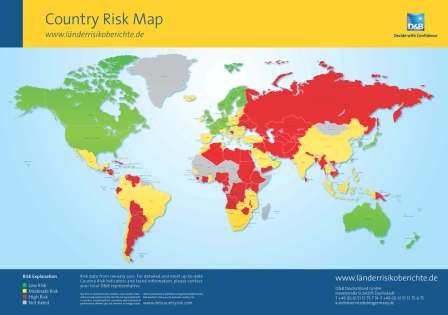
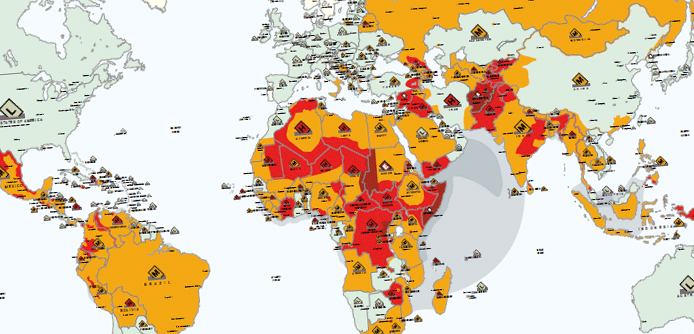
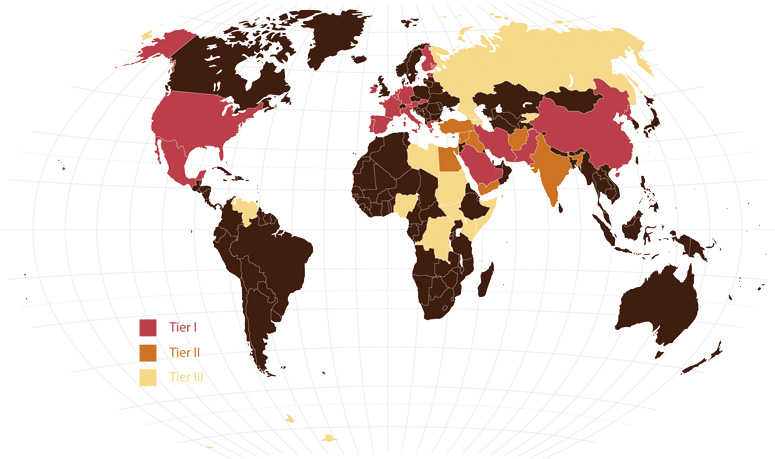
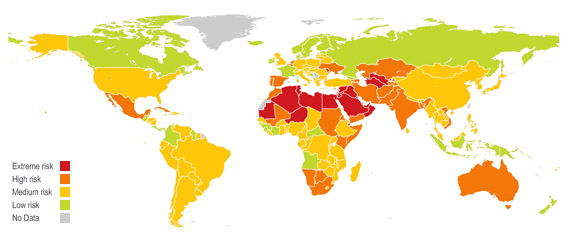
Great search, thank you. How “risk” is defined determines what countries are up or down. It is therefore essential to demand an itemization of assumptions, and to question those risk maps that are so conventional in nature as to ignore both rising sea levels and dropping drinkable water aquifers. Dun & Broadstreet has never been especially thoughtful about risk at either the enterprise or the country level. Similarly, Control Risks is focused on “old” concepts of risk rather than new concepts, or the USA and China would both be red zones. Here are a few links and images.
The Council on Foreign Relations preventive priorities map is fascinating, in part because it places no importance on Brazil, Canada, Chile, or Indonesia, four locatons that we consider of vital importance.
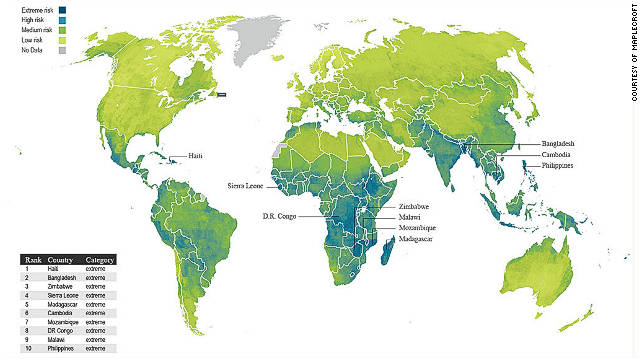
London (CNN) — Some of a world’s fastest flourishing race centers in Asia and Africa are during biggest risk from a impact of meridian change, according to a new report.
A sum of 30 countries were personal as being during “extreme risk” with Haiti, Bangladesh, Sierra Leone, Zimbabwe and Madagascar creation adult a tip 5 many in peril, while Vietnam, Indonesia and India all ranked inside a tip 30.
Click on Image to Enlarge
Six out of a 20 fastest flourishing cities worldwide, including Calcutta, India, Manila in a Philippines, Indonesia’s capital, Jakarta and Addis Ababa in Ethiopia, were also personal as during “extreme risk” by a CCVI.
“How does a company respect local communities' right to water when operating production facilities that require high levels of water consumption and where the community suffers from an inadequate water supply by relevant government authorities, but where the business is welcome as a source of jobs and revenue?”
With the coming U.S. presidential election, 2012 offers voters, business leaders and politicians an opportunity for a joint debate over the fundamentals of capitalism in America.
By Michael HiltzikLos Angeles Times, December 31, 2011
Occupy Wall Street and its coast-to-coast spinoffs captured the headlines in 2011, but the economic debate it helped trigger should reverberate deep into 2012.
That’s the debate over the future of the American middle class. Rarely has its economic plight been an explicit issue in a presidential election, but candidates on both sides of the partisan divide are poised to make it the centerpiece of their campaigns in the coming year.
. . . . . .
Yet so far the lionization of the middle class has been largely rhetorical. The year just past was one in which the stagnation of income and wealth for the great majority of Americans continued — indeed, bit so deep that it helped fuel the Occupy movement taking as its constituency the “99%,” those left behind by the continued gravitation of economic bounty toward the top 1% of U.S. taxpayers.
. . . . . .
Confidence in the essential fairness of American life, including confidence in the social and economic safety net, underlies the optimism that fuels consumer spending. That has ebbed in recent decades. As Michigan’s Curtin put it, “For the first time since the 1930s, consumers no longer think that jobs and wages will spring back anytime soon, that the value of their homes will rebound, or that their retirement funds will soon be fully restored…. Their worsening finances were mainly attributed to job losses, reduced hours, wage give-backs, and reduced bonuses.”