Sepp Hasslberger: Scientists, Citizens, & Real-Time Pervasive Science

Earth Intelligence
Sepp Hasslberger

Scientists and citizens

Sam Geall

February 24, 2012

Could a new wave of networked, amateur scientific endeavour speed the discovery of solutions to pressing environmental problems? Sam Geall reports.

What connects a group of Bayaka pygmy hunters in the Congo Basin, opposed to illegal loggers encroaching on their land; residents of Deptford, in south London, concerned about a noisy scrapyard across the road from a school; and members of the website oldweather.org, transcribing century-old ship log books to gather information about historical weather conditions?

The answer is they all have become citizen scientists, on the frontiers of a field that harnesses the wisdom of crowds, a do-it-yourself approach to technology and a radical approach to knowledge that blurs the traditional boundaries between local understanding and scientific expertise. In the words of Francois Grey, physicist at Tsinghua University in Beijing and coordinator of the Citizen Cyberscience Centre in Geneva, Switzerland, they all embody the spirit that: “Science is too important to be left to scientists alone”.

Continue reading “Sepp Hasslberger: Scientists, Citizens, & Real-Time Pervasive Science”
Sepp Hasslberger: Mark Boyer on Scientist Develops Self-Sustaining Solar Reactor That Produces Clean Hydrogen Fuel

05 Energy, Earth Intelligence
Sepp Hasslberger

Mark Boyer

Scientist Develops Self-Sustaining Solar Reactor That Produces Clean Hydrogen Fuel

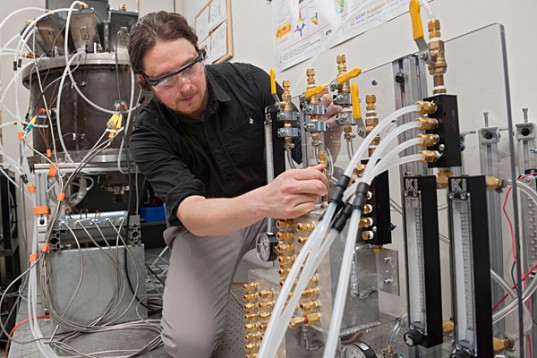
Hydrogen is a fuel that has seemingly limitless potential, but scientists have only been able to produce it from fossil fuels, like natural gas. That is, until now. A doctoral student in mechanical engineering at the University of Delaware has designed a new type of reactorthat produces hydrogen using nothing more than concentrated sunlight, zinc oxide, and water. And best of all, the zinc oxide used by the reactor can be reused, meaning that once the reactor is up and running, it would be self-sustaining.

Doctoral candidate Erik Koepf designed a large cylindrical reactor that is made of heat-insulating ceramic materials. With some help from gravity, zinc oxide powder is fed into the system from 15 hoppers, and concentrated sunlight enters through a quartz window and the aperture ring.

Click on Image to Enlarge

This week, Koepf will bring his reactor to Switzerland, where it will be tested for the first time at the Swiss Federal Institute of Technology in Zurich. In the testing phase, concentrated light equal to the energy of 10,000 suns will be focused on the reactor, bringing the temperature up to about 3,000 degrees Fahrenheit. Then the zinc oxide will be added, creating a reaction that will convert the powder into zinc vapor. Finally, the zinc will be reacted with water, producing hydrogen.

“The idea is to create a small, well-insulated cavity and subject it to highly concentrated sunlight from above,” Koepf explained in a release. If successful, the reactor could represent a major breakthrough, providing a new source of emission-free, completely sustainable fuel. Koepf’s advisor professor Ajay Prasad says he can imagine huge arrays of these devices in the desert producing hydrogen on an industrial scale.

Mini-Me: Provocative Comparison – Imperial Conquest & Catholic Conquistadores

Cultural Intelligence, Earth Intelligence
Who? Mini-Me?

Huh?

The doctrine of intervention

Manuela Picq has just completed her time as a visiting professor and research fellow at Amherst College.

Today's political ethics are surprisingly similar to the doctrine of discovery set by the Vatican back in 1452.

Al Jazeera, 04 Apr 2012

New York, NY – One does not think of archaic papal bulls when witnessing democratic states like Brazil or the United States building dams on Amazon rivers or drilling for oil in the Arctic Ocean. Yet today's political ethics are surprisingly similar to the doctrine of discovery set by the Vatican back in 1452.

Fifteenth-century papal bulls that declared war against all non-Christian peoples also encouraged the conquest and exploitation of enemy territories throughout the world. European explorers like Columbus took possession of newly “discovered” non-Christian lands with the express authorisation of the Catholic Church.

This internationally recognised doctrine allowed claims to be made on “empty” invaded lands outlasted European absolute monarchies and has become enshrined in secular nation-states. In the US, for instance, Chief Justice John Marshall used the right of discovery in 1823 to invalidate native claims over their land and to assert the authority of the US government over land titles.

The World Council of Churches (WCC) recently disowned the doctrine of discovery, perhaps in light of its centrality at the 11th session of the UN Permanent Forum on Indigenous Issues this coming May in New York. Better late than never.

The discourse that rationalised the colonisation of the Americas in the sake of Christianity is the same that justifies protecting human rights in Iraq or privatising water supplies for the sake of development.

Continue reading “Mini-Me: Provocative Comparison – Imperial Conquest & Catholic Conquistadores”

Dophin: Intelligent Life at Washington Post (Blog) — True Costs Snapshot

Earth Intelligence
YARC YARC

Every once in a while, there is a flash of intelligence at The Washington Post. This short blog illuminates both the true costs of various options around carbon emissions, and the importance of considering “360 degree” trade-offs.

Sucking carbon dioxide out of the air: Neat idea, but impractical

Posted by at 03:01 PM ET, 04/05/2012

Washington Post (Blog)

Humanity is making dismal progress on curbing its greenhouse gas emissions. That’s led some scientists to dream up zany geoengineering schemes to avert drastic climate change. One promising idea involved sucking carbon dioxide out of the air. Alas, new research suggests, this isn’t very practical:

You can strip CO2 from the air with chemical filters or by boosting reactions occurring as rocks weather. Colin Axon of Brunel University in Uxbridge, UK, and Alex Lubansky at the University of Oxford estimated what it would take to remove the 30 gigatonnes of CO2 we emit every year.

That would mean processing 75,000 Gt of dry air. Scaling up proposals to filter air would use 180 Gt of clean water per year, depriving 53 million people of water, on top of the 66 per cent of the world’s population who will face water shortages by 2025.

To make matters worse, mopping up carbon dioxide with chemical filters would use an enormous amount of energy and be prohibitively expensive. A study last year in Nature pegged the cost of carbon dioxide removal at about $600 per ton, which is about seven times more pricey than even the high-end estimates of carbon taxes deemed necessary to curtail the world’s emissions.

Continue reading “Dophin: Intelligent Life at Washington Post (Blog) — True Costs Snapshot”

Marcus Aurelius: Living in an Upside Down Land – Email from O-6 USMC

Cultural Intelligence
Marcus Aurelius

Following is circulating among military circles via email.

From:  REDACTED [USMC O-6 Retired]<

We the people are the rightful masters of both Congress & the courts, not to overthrow the Constitution, But overthrow the men who pervert the Constitution.”

Abraham Lincoln

“… there comes a time when one must take a position that is neither, Safe, nor Politically Correct, nor Popular, but one must take it, because its RIGHT!!”

Common Sense

Upside-down Land

You know you live in anUpside-down Land if…

Continue reading “Marcus Aurelius: Living in an Upside Down Land – Email from O-6 USMC”

Sepp Hasslberger: Putting Ground Transport Deep Underground

05 Energy, Communities of Practice, Earth Intelligence
Sepp Hasslberger

Evacuated tube travel to replace trains, planes and automobiles?

“Some people spend their life watching the tube, but Daryl Oster is spending his trying to get people to travel in one.”

“To be fair, Evacuated Tube Travel might be even bigger — Oster is proposing uisng magnetic levitation to send car-sized capsules through giant long vacuum tubes at speeds of up to 4,000 miles per hour.”

“The passenger vehicle is pressurized and has plenty of air, but moves through the airless tube on a magnetic track and all movement is controlled by manipulating the magnetic forces that are at play between the track and the capsule, according to Discovery.”

“Oster and his team are selling licenses for the rights to build the tracks and tubes, but says the ultimate network will need both private and public funding. He also plans to start a Kickstarter campaign in hopes of raising funds for a documentary about ETT.”

Phi Beta Iota:  We are long overdue for putting ground transport as well as utilities deep underground but this will require greater intelligence with integrity about structural resilience and human early warning in the face of earthquake potential.  This could also spawn greater attention to underground small cities, with the surface areas gradually redirected to recovering agricultural land and localized renewable energy platforms.

Event: 13-15 July 2012 NYC Hackers on Planet Earth (HOPE) Number Nine

Cultural Intelligence, Hacking

HOPE Ticket Sales to Benefit Electronic Frontier Foundation: For the entire month of April, we will be donating ten percent of the amount brought in from HOPE ticket sales to the Electronic Frontier Foundation. Purchase your tickets now!

Call for Activities issued: workshops, artwork, collaborative spaces.  Bring your creativity!

HOPE Number 9 Call for Hackerspaces seeks participation

Confirmed talks (so far) are now listed.  Some speakers are returning favorites, and others are fresh new faces.  All talks will offer something new and exciting.

Keynote announced!  The Yes Men will talk about their approach to hacking corporations and saving the world.  See the press release at 2600.com.

About HOPE

Continue reading “Event: 13-15 July 2012 NYC Hackers on Planet Earth (HOPE) Number Nine”

noble gold