A couple of decades back, in his seminal work MegaTrends, author John Naisbitt pointed out that no technology can ever succeed without a compelling human benefit, referring to it as “high tech-high touch.”
EXTRACT:
Likewise, some technologists are discovering that many computational challenges may be better solved by interactive, online games — not brute-force supercomputing. In a recently released video of his latest TED talk, Shyam Sankar, director at Palantir Technologies, explains how a long-time biological puzzle in protein analysis was solved in a matter of days by three non-technical, non-biological amateurs playing a computer game called Foldit: Read full article.
What happens if you give a thousand Motorola Zoom tablet PCs to Ethiopian kids who have never even seen a printed word? Within five months, they'll start teaching themselves English while circumventing the security on your OS to customize settings and activate disabled hardware. Whoa.
The One Laptop Per Child project started as a way of delivering technology and resources to schools in countries with little or no education infrastructure, using inexpensive computers to improve traditional curricula. What the OLPC Project has realized over the last five or six years, though, is that teaching kids stuff is really not that valuable. Yes, knowing all your state capitols how to spell “neighborhood” properly and whatnot isn't a bad thing, but memorizing facts and procedures isn't going to inspire kids to go out and learn by teaching themselves, which is the key to a good education. Instead, OLPC is trying to figure out a way to teach kids to learn, which is what this experiment is all about.
Rather than give out laptops (they're actually Motorola Zoom tablets plus solar chargers running custom software) to kids in schools with teachers, the OLPC Project decided to try something completely different: it delivered some boxes of tablets to two villages in Ethiopia, taped shut, with no instructions whatsoever. Just like, “hey kids, here's this box, you can open it if you want, see ya!”
And he’s not alone. The Post’s own Vivek Wadhwa recently predicted that all online education would be totally free within 10 years — and that includes an education from the same elite institutions who have joined Coursera. For a really mind-blowing scenario of how it all unfolds check out the EPIC 2020 video — it lays out a realistic route for free online education by the year 2020.
A workshop on social media, surveillance, and knowledge production
Despite the promises and growth of digital social networks and the Web, social tensions and boundaries pervade our everyday “virtual” communications, shaped by a number of cultural, national and structural borders. Come help us explore the current (r)evolutions of the global Internet.
featuring
Francesca Musiani
Yahoo! Fellow, Institute for the Study of Diplomacy, Georgetown University
“The plurality of Internet borders”
Seeta Peña Gangadharan
Senior Research Fellow, Open Technology Initiative, New America Foundation
“Internet borders and rights: Vulnerable populations, digital inclusion, and its dark sides”
David Ribes
Assistant Professor, Communication, Culture and Technology Program (CCT), Georgetown University
“Internet borders: Orphans of infrastructure?”
Friday, November 9, 2012
12:00 PM – 2:00 PM
Mortara Center for International Studies
3600 N Street, NW
A light lunch will be served.
For more information on the Institute for the Study of Diplomacy, please visit our website.
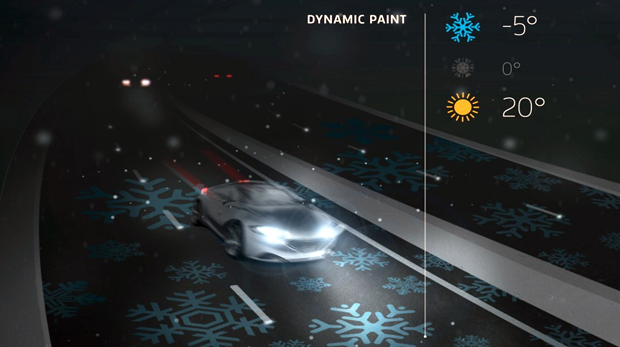
By mid-2013, the Netherlands will feature glow-in-the-dark tarmac and dynamic paint that warns drivers of weather conditions.
Click on Image to Enlarge
“The Smart Highway” is a concept designed by Studio Roosegaarde and Heijmans Infrastructure. Including glow-in-the-dark roads, interactive lighting and an induction priority lane for electric vehicles, the team wants to use light, energy and road signs that automatically adapt to varying traffic conditions.
One particularly interesting feature is the luminous pathways in the road. Treated with a foto-luminizing powder, extra lighting in the dark becomes “unnecessary”, according to Studio Roosegaarde. Charging by solar technology in the day, once daylight has fled, the pathways then illuminate the contours of the road for up to ten hours.
In addition, ‘dynamic paint’ responds to changes in temperature, and then can relay traffic information to drivers. For example, if its -5C and slippery, the roads are highlighted with ice crystals.
“Research on smart transportation systems and smart roads has existed for over 30 years — call any transportation and infrastructure specialist and you’ll find out yourself,” Studio Roosegaarde communications partner Emina Sendijarevic told Wired.co.uk. “What’s lacking is the implementation of those innovations and making those innovations intuitive and valuable to the end-consumers — drivers. For this, a mentality change needs to take place within a country and its people.”
Awarded with a Best Future Concept by the Dutch Design Awards 2012, the smart highways will be in use next year.
We saw the usual spikes in Twitter activity and the typical (reactive) launch of crowdsourced crisis maps. We also saw map mashups combining user-generated content with scientific weather data. Facebook was once again used to inform our social networks: “We are ok” became the most common status update on the site. In addition, thousands of pictures where shared on Instagram (600/minute), documenting both the impending danger & resulting impact of Hurricane Sandy. But was there anything really novel about the use of social media during this latest disaster?
I’m asking not because I claim to know the answer but because I’m genuinely interested and curious. One possible “novelty” that caught my eye was this FrankenFlow experiment to “algorithmically curate” pictures shared on social media. Perhaps another “novelty” was the embedding of webcams within a number of crisis maps, such as those below launched by #HurricaneHacker and Team Rubicon respectively.
With 60 million people expected to be impacted by Hurricane Sandy, days of advanced notice have allowed the New York governor to issue a state of emergency, evacuations to take place along the Atlantic coast, and (at least in my Washington, D.C. neighborhood) residents to clear the grocery store shelves ahead of the storm’s dangerous surge. But soon weather forecasters might not be able to provide us with details and predictions of dangerous storms.That’s because there’s another looming problem in the United States that could be even bigger than Hurricane Sandy: dying satellites. The New York Times reports:
The United States is facing a year or more without crucial satellites that provide invaluable data for predicting storm tracks, a result of years of mismanagement, lack of financing and delays in launching replacements, according to several recent official reviews.
The looming gap in satellite coverage, which some experts view as almost certain within the next few years, could result in shaky forecasts about storms like Hurricane Sandy, which is expected to hit the East Coast early next week.

 Why supercomputers will always have limits