
Nato maps out Afghanistan withdrawal by 2014 at Lisbon summit
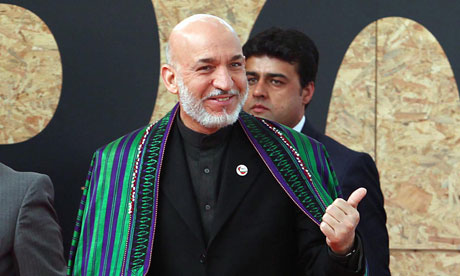
Alliance leaders meet with Hamid Karzai to discuss handover of security but pledge not to simply leave country to its fate
David Batty
Guardian UK, Saturday 20 November 2010

The truth at any cost lowers all other costs — curated by former US spy Robert David Steele.
Nato maps out Afghanistan withdrawal by 2014 at Lisbon summit
Alliance leaders meet with Hamid Karzai to discuss handover of security but pledge not to simply leave country to its fate
David Batty
Guardian UK, Saturday 20 November 2010
Afghanistan: Special NightWatch Essay. Readers might wonder about the significance of comments about a new deadline for transferring security to Afghans, about the announcement that a squadron of Abrams M-1 main battle tanks is to be shipped to support the Marines in Helmand Province and the news report that combat air support has increased. These indicate significant decisions have been made that promise to change the Afghan fight into more of a war.
(Note: This essay is an analysis of developments this week and their implications, based on open sources. It is neither a criticism nor an endorsement.)
Change of focus. The repeated US and NATO public references this week to the year 2014 as an “aspirational” date for transferring security to the Afghans have been accompanied by an absence of substantive commentary about drawing down forces. This pattern invariably means a policy review has taken place and a significant change has been decided.
The focus is now on transferring security duties, not on drawing down forces. No official statements this week mentioned when the surge will end and the soldiers brought home. The vocabulary of the conflict has changed.
Clearly western forces will not begin drawing down in 2011 in any consequential numbers, as in Iraq. Any pullout would be for demonstration purposes, because combat operations are now set to continue for four or more years. President Karzai appears to be aware of this, according to new coverage from the NATO summit in Lisbon.
New deadlines. At the start of the week, officials described the transfer of security as occurring by 2014, which conventionally means by 31 December 2013. At mid-week, a spokesman clarified the intent as “by the end of 31 December 2014.” By Thursday, a further clarification described 2014 as a goal, a desirable target or an aspirational date, with the proviso that the real date for ending the combat mission might be 2015 or thereafter.
The repeated mention of 2014 by State and Defense Department officials was not accompanied by an explanation for the change from 2011; a statement of new or changed goals; or a definition of what constitutes transferring security duties and, especially, how much the costs will rise. Apparently some of the details will be worked in Lisbon and are likely to be announced after the summit.
The transfer of security duties always has been a goal, but not the primary goal in the sense with which it was treated this week. It seems to absorb the other goals that have had primacy in the past two years: breaking the momentum of the Taliban, building the Afghan forces, creating secure conditions for development, improving governance, win hearts and minds and so on. It seems to be broad enough to cover them all, but still lacks definition for the public to measure progress or know what to expect in the next four years.
Heavy armor. The announcement of the heavy armor commitment informs implies that some of the Marines will be permitted to fight like Marines in warfare. Main battle tanks bring to mind the images of the US armored forces dashing up the west bank of the Euphrates River in Iraq seven years ago.
This signifies another policy shift about the nature of the war. The long overdue introduction of heavy armor portends that tactics in some areas must continue to drift farther from the announced hearts and minds strategy.
More air power. The third announcement was a statement, en passant, that this month US and NATO forces have increased their use of airpower against the Taliban. One commentator said this means that US and NATO tactics are now aimed at exterminating the Taliban, not just breaking their momentum, a goal stated on multiple occasions. Defeating the Taliban is an included task in a mission to transfer security to Afghan forces.
The broader implication appears to be that US and NATO forces appear to be returning to some of the tactics that worked earlier in the Afghan War. One condition that the fighting data in 2009 and 2010 establish is that the Taliban are not afraid of US and NATO forces, unless they are backed by air power. Conversely, their collective memory of defeat in 2001 by a significantly smaller US force is that they had no defense against US air power. That remains the case today.
Cumulatively, the announcements and actions appear to point to an escalation and prolongation of the Afghan War. If so, they should have a strongly discouraging effect on the Taliban leadership in Pakistan who persist in boasting that they will wait out the Americans.
A second consequence should be a reduction of coalition losses. The Afghans are not stepping up to the fight much more than before, based on casualty reporting in the Afghan media. Coalition forces should start cutting losses by rebuilding the aura of invincibility, which they had in 2001 and which rested on effective use of air power, but can now include tanks.
A third consequence should be gradual demoralization of the Taliban fighters in two respects: less hubris and more losses. Taliban web postings boast about attacking coalition forces in their bases. The reports of fighting often bear out the boasts. That hubris should diminish as losses increase.
As for Taliban casualties, during the summer and autumn offensive between June and November 2008, the Taliban sustained more than 1,000 killed a month every three months in a 90-day cycle. After a month of increased operations in June, they went to ground, reduced operations, regrouped, rearmed and recruited. After 30 days of down time, they again increased operations in August and lost another thousand fighters. They repeated that cycle once more in October and stretched it into November 2008, before they ended what appears to have been a premature and disastrous attempt to seize and hold ground. They have never tried that again.
In 2009 and in 2010, they have not been willing to take such losses. A thousand dead a month over a combat season represents the threshold for breaking the back of the Taliban and reducing it to banditry. In part, their aggressive operations in 2009 and 2010 may be attributed to restrictions on the use of air power. If those are easing, the Taliban can be defeated for a time.
A fourth consequence is that the coalition might begin to start making its own luck. Diligent prosecution of the fight in a more warlike fashion is more likely to shorten the conflict than the mixture of fighting with development projects to win hearts and minds. Under the pressure from no withdrawal date and increased losses, the Taliban inside Afghanistan might be more receptive to negotiations.
If the changes are implemented consistently, and are not just piecemeal, spot fixes, they should improve security conditions. However, they also are likely to produce significant negative consequences in property damage, civilian and militant casualties and bad press, all consistent with a war. On the other hand, the stalemate will continue if the most important change is a longer conflict.
Phi Beta Iota: Emphasis added. There is a very strong flavor here of the Marines taking a greater interest in the Afghanistan War, where the author of the two books below now teaches. We are troubled by the continued expenditure of blood, treasure, and spirit abroad, when we have so many needs here at home. The new contract for a $750 million embassy-fortress in Islamabad, joining similarly expensive embassy-fortresses in Kabul and Baghdad, while poverty and homelessness sky-rockets in the USA, is a clear indication of where the Administration wishes to focus.
Stewart Impersonates Glenn Beck To Debunk His George Soros Conspiracy Theory (VIDEO)
Two clips. Perhaps the funniest footage in the English language on a very serious topic.
1999 Setting the Stage for Information-Sharing in the 21st Century: Three Issues of Common Concern to DoD and the Rest of the World
1994 Sounding the Alarm on Cyber-Security
1992 Intelligence Preparation of the Battlefield: The Marine Corps Viewpoint
Reference: 1992 USMC C4I Campaign Plan
1992 Information Concepts & Doctrine for the Future
1992 Intelligence Lessons Learned from Recent Expeditionary Operations
1992 SIGNAL Leaner Marine Corps Faces Meaner Global Challenge
1991 MCG Intelligence Support for Expeditionary Planners
1991 Defense Intelligence Productivity
Reference: USMC Utilizing the Counter-Narcotics Center Experience as a Basis for General Intelligence Restructuring Initiatives (1991)
Reference: USMC Draft Defense Intelligence Fixes (1990)
1990 Expeditionary Environment Analytic Model
1988 Generic Intelligence Center Production Requirements
The Coming Sell-Out to the Super Rich and What It Means for the Rest of Us
By MICHAEL HUDSON
Counterpunch
Web Censorship Bill Sails Through Senate Committee
Sam Gustin
WIRED
Why Gen Y is Better at Your Job Than You Are
Penelope Trunk
BNET
Weekend Edition
November 19 – 21, 2010
Open Letter to Erskine Bowles
By THOMAS CHRISTIE, PIERRE SPREY, FRANKLIN SPINNEY et al.
Counterpunchhttp://www.counterpunch.org/christie11192010.html
The Honorable Erskine Bowles
National Commission on Fiscal Responsibility and Reform
1650 Pennsylvania Avenue, N.W.
Washington, DC 20504
Dear Mr. Bowles:
We are writing to you and other members of the President's National Commission on Fiscal Responsibility and Reform as individuals who have worked in national security affairs for decades for the Department of Defense, in the Armed Forces and for Democrats and Republicans in Congress. Our concern is the defense budget.
Similar to what your “Co-Chairs' Proposal” said last week regarding Social Security and other issues, we do not believe that defense spending should be reduced to a bargaining chip in budget negotiations at the Deficit Commission. On the other hand, we do believe that the defense budget is dangerously bloated, giving rise to serious decay in our armed forces.
Weaker forces at higher costs (discussed below) are the result of many years of exploitation of defense spending for political purposes, dereliction of oversight duties, and gross mismanagement by the Pentagon, the White House and the Congress. There has been a fundamental absence of accountability, both that required by the Constitution and that which accompanies sound management.
Read entire very detailed letter of testimony…
Phi Beta Iota: What our distinguished colleagues have not included in this letter is the fact that the US does not have a coherent reality-based strategy within which to evaluate ALL threats and provide a force structure suitable to ALL threats, nor does the US have an intelligence community able to provide any more than 4% (“at best” according to General Tony Zinni) of what we need in the way of intelligence support to policy, acquisition, and operations. At the same time, the Pentagon is committing a major crime against its own humanity by spending less than 1% of its budget on the 4% of the force that takes 80% of the casualties: the infanty, this from General Robert Scales. With all due respect, both Gates and Clapper have presided over the maintenance of the status quo; they have not changed the game for the better; and they have failed to do what needed to be done.
