Now from the same country comes a company that says it has pulled 5 liters (1.3 U.S. gallons) of gasoline from the ether over the last 3 months, the Daily Telegraph reports. And get this: Air Fuel Synthesis says its process also removes CO2
‘Arab Awakening' countries at increased risk from 2013 food price shocks
10/10/2012
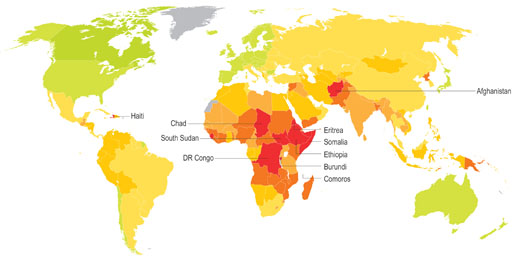
Despite strong economic growth, food security remains an issue of primary importance for Africa, according to a new study by risk analysis company Maplecroft, which classifies 75% of the continent’s countries at ‘high’ or ‘extreme risk.’
Click on Image to Enlarge
In the light of recent food price spikes, the findings are especially significant for areas of sub-Saharan Africa where poverty, armed conflict, civil unrest, drought, displacement and poor governance can combine to create conditions where a food crisis may take hold.
Africa accounts for 39 of the 59 most at risk countries in Maplecroft’s Food Security Risk Index and hosts nine of the eleven countries in the ‘extreme risk’ category. These include: Somalia and DR Congo (ranked joint 1st in the index), Burundi (4), Chad (5), Ethiopia (6), Eritrea (7), South Sudan (9), Comoros (10) and Sierra Leone (11). The countries of Haiti (3) and Afghanistan (8) complete the category.
Forecasts of Abundance Collide with Planetary Realities
Last winter, fossil-fuel enthusiasts began trumpeting the dawn of a new “golden age of oil” that would kick-start the American economy, generate millions of new jobs, and free this country from its dependence on imported petroleum. Ed Morse, head commodities analyst at Citibank, was typical. In the Wall Street Journal he crowed, “The United States has become the fastest-growing oil and gas producer in the world, and is likely to remain so for the rest of this decade and into the 2020s.”
Once this surge in U.S. energy production was linked to a predicted boom in energy from Canada’s tar sands reserves, the results seemed obvious and uncontestable. “North America,” he announced, “is becoming the new Middle East.” Many other analysts have elaborated similarly on this rosy scenario, which now provides the foundation for Mitt Romney’s plan to achieve “energy independence” by 2020.
By employing impressive new technologies — notably deepwater drilling and hydraulic fracturing (or hydro-fracking) — energy companies were said to be on the verge of unlocking vast new stores of oil in Alaska, the Gulf of Mexico, and shale formations across the United States. “A ‘Great Revival’ in U.S. oil production is taking shape — a major break from the near 40-year trend of falling output,” James Burkhard of IHS Cambridge Energy Research Associates (CERA) told the Senate Committee on Energy and Natural Resources in January 2012.
Increased output was also predicted elsewhere in the Western Hemisphere, especially Canada and Brazil. “The outline of a new world oil map is emerging, and it is centered not on the Middle East but on the Western Hemisphere,” Daniel Yergin, chairman of CERA, wrote in the Washington Post. “The new energy axis runs from Alberta, Canada, down through North Dakota and South Texas… to huge offshore oil deposits found near Brazil.”
Extreme Oil
It turns out, however, that the future may prove far more recalcitrant than these prophets of an American energy cornucopia imagine. To reach their ambitious targets, energy firms will have to overcome severe geological and environmental barriers — and recent developments suggest that they are going to have a tough time doing so.
Imagine what you might do if you could print your own solar panels. That's kind of the dream behind Shawn Frayne and Alex Hornstein's Solar Pocket Factory — although they see it more as the “microbrewery” of panel production rather than a tool for everyone's garage. With over $70,000 of backing from a successful Kickstarter campaign, the inventors are now working on refining the prototype. If all goes well, by April they'll have a machine that can spit out a micro solar panel every few seconds. In the meantime, Frayne stopped by Flora Lichtman's backyard with a few pieces of the prototype to explain how the mini-factory will work.
Americans have been repeatedly told a series of lies about accommodating renewables onto the power grid: That it can’t handle large amounts of intermittent power generation. That standby fossil-fueled capacity must be maintained at 100 percent of demand for those times when the sun isn’t shining and the wind isn’t blowing. That brownouts and blackouts will inevitably result from depending on renewables. That nuclear is the only power source that can meet our needs in the future. And so on.
Europeans beg to differ.
An August 31 article by James Conca in Forbes (”Germany — Insane or Just Plain Stupid?“) regurgitated these hoary tropes, claiming that Germany’s decision to shut down nuclear plants and transition to renewables was a colossal mistake, because “the grid can’t handle it, the transmission system is not there, and the power disruptions and brownouts are wreaking havoc on the country’s energy reliability.”
The fact is that none of what is happening in Germany fits what Americans think, and the only regular source of news from Germany in English is Spiegel Online, a laughable source of energy news (the Forbes article cites Spiegel). Germany is switching to renewables quickly, without raising its carbon emissions, with probably the most reliable grid in the world, on a market with freedoms Americans don’t even know they lack, with a job market that continues to strengthen (even during the ongoing economic crisis), and in combination with a nuclear phaseout. None of this makes sense to Americans, who respond not by accepting the facts and changing their minds but by getting the picture wrong.
Morris highlighted a 2010 study I mentioned in March (”Why baseload power is doomed“), which found that nuclear power plants are fundamentally “incompatible with renewable energies.” Because renewables enjoy priority dispatch on the grid, conventional generators need to be cut back when the wind is blowing and the sun is shining. Older nuclear and coal power plants, which cannot be ramped up and down easily, are ill-suited to a grid with large amounts of variable renewable power.
Morris proceeded to dismantle the reliability argument, pointing out that instead of power disruptions, Germany’s grid is now the most reliable of the EU member states.
Phi Beta Iota: The article focuses on macro or nation-wide grids. The other half of the renewables coin is at the micro-level — self-sufficient neighborhoods focused on optimization of localized wind, solar, and biomass.
On the eve of the opening of the European Solar Decathlon, a team from the Budapest University of Technology and Economics is ready to present its innovative solar-powered prefab home, which produces twice the amount of energy than it consumes. The decathlon is an international competition among universities which promotes research in the development of energy-effective and light-structured residential buildings that only use solar energy. This year the prestigious competition is being hosted in Madrid, Spain and will see a selection of university entries from across Europe, including Germany, Denmark, Spain, France, Hungary, Italy, The Netherlands, Norway, Portugal, The United Kingdom and Romania, and four more from China, Japan, Brazil and Egypt.
Air, that invisible ampleness all around us, could hold on to energy from wind turbines that spin at night when we don’t need the electricity, and then release it later, the BBC reports.
All you have to do is first turn the air into a liquid state, using technology adapted by a British company called Highview Power Storage.
. . . . . . . . .
Highview uses night time electricity generated by wind turbines to chill air down to -190 degrees C (-310 degrees F), at which point it becomes liquid nitrogen. (I assume the process could also store excess daytime solar energy, although the BBC article only discusses wind).
Store that liquid in a giant vacuum, heat it back into a gas some other time, and the rush of air will drive a turbine. Feel good that renewable energy, not dirty old coal, will power your coffee maker in the morning. Except possibly for one thing – some external energy source has to help warm things up, and that source might not be renewable.

 Air power: UK company pulls gasoline from the ether