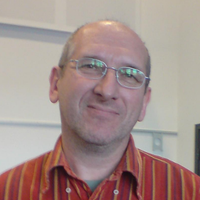
Interview with the late Professor Elinor Ostrom, to date the only woman to win the Nobel for economics, on environmental issues, commons and her time at Beverley Hills High. The interview took place in the Excel centre, London. March 2012. Sadly Professor Ostrom died in June 2012, she was a visionary who put her ideas into practice dedicated to creating a sustainable future for all based on human creativity. She discussed some of her key ideas with humour and clarity with Derek Wall.
In this new RSA Animate, Manuel Lima, senior UX design lead at Microsoft Bing, explores the power of network visualisation to help navigate our complex modern world. Taken from a lecture given by Manuel Lima as part of the RSA's free public events programme. Listen to the full talk: http://www.thersa.org/events/audio-and-past-events/2011/the-power-of-networks…
Damon Horowitz, a philosophy professor and “serial entrepreneur,” recently joined Google as an In-House Philosopher/Director of Engineering. Prior to his work at Google, Horowitz co-founded Aardvark, Perspecta, and a number of other tech companies. In this talk at Stanford University’s 2011 BiblioTech conference on “Human Experience,” Horowitz explains why he left a highly-paid tech career, in which he sought the keys to artificial intelligence, to pursue a Ph.D. in Philosophy at Stanford (the text of the talk is available here).
Horowitz offers fellow techies a formidable challenge, but a worthwhile one. In saying so, I must confess a bias: As a student and teacher of the humanities, I have watched with some dismay as the culture becomes increasingly dominated by technicians who often ignore or dismiss pressing philosophical and ethical problems in their quest to build a better world. It is gratifying to hear from someone who recognized this issue by (temporarily) giving up what he admits was a great deal of power and societal privilege and headed back to the classroom.
Horowitz describes his intellectual journey from “technologist” to philosopher with passion and candor, and concludes that as a result of his academic inquiry, he “no longer looks for machines to solve all of our problems for us,” and no longer assumes that he knows what’s best for his users. This kind of humility and intellectual flexibility is, ideally, the outcome of a higher degree in the humanities, and Horowitz uses his own trials to make a case for better critical thinking, for a “humanistic perspective,” in the tech sector and elsewhere. For examples, see Horowitz’s TED talks on a “moral operating system” and “philosophy in prison.” Complicating Google’s well-known, unofficial slogan “don’t be evil,” Horowitz, drawing on Hannah Arendt, believes that most of the evil in the world comes not from bad intentions but from “not thinking.”
In her research, Arrien discovered a pattern of human archetypes that are consistent across cultures, seemingly universally embedded in the mythic structure of societies. When we learn to live these archetypes within ourselves, we can tap into their wisdom and begin to heal ourselves and our fragmented world.
The principles of the Four-Fold Way, based on the four archetypes, are:
1. Show up, or choose to be present. Being present allows us to access the human resources of power, presence, and communication. This is the way of the Warrior.
2. Pay attention to what has heart and meaning. Paying attention opens us to the human resources of love, gratitude, acknowledgment, and validation. This is the way of the Healer.
3. Tell the truth without blame or judgment. Nonjudmental truthfulness maintains our authenticity, and develops our inner vision and intuition. This is the way of the Visionary.
4. Be open to outcome, not attached to outcome. Openness and nonattachment help us recover the human resources of wisdom and objectivity. This is the way of the Teacher.
The first archetype explored in the book is that of the Warrior. The theme is about accessing the quality of courage, and to claim full leadership. She says:
The principle that guides the Warrior is showing up and choosing to be present. The developed Warrior shows honor and respect for all things, employs judicious communication, sets limits and boundaries, is responsible and disciplined, demonstrates right use of power, and understands the three universal powers.
As I read through the descriptions of the expressions of the Warrior, I could clearly see the places where I’m struggling to claim those things within myself.