Review: The Impossible Will Take a Little While–A Citizen’s Guide to Hope in a Time of Fear

5 Star, Democracy

Amazon Page
Amazon Page

5.0 out of 5 stars Superb Collection, Needs to Identify Original Pieces,

November 5, 2004
Paul Loeb
Edited 20 Dec 07 to add links to more recent books along these lines.

My title page, where I put my summary notes, is covered with writing. The first and most important point: this is not a “do gooder feel good” book–it is a compelling, absorbing book that lays out some good insights and provides an antidote to paralysis and dispair. It is, in short, a book that inspires many small actions that in the aggregate could lead to revolutionary improvements in democracy and our quality of life.

It took a lot of work to put this book together, including getting all the copyright permissions, and if I had one complaint, it is that I have already read many of these older items (e.g. Mandela, Havel, Martin Luther King) and it was too difficult to find the original pieces commissioned just for this book. Having said that–as a 52 year old that reads a great deal–I would quickly say that if you want to introduce younger people to great thinkers in the democratic tradition, it would be hard to do better than this book as a “reader.”

The book is also complemented by the online aids for further study and for reading group discussion.

I thought of my teen-ager as I read the book, and wrote his name in several places on the margin–this book is relevant to parents dealing with very smart young people who may tend to say “I'm never having children” because the world is going to hell.

At a tactical level, this book complements Bill Moyer's “Doing Democracy,” and is a personal counterpart to Jonathan Schell's work, “The Unconquerable World: Power, Nonviolence, and the Will of the People.”

I put the book down with one big thought ably communicated by this book: The problem among us is not that we lack power, but that we lack the will and perspective to use the power that we do have in small ways that add up to big power in the aggregate.

See also, with reviews:
A Power Governments Cannot Suppress
Escaping the Matrix: How We the People can change the world
Society's Breakthrough!: Releasing Essential Wisdom and Virtue in All the People
The Tao of Democracy: Using Co-Intelligence to Create a World That Works for All
The World Cafe: Shaping Our Futures Through Conversations That Matter
The Cultural Creatives: How 50 Million People Are Changing the World
Group Genius: The Creative Power of Collaboration
One from Many: VISA and the Rise of Chaordic Organization
All Rise: Somebodies, Nobodies, and the Politics of Dignity (BK Currents)
The Average American: The Extraordinary Search for the Nation's Most Ordinary Citizen

Vote on Review
Vote on Review

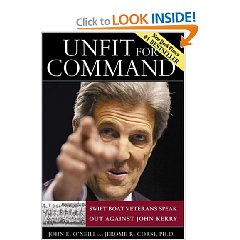
Review: Unfit for Command–Swift Boat Veterans Speak Out Against John Kerry

5 Star, Biography & Memoirs, Leadership, Politics

Amazon Page
Amazon Page

5.0 out of 5 stars If 5% is true, it's over–wake up call for future wanna-bees,

October 11, 2004
John E. O'Neill
I agonized over this book. It is assuredly a destructive mean-spirited, politically-motivated revenge sort of book, and one is tempted to put it in the fire bin with the grossest sort of pornography, satanic writings, and other forms of trash without which we can do quite nicely (see my review of “Forbidden Knowledge”).

However, as a retired Marine, as a crusader for Dean (one of the 20% of the moderate Republicans ready to jump ship), and as a proponent for public intelligence as a means of keeping honest both the secret intelligence producers and their White House masters, I have to come down in favor of this book for two simple reasons:

1) If just 5% of this book is true, and I think at least 50% is, then Kerry–whatever his merits–took conniving and mis-representation to levels never before achieved, and is, as the book suggests, unfit for command. When I look at the genuine bleedling and pain that goes with most purple hearts (Zinni and Franks, for example), the blatant gamesmanship that this book documents, against the medal created by George Washington for the heroes of Valley Forge and other key battles, just makes my blood boil.

2) This book–and the many books dissecting Bush and Cheney–should also serve as a wake-up call for wanna-be Presidents. Hilary will never be President–the Secret Service retirees will surely publish what they know.

There are two bottom lines here: morality matters as a fundamental aspect of character and consistency; and there are no secrets anymore whenever more than one person is engaged in acts that are ultimately not in the public interest.

As we go into the election, we have more than one evil to contend with. Kerry is unfit to command; Bush picked or got hijacked by some truly dangerous neo-conservatives and inherently dishonest corporate cronies; and the Republican and Democratic party leaderships have both conspired to keep the best men (John McCain and Howard Dean) away from the candidacy, while illegally blocking the Green and Reform Presidential candidates from sharing the debate forum on television (see my reviews of three books: Running on Empty, Doing Democracy, and Gag Rule).

This book is a form of “capstone” that represents rock-bottom in American politics. It makes it clear that we are all voting for the least of all weevils (pun intended), and that this is one little weevil that should not make it to the White House. It makes me angry that this great Nation should come down to this. It makes me angry that we get the government we deserve, and the books we deserve, and this book captures all of that, America at its most base–this book *is* America, consequently every American should be ashamed that we have allowed it to get to this abyssmal point.

Vote on Review
Vote on Review

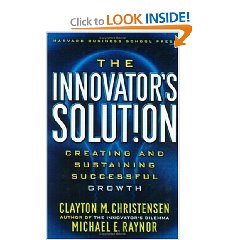
Review: The Innovator’s Solution–Creating and Sustaining Successful Growth

5 Star, Change & Innovation

Amazon Page
Amazon Page

5.0 out of 5 stars Illuminates Disruptive Innovation, Why Manager's Fail At It,

October 7, 2004
Clayton M. Christensen
Edited 20 Dec 07 to add links to natural capitalism books

I was talking to a friend the other day about why major (multi-billion dollar a year) companies are not good at innovation, and he recommended this book. Wow! Looking at the companies I know and admire, it all became clear. Innovation *is* disruptive; the most promising marketplace is the opposite of their existing defense and intelligence clients–the people that do not get adequate intelligence support from the existing cash cow; and all of the middle and senior managers (Washington-based) are incrementalists who had succeeded at building bodies-for-hire accounts over decades.

For those who feel an intuitive faith in disruptive endeavors, this book is inspiring and also instructional. It specifically suggests that entrants will beat incumbents when the objective is to substitute lower-cost good-enough solutions for client needs that are not satisfied by high end production. However, it also makes clear that the *last* place you want to sell disruptive solutions in to is the existing high end client base. Go for new customers and new contexts.

In government intelligence terms: stop trying to teach the spies that they need to do a better job on open sources of information in 33+ languages. Instead, go after the Departments of State, Commerce, Treasury, Agriculture, Homeland Security, and the elements of the Department of Defense that do not get adequate classified intelligence support. Establish Open Source Intelligence (OSINT) as a viable endeavor there, and in ten years come back and crush the spies in head on competition.

Three “litmus tests” that the authors put forward are very helpful to those seeking to monetize disruptive new ideas:

1) Is there a population of clients that has historically been under-funded, under-staffed, and have as a result *gone without*?
2) Is this group likely to appreciate lower cost “good enough” solutions?
3) Is it possible to be profitable while providing these clients lower cost good enough solutions (e.g. monitoring risk around the world, at the sub-state level, something the spies simply cannot do effectively despite their $50 billion a year budget)?

Another major lesson I drew from this book is that alternative channels can be phenomenally successful. One example the book uses: instead of selling low-cost throw away cameras through photography shops oriented to high-end perfectionists, move them into grocery stores and discount stores for the low-end market that could not afford a traditional camera. This *makes sense.* Hence, instead of trying to sell low-cost open source services to the people who think they have the most to lose from promoting them (the mandarins of the high-cost secrets), go instead to the least well-served end-users, the logisticians, acquisition managers, diplomats, etcetera, and get them to test localized rather than centralized solutions that then “explode” as other end-users see the low-cost success and emulate through decentralized adoption of new best practices.

The last half of the book is loaded with stuff useful to how I am going to structure my relationship with any major corporation–it focuses on a number of key factors including scale, profitability over growth, proprietary end to end solutions in the beginning, transitioning rapidly to open distributed solutions at the right moment, and ensuring that the team members are *not* (NOT) incrementalist line managers that succeeded by going along within a status quo system.

The following quote captures my perception of the imperfection of the guys at the top that don't get it: “In many ways, the managers that corporate executives have come to trust the most because they have consistently delivered the needed results in core businesses cannot be trusted to shepherd the creation of new growth.” (Page 183).

The book goes on to discuss the conflict between the traditional processes of managing traditional businesses, the conflict between traditional business values versus those of disruptive innovators (who can tend to alienate and aggravate executives used to having life just so), and between the “pace” of big organizations that need 12 months to think about an opportunity, and small “fleet of foot” innovators that can evaluate, act, write a proposal, and win million-dollar jobs over a week-end.

The authors are generally negative about business unit consolidation, and make the point that the bigger the business gets, the more process takes precedence over people. They specifically caution against a strategy of acquisition as a means of growth, documenting the terrible toll this can take as a cash flow drain, in essence saying that really big growth cannot come from incrementalist approaches. I put the book down with the feeling that the really big companies need to think seriously about launching spin-offs, as Charles Schwab did, and the really small companies, like mine, have a fighting shot at beating the hell out of the established beltway bandits who are too slow, too arrogant, and too rich to be serious about innovation for the future.

This book made me smile, and it made me think. Super piece of work.

Here are some recently published books that can be combined with this one to reintegrate and re-energize our economy:
The Battle for the Soul of Capitalism: How the Financial System Underminded Social Ideals, Damaged Trust in the Markets, Robbed Investors of Trillions – and What to Do About It
Blessed Unrest: How the Largest Movement in the World Came into Being and Why No One Saw It Coming
Natural Capitalism: Creating the Next Industrial Revolution
The Fortune at the Bottom of the Pyramid: Eradicating Poverty Through Profits (Wharton School Publishing Paperbacks)
The Ecology of Commerce
Cradle to Cradle: Remaking the Way We Make Things
One from Many: VISA and the Rise of Chaordic Organization

Vote on Review
Vote on Review

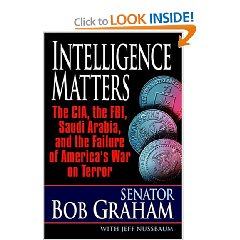
Review: Intelligence Matters

5 Star, Intelligence (Government/Secret)

Amazon Page
Amazon Page

5.0 out of 5 stars One of Top Five Books on Topic, But Has Some Gaps,

September 13, 2004
Bob Graham
Edit of 20 Dec 07 to add links.

The negative reviews on this book are by people that have not read the book carefully (one appears to have not read it all, having only seen the author on television). I am comfortable, on the basis of my career in intelligence, my three published books on intelligence (two with forewords by Senators, one Democratic, one Republican), and my 1100+ reviews on non-fiction about national security issues, is saying that this book is easily one of the top five books on the topic that most Americans should consider reading. The other four are the Webster Tarpley's book 9/11 Synthetic Terror: Made in USA, Fourth Edition which displaced the utterly imcompetent and unethical 9-11 Commission Report, the Aspin-Brown Commission Report (1996), Jim Bamford's book, A Pretext for War: 9/11, Iraq, and the Abuse of America's Intelligence Agencies and George Allen's book on the failure of intelligence in Viet-Nam, None So Blind: A Personal Account of the Intelligence Failure in Vietnam There are many others, but for 9-11 and the urgently needed reforms to intelligence after 9-11 (three years ago, still no reforms of note), these are the five.

The book is most important as an unclassified record of what can be known about our failures–in both intelligence and in policy–as understood by the then serving Chairman of the Senate Select Committee on Intelligence (SSCI). It does have gaps–it is much less detailed than the 9-11 Commission Report, harder to read than Jim Bamford's book, and suffers from considerable gaps in both what went wrong and what needs to be fixed, as covered by my own books as well as the many other intelligence reform books that I have reviewed in their own Amazon spaces. That does not diminish its relative value as a “touchstone” for all Americans.

There are, in my view, three compelling bottom lines in this book that cannot be ignored:

1) Senator Graham recognizes better than most that in the absence of public pressure for reform, there is little incentive for Congress or the Executive to take action. As one Member is reported to have told Amy Zegart “America still does not get it–it will take another 5,000 body bags.” It is my view that the combination of intelligence community leadership misrepresentation (“its all better now, no need to make major changes” and the White House denial that there was an intelligence failure at all, which defies understanding, have led the country to fall asleep again–a point that “Anonymous” makes in Imperial Hubris: Why the West Is Losing the War on Terror.

2) Page 243 covers both of the other two points. The first is that the Department of State has become a neglected orphan in US intelligence and US policy making about global threats, and this needs to change. It is worthy of note that the Department of State got it right on Iraq despite its small numbers and tiny budget, and I agree completely with Senator Graham–State has to get back in the business of being America's *primary* foreign and national security policy strategist. I put together THE SMART NATION ACT: Public Intelligence in the Public Interest but State leadership at this time is intellectually and morally challenged (2007).

3) Although disappointing in its brevity, especially since both the Aspin-Brown Commission and the 9-11 Commission found cause to note the importance of open sources of information, Senator Graham also notes on page 243 that a primary corrective measure to the failure of the intelligence community to “connect the dots” and related “incestuous amplification” lies in combining a renewed primary by the Department of State with greatly increased investments in Open Source Intelligence (OSINT) such as Congressman Rob Simmons (R-CT-02) is planning to put into the House Armed Services Committee legislation addressing 9-11 deficiencies.

Senator Graham joins Dick Clarke (whose book, Against All Enemies: Inside America's War on Terror I strongly recommend) in condemning both Saudi Arabian sponsorship of terrorism, and the bi-partisan Clinton-Bush pandering to the Saudi's, accepting despicable sustained actions by the government of Saudi Arabia against the government and people of the United States of America, for the sake of cheap oil (see also the book by Michael Klare, and by Robert Baer). While I distinguish to an extent between Saudi intelligence, which sponsors terrorism, and Saudi royalty, which tried to deny its roots in Arabia, the bottom line is that both governments knew that Bin Laden was being nurtured by Saudi intelligence, and both chose to ignore the danger.

Senator Graham ends his book by lamenting the lack of accountability in both intelligence and policy. He is completely correct. George Tenet failed to resurrect the clandestine service in the seven years he served as Director of Central Intelligence, and then had the audacity to tell the 9-11 Commission that he needed seven more years to do this, now that he realized it was broken. No way, Jose. It is time to fire all the losers that have been testifying to Congress on how they would do things differently, and bring in the people who resigned their commissions in order to go public from 1985-2001. It is noteworthy that both the House and the Senate have failed to ask the latter to testify–virtually all of the witnesses on 9-11 are from the crowd that allowed 9-11 to happen in the first place.

Intelligence matters, indeed. It is clear from this book that the public does not yet grasp this, and it is not clear from this book that Congress ever will. The current legislative proposals are still in lip-service, cosmetic mode. The Members are still too reliant on ignorant staff and still too prone to substitute press conferences for deep discussions with the top 15 practitioner-authors who know what is needed.

There *will* be another 9-11, and there *will* be a “nuclear hell-storm” in America, courtesy of Al Qaeda. You cannot have smart spies in the context of a dumb Nation…..

See also, with reviews:
Legacy of Ashes: The History of the CIA
Web of Deceit: The History of Western Complicity in Iraq, from Churchill to Kennedy to George W. Bush
On Intelligence: Spies and Secrecy in an Open World

Vote on Review
Vote on Review

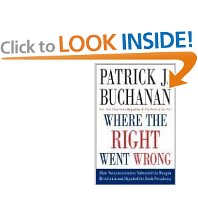
Review: Where the Right Went Wrong–How Neoconservatives Subverted the Reagan Revolution and Hijacked the Bush Presidency

5 Star, Philosophy, Politics

Amazon Page
Amazon Page

5.0 out of 5 stars Buchanan–and Nader–More Mainstream than Bush-Kerry!,

September 12, 2004
Patrick J. Buchanan
Edit of 20 Dec 07 to add links.

The most shocking aspect of this book, in a positive “eye-opening” sense, is that Pat Buchanan seems to be more in touch with what I as a moderate Republican believe, than anyone associated with the current Bush-Cheney Administration. Although he has some extremist views that I do not agree with, notably a desire to set back attempts to achieve racial equality, on balance his focus on avoiding elective wars, on eliminating the deficit, on reducing the size of government, on restoring state rights, and on putting the Supreme Court back in its place, all strike me as more “representative” than the views of the neo-conservatives, whom he attacks with eloquence and force.

There are some gems in the book that most people will enjoy because they are not being discussed. Chief among these is that the 2004 election is about the Supreme Court, and who gets to nominate as many as five new Justices. Fully enjoyable is the author's blistering critique of the Court, and the moral cowardice of the Congress in allowing the Court to take on powers of legislative review never envisioned by the founders. The author's quote of Lincoln is especially compelling on this point.

The author is also compelling in his discussion of the role that a common faith must play in keeping democracy alive. As the US foolishly strives to demand “secular democracy” in Iraq, something of an impossibility, the author is moving and thoughtful in showing that the decline of faith (and of the family) has harmed US democracy and its prospects.

Over-all the book is a litany of ills associated with an extremist Republican party run amok, funding Chinese weapons development at the same time that it exports jobs, funds the debt of loser nations while running up our own debt, etc. The author provides several lists of poor policy decisions that provide food for thought. Most troubling is the degree to which the USA is hostage to others for 72% of its medicines, 70% of its computer equipment, etc.

This is one of the few books I have encountered that covers both economic issues–the author is blistering on how “free” trade is not free, with fullsome detail on how we need *fair* trade–and national security issues. The author clearly understands that we are not winning the war on terrorism, only minor battles, and–in a phrase that especially moved me–that you cannot defeat a faith without a faith of your own. “To defeat a faith you need a faith.” I would refer the readers to Doug Johnston's Faith-Based Diplomacy: Trumping Realpolitik as well as Jonathan Schell's The Unconquerable World: Power, Nonviolence, and the Will of the People.

Over-all, this book caused me to reflect on the reality that the two so-called “mainstream” political parties are no longer representative of America. Pat Buchanan is right–the moderate Republican Party with conservative values that I thought I was a member of has been hijacked and corrupted. At the same time, the same can be said for the Democratic Party, whose traditional values are now more ably represented by Ralph Nader. In brief, Americans are in limbo, lacking collective associations that truly represent their needs and concerns, and America is in need of a realignment of its grass-roots political organizations.

Super book, essential reading for anyone concerned about why the 2004 election is not a choice at all, only a pretense.

Estranged moderate Republican that I am, I grow more and more respectful of Patrick Buchanan. He saw this all coming. Little did we know.

Other books that add weight to his message:
Vice: Dick Cheney and the Hijacking of the American Presidency
Running on Empty: How the Democratic and Republican Parties Are Bankrupting Our Future and What Americans Can Do About It
The Broken Branch: How Congress Is Failing America and How to Get It Back on Track (Institutions of American Democracy)
Breach of Trust: How Washington Turns Outsiders Into Insiders
Blood Money: Wasted Billions, Lost Lives, and Corporate Greed in Iraq
American Fascists: The Christian Right and the War On America
God's Politics: Why the Right Gets It Wrong and the Left Doesn't Get It (Plus)
Day of Reckoning: How Hubris, Ideology, and Greed Are Tearing America Apart

Vote on Review
Vote on Review

Review: Blood and Oil–The Dangers and Consequences of America’s Growing Dependency on Imported Petroleum

5 Star, Empire, Sorrows, Hubris, Blowback, True Cost & Toxicity, Water, Energy, Oil, Scarcity

Amazon Page
Amazon Page

5.0 out of 5 stars Absolutely Extraordinary: Cheap Oil Equals Lots of Bloodshed,

September 4, 2004
Michael T. Klare
Edit of 20 Dec 07 to add links.

I have heard this author speak to groups of international intelligence professionals, and they take him very seriously, as do I. In many ways, his books complements the one by Thomas Barnett, The Pentagon's New Map: War and Peace in the Twenty-first Century except that whereas Barnett says that the military must go to war to make unstable areas safe for America, Klare points out that a) we don't have enough guns or blood to stabilize a world that we antagonize every time we deploy into an “occupation” mode, and b) cheap oil is going to be very very expensive in terms of American blood on the floor.

Although I have reviewed many books about both the problems within America and its policies, as well as books optimistic about the future of America and the world, I give credit to Klare and this book for finally forcing me to realize that our federal budget and federal policies, in relation to protecting America, are “inside out and upside down.” There is, and Klare documents this beautifully in relation to petroleum, a very pathological cycle that could be easily stopped. We insist on cheap oil, this leads to bloodshed and high oil prices; this comes back to lower quality of life for the workers, etc.

As Klare points out, the pipelines (and I would add the pipe to ship portals) cannot be protected. American policy makers are deceiving the public when they suggest they can stabilize the Middle East and protect cheap oil. Not only can the pipelines not be protected, but on America's current consumption path, according to Klare, the Gulf States would have to DOUBLE production to keep up with American demand.

Klare is also intellectually powerful in painting a future picture when China, Russia, and Europe are in armed competition with the USA for energy from Central Asia, Latin America, under the Spratley Islands, etcetera. As I read Klare's book, I was just shaking my head. Our policies on energy are delusional and destructive, and Klare is among the few that is providing an objective report to the public on this reality.

Klare is actually kind to the current Administration (Bush-Cheney), pointing out that they are no more or less corrupt than previous administrations going back to World War II. Cheap oil has become a mantra, and military power has become the unquestioned means of achieving that–along with supporting 44 dictators, genocide, state-sponsored terrorism (as long as we like them and we get the Jewish vote to boot).

I especially liked Klare's observation that cheap oil for the US is a major contributor to unemployment and destabilization within Arabia. Buying oil from Saudi Arabia subsidizes terrorism. Buying cheap oil from Saudi Arabia increases the number of unemployed who might be inspired to become terrorism. Hmmmm… At what real cost shall we continue to demand cheap oil?

Klare is also very effective in objectively criticizing the manner in which the US Administrations have integrated anti-terrorism initiatives with energy-protection initiatives. Bin Laden is still at large, but by golly, we have 200,000 Americans sitting on top of the Iraqi oil fields.

Klare joins Jim Bamford Body of Secrets: Anatomy of the Ultra-Secret National Security Agency, Chalmers Johnson The Sorrows of Empire: Militarism, Secrecy, and the End of the Republic (The American Empire Project), Derek Leebaert The Fifty-Year Wound: How America's Cold War Victory Has Shaped Our World and a score of other authors who have in one way or another alluded to the fact that we are now doing to China what we did to Russia after the Cold War: needlessly confronting them, scaring them, and pushing them to arm themselves. Klare focuses on our “occupation” of Central Asia, an area of direct concern and interest to China, but I would add our sending seven carriers to the Formosa Straits recently and part of the problem–reminding me of how we sent squadrons of nuclear bombers deep into the Soviet Union from the north, immediately following World War II, just to see how far we could get. WE started the arms race!

The book ends as intelligently as it begins, with emphasis on getting to a post-petroleum economy. Listing all the ways we could get there would be another book in itself, but we could start with neighborhood level solar power, more wind power, deep conservation (which must also apply to water), a gradual elimination of chlorine-based and petroleum-based industries, a turn toward self-sustainment across the board, and what Klare cites as his big three steps:

1) divorce energy purchases from security commitments—stop tolerating dictators and arming terrorist nations for the sake of cheap oil

2) reduce our reliance on imported oil, dramatically

3) prepare the way for a transition to a post-petroleum economy that includes conservation, hybrid vehicles, public transportation, the two-way energy grid that WIRED featured on its cover the same week Cheney met secretly with Enron…and so on.

Fool's gold at high moral cost. Klare makes it clear that if we do not heal ourselves from inside out, that no amount of guns, blood, or destruction will save us from the inevitable implosion of the unstable places where oil is to be found.

Special books read since then that carry the argument forward:
Web of Deceit: The History of Western Complicity in Iraq, from Churchill to Kennedy to George W. Bush
Sleeping with the Devil: How Washington Sold Our Soul for Saudi Crude
Crossing the Rubicon: The Decline of the American Empire at the End of the Age of Oil
Twilight in the Desert: The Coming Saudi Oil Shock and the World Economy
The Long Emergency: Surviving the End of Oil, Climate Change, and Other Converging Catastrophes of the Twenty-First Century
9/11 Synthetic Terror: Made in USA, Fourth Edition


Vote on Review
Vote on Review

Review: America the Vulnerable–How Our Government Is Failing to Protect Us from Terrorism

5 Star, Congress (Failure, Reform), Executive (Partisan Failure, Reform), Threats (Emerging & Perennial)

Amazon Page
Amazon Page

5.0 out of 5 stars “The” Book on Domestic Security,

August 29, 2004
Stephen Flynn
Edited 20 Dec 07 to add links.

Some will say this book aids the enemy, pointing out with shocking clarity the extreme vulnerabilities of our transportation, communications, and other core systems. I happen to agree with the author's core point, as Thomas Jefferson would agree: politicians will continue to ignore these vulnerabilities and lie to the public until the public achieves its own appreciation of the threat.

This is a double-spaced book, an easy read from Tampa to Dulles (2.5 hours), and well-worth any thinking person's attention. For those who disparage this book as “gloom and doom”: go back to your vodka martinis.

THE fundamental point of this book, and one that I happily endorse on the basis of my other 493 reviews of national security non-fiction, is that how we spend the federal tax dollar is completely out of balance. We are spending $500 billion on a “hard power” military that can barely contain terrorism, crime, genocide, revolution, and war between states, while we are letting our states and cities go begging, and refuse to fund just 16,000 Customs inspectors, among other vital initiatives.

This is the single best book I have found that points out that in the era of asymmetric warfare, where non-state actors have both explosive and nuclear-biological-chemical power at their disposal, it is the “soft targets”, the non-military infrastructure targets, which will be most attractive to the “sleeper” agents of Al Qaeda and others. Washington continues to deceive America about its vulnerability, and about Washington's feckless irresponsibility in failing to redirect funds from hard power only relevant to fighting major states, to a combination of homeland defense of soft targets, which is this book's focus, and soft power projection such as Joe Nye recommends in his various books, but especially The Paradox of American Power: Why the World's Only Superpower Can't Go It Alone,

The author's first line is a block-buster: “If September 11, 2001 was a wake-up call, clearly America has fallen back asleep.” He is right. I deal with those responsible for the “Global War on Terror” and most of them are working 9-5, spending half their day gossiping or browsing the Web. [This is still true as of 20 Dec 07, besides which, terrorism is a tactic, you cannot make war on a tactic].

In my view, the author, a former Coast Guard commander and also a National Security Council staff member, is right on target when he says that the Pentagon is guilty of an “escapist” perspective in thinking they can defeat terrorism “over there.” It was this point that caused me to both buy this book in an airport, and to review it concurrently with General Tommy Franks' book American Soldier General Franks is both a superb officer, and a naive escapist, and reading this book drives that point home in a way that would make any intelligent person pleased to have spent time with the author.

There is a “seam” between our homeland security and our overseas capabilities, and there is no one in charge of any coherent program to decide how best to protect BOTH our neighborhoods AND our overseas investments.

This is a nuanced book, one that makes the point that security must become as embedded as safety has been, and the further point that security properly embedded is actually PROFITABLE! He's right. Green lanes for containers that have proper GPS and content authentications will SAVE dollars by saving time. Bio-chemical detection across all herds and food supplies will detect “natural” threats such as we have seen with SARS, monkey pox, bird flu, West Nile virus, etc.

Finally, security and openness can help reduce fraud, especially import/expert tax fraud, where containers loaded with priceless equipment are mis-labeled as low-cost machinery, or vice versa, an advanced form of money laundering that is costing the U.S. taxpayer over $50 billion a year in lost tax revenues.

Of the 1000+ books or so that I have reviewed here at Amazon, this book easily makes it into my top ten list of books relevant to getting national security right in the near term. Beyond five stars.

See also, with reviews:
Open Target: Where America Is Vulnerable to Attack
American Jihad: The Terrorists Living Among Us
Vice: Dick Cheney and the Hijacking of the American Presidency
American Fascists: The Christian Right and the War On America
THE SMART NATION ACT: Public Intelligence in the Public Interest

Vote on Review
Vote on Review
noble gold