Review: On the Meaning of Life

5 Star, Philosophy

Meaning of LifeWOW! A Jewel Pops Out of Amazon's Recommendation System, October 14, 2008

Will Durant

EDIT of 30 May 2009 to add flyleaf notes.

I was utterly THRILLED to see this book by Will Durant, published in 2005, pop up out of Amazon's recommendation system. Now I'm hooked.

The book opens with suicide statistics to point out the ultimate sacrifice or loss when hope is not to be found. One million in the world, 81,000 in the USA, 84.5 per day, 1 every 17.1 minutes. I have had 18 professional and one personal suicide in my life, What an important opening.

Finished, it surprises and delights with the common sense selections.

Key insights, remembering that this book is an edited collection of many people responding in one page to the QUESTION from Durant, who sent out 100 letters. First published in 1932, all the answers are grounded in the real world.

1) Uncertainty fosters greed.

2) Corruption of a society does not preclude the emergence of great minds that can catalyze further progress.

3) 1000 citivilizations have died in the course of history.

4) Citing Aristotle, all things have been discovered and forgotten manytimes over. Man–imperfect man–is the constant.

5) Utopia would be birth control, enfranchisement of all, emancipation of all–all of this is undone by crime, corruption, and war, none of which are necessary

Four quotes I feel should be here to encourage purchase of the book:

a) “We are driven to conclude that the greatest mistake in human history was the discovery of ‘truth.' It has not made us free, except from delusions that comforted us and restraints that preserved us.” Page 14

b) “Where such a faith [that gives hope], after supporting men for centuries, begins to weaken, like narrows down from a spiritual drama to a biological episode, it sacrifices the dignity conferred by a destiny endless in time, and shrinks to a strange interlude between a ridiculous birth and an annihilating death.” Page 17

c. “We discovered birth control, and now it sterlizes the intelligent, multiplies the ignorant, debases love with promuscuity, frustrates the educator, empowers the demagogue, and deteriorates the race.” Page 29

d. “The greatest questions of our time is not communism vs. the West, it is whether men can bear to live without God.” Page 34

All of the above are Durant's words. Then the book goes forward with two pages for each of those responding, one a graphic etching, the other their text.

The Lessons of History
The Landscape of History: How Historians Map the Past
Integral Consciousness and the Future of Evolution
How to Change the World: Social Entrepreneurs and the Power of New Ideas, Updated Edition
The leadership of civilization building: Administrative and civilization theory, symbolic dialogue, and citizen skills for the 21st century
Consilience: The Unity of Knowledge
The Future of Life
DVD: What the Bleep Do We Know!?

Review: Kill Bin Laden–A Delta Force Commander’s Account of the Hunt for the World’s Most Wanted Man

4 Star, Insurgency & Revolution, Terrorism & Jihad, War & Face of Battle
Amazon Page

Dalton Fury

Over-Hyped by Marketing, Excellent for Students of SOF, October 15, 2008

This book has been very heavily over-sold by the publisher and will disappoint those who are expecting something other than a professional account of a professional mission with all its warts.

This is a very fine first person account with ample detail that I for one found very rewarding and worthy of both my time and money (the book is very reasonably priced). The reader will benefit from first reading the reviews of the books I list at the end–one would never know from this account that Rumsfeld gave the Pakistani's an air corridor to evacuate 3000 Taliban overnight from Tora Bora, that the Navy was certain they killed Bin Laden, or that General Franks refused to put a battalion of Rangers on the back door (the author does tell us of his understanding that President Bush personally ruled that the back door belonged to the “trusted” Pakistanis).

The author tries hard to be nice to intelligence, but his true bottom line is captured in his description of what they had for him:

1) It's winter in Afghanistan
2) Bin Laden can ride a horse

We all know they had more than that–even with a US Senator blowing the fact that we were listening to Bin Laden's cell phones and satellite phones–but the reality is that CIA could meet with the warlords but did not have actual people within the tribes and on the ground as the Pakistani ISI did.

The author also makes clear that it was just as hard to figure out the friendly situation as it was the enemy situation. From where I sit, “total battlefield awareness” is a pipe dream–a fraud–and it's time we started refocusing on humans that can live up to the Gunny Poole “Tiger's Way.”

Here I my notes, ending with my conclusions and ten books I recommend in partnership with this one.

Early on the role of snipers, and the possible uses of snipers if we could get bureaucrats and politicians out of the way, impress me.

Small teams with a forward air controller that can go deep and stay for days impress me, very much. Unfortunately, we don't field them often enough (I only have read of use in Colombia, not generally, but SOF operates in over 150 countries so who knows).

Author reinforces the concept of Irregular Warfare as bottom-up thinking in which every person has a say, but takes pains to distinguish this from leadership, with the self-effacing comment that the leaders will decide after the enlisted personnel tell the leaders what they need to know.

Early on he laments to misplacing of the Special Operations “truths,” the first one being “Humans are more important than hardware.” Today privates are being selected for special operations right out of boot camp, and between private military contractors being allowed to loot the public treasury of both money and skilled manpower, and the complete dismissal of all standards, one can sense the author's thoughts between the lines: DELTA is the last vestige of “true” special forces (although I would include SEALs and some special air).

Air Force air strikes were not great–1 out of 3 hit the target, and the so-called super bomb, the BLU-82, did not explode as advertised.

Bin Laden's “order of battle” was surmised to be an inner circle of Saudis, Yemenis, and Egyptians, with an outer circle of Afghans, Algerians, Jordanians, Chechnyans, and Pakistanis.

Taliban liked to wear black on black…I could not help being reminded of the Viet-Cong.

Terrain blocked our radios. General Clark and others have made it clear that we are not trained, EQUIPPED, or organized for mountain operations, and between this point, and the personal knowledge I have of how few special Chinooks we have that can operate above 12,000 feet–and only because their CWO pilots have learned to fart into the fuel–it's clear the US is not serious about mountain or jungle warfare, and marginally competent as urban warfare.

After seven days they were out of batteries and water.

There was a “surrender” gambit when they got close, the primary purpose being to keep an Afghan warlord between Bin Laden and the Americans.

We still have total disconnect between ground troop use of grids on a map, and Air Force demand for latitude and longitude. The $150 GPS conversion is great, Navy and Air Force still not joint.

Lovely account of how they did a field hire of a seeming gift from heaven, a second translator who spoke English, only to learn later he also spoke Arabic and had been sent as a penetration. Sidebar on Pakistani penetration of the Afghan group they were with.

No mules. Very very tough to resupply in the mountains in winter. Even without loads, four kilometers on one occasion took five hours.

Bin Laden evidently wrote his will on the 14th of December, coincident with his rather desperate sounding call over the radio to all to arm their women and children.

We dropped 1100 “precision” bombs and $550 “dumb” bombs on Tora Bora, plus tens of thousands of rounds of other artillery and ammunition. I am so reminded of Viet-Nam, where what we paid for artillery shells being fired could have bought every Vietnamese a two-story cinderblock house with electricity and running water.

Author concludes that the CIA model of buying warlords DOES NOT WORK for specific objectives.

I learn for the first time that a visit was made to Tora Bora after the fact, a forensic visit. [He know from Bin Laden's later emergence that he did get out.]

The author is scathingly critical of the Army Center for Army Lessons Learned, which has exactly one hit on Tora Bora against thousands of documents visible via the web.

What I learned from this:

DELTA is over-trained and under-utilized.
Conventional Army leaders have no idea how to use special forces in advance of operations or deep behind enemy lines–they simply do not have the mind-set.
CIA paramilitary and some clandestine needs to be transferred into a new Active Measures Command that is the dark and dirty side of Irregular Warfare.

Fine book! See also:
First In: An Insider's Account of How the CIA Spearheaded the War on Terror in Afghanistan
Jawbreaker: The Attack on Bin Laden and Al-Qaeda: A Personal Account by the CIA's Key Field Commander
Delta Force: The Army's Elite Counterterrorist Unit
About Face: Odyssey of an American Warrior
Tactics of the Crescent Moon: Militant Muslim Combat Methods
None So Blind: A Personal Account of the Intelligence Failure in Vietnam
Who the Hell Are We Fighting?: The Story of Sam Adams and the Vietnam Intelligence Wars
The Tunnels of Cu Chi
Legacy of Ashes: The History of the CIA
War Without Windows: A True Accout of a a Young Army Officer Trapped in an Intelligence Cover-Up in Vietnam.

See Also the Comments

Robert David Steele
ON INTELLIGENCE: Spies and Secrecy in an Open World

Vote and/or Comment on Review

Review: Modern irregular warfare–In defense policy and as a military phenomenon

5 Star, Insurgency & Revolution

Beautiful Piece of Work, October 15, 2008

Friedrich August Heydte

I ended up buying this book without much to go on *other than* the not inconsequential fact that at least one War College student relied very heavily on it for their paper on irregular warfare. The book is dedicated to Maxwell Taylor and Jacques Massu, and has a foreword from Lyndon LaRouche that slams Zbigniew Brzezinski as an appeaser and compromiser with respect to Middle Eastern terrorism, so right away my appetite is whetted.

The publisher or seller should have done this, but to encourage others to add this book to their reflections, here are the *top-level* divisions in the table of contents:

I Foundations
1. The Essence of Irregular Warfare
2. Irregular Warfare and Revolution
3. Irregular Warfare and International Law

II Irregular Warfare and Grand Strategy
1. General Strategic-Political Problems
2. Nuclear War and Irregular War as Alternatives in the Unconventional Conduct of War
3. The Threat of Nuclear and Irregular War in the Process of War Prevention

III War of Blurred Contours
1. The Problem of Space
2. The Problem of Time
3. Movement, Terrain, and Population

IV Preparation of Irregular Warfare
1. The Conspiracy
2. Subversion
3. Armament

V Covert Combat
1. The Nature of Covert Combat
2. Leadership Problems
3. Terrorism and Sabotage in Covert Combatg
4. Assassinations and Raids in Covert Combat

VI Transition to Open Combat
1. Covert Combat and Open Combat
2. Unsolved Problems of the Transition to Open Combat

This book was published in 1986. The bibliography is very deep. There is no index.

I suspect it will be reprinted now that the adults are paying attention to Irregular Warfare. My impression continues to be confirmed that we need a completely new craft of intelligence for irregular warfare, and that we need to more clearly understand the spectrum of irregular warfare from black assassinations to white peace operations “one cell call at a time.”

Other books I recommend with this one:
Asymmetric Warfare: Threat and Response in the 21st Century
Counterinsurgency and the Global War on Terror: Military Culture and Irregular War (Stanford Security Studies)
Guerrilla Warfare: Irregular Warfare in the Twentieth Century (Stackpole Military History Series)
The U.S. Army/Marine Corps Counterinsurgency Field Manual
Never Surrender: A Soldier's Journey to the Crossroads of Faith and Freedom
Seven Pillars of Wisdom: A Triumph
Uncomfortable Wars Revisited

Review: The U.S. Army/Marine Corps Counterinsurgency Field Manual

5 Star, Insurgency & Revolution

COINBest in Class MILITARY Manual–Need Civilian Peace SOP, October 15, 2008

Sarah Sewall et al

The publisher should load the table of contents and nominate this important book for “Inside the Book” digitization.

Since the publisher has failed to do that, for now (pending my substantive summative review) I will just list the top level table of contents.

Chapter 1. Insurgency & Counterinsurgency
Chapter 2. Unity of Effort: Integrating Civilian and Military Activities
[This is fine for a military cursory glance, but what we really need are two other volumes: a civilian counterpart to this military manual; and a strategic planning mannual that includes both resources we control and resources we can influence with unclassified multinational decision support]
Chapter 3. Intelligence in Counterinsurgency
[This chapter is deep and broad–someone tried very hard to get it right and at first glance, it appears vastly superior to the tripe that has been published before.]
Chapter 4. Designing Counterinsurgency Campaigns and Operations
[This is new thinking and demands careful reading]
Chapter 5. Executing Counterinsurgency Operations
Chapter 6. Developing Host-Nation Security Forces
[This will need development, perhaps in the strategic manual. Apart from the obvious that the professionals knew but the political lightweights refused: go in strong enough to keep the peace, do not disband the armed forces and police, pay them first, it seems to me we need to do much much more with Ambassador Bob Oakley's original thinking on Policing the New World Disorder, and invest heavily in REGIONAL stability forces and REGIONAL gendarme reserve forces.]
Chapter 7. Leadership and Ethics for Counterinsurgency
[Important, but I continue to be shocked at the way we vacuum people into confinement, and by the reality that stupid kids with camaras not-withstanding, we cannot overcome an unethical White House or Secretary of Defense in the field–this section could use discussion of what constitutes an illegal order and what each level of operations can do to refuse an illegal order.]
Chapter 8. Sustainment
[Good start but already out of date. Army is doing some extraordinary things in “eating the tail” by implementing renewable power solutions at the outposts so that ground-based heavy logistics are dramatically reduced. Very positive focus on logistics preparation of the battlefield but misses the larger issue: secret intelligence could care less about logisticians, who have a legitimate need for bridge weights, tunnel clearance, ferry times, pierside outlet specifications, cross-country trafficability, line of sight distances along the supply line, and so on. The fact is that intelligence support to both acquisition and to logistics STINKS, and this needs draconian scorched earth management.]
Appendix A. A Guide for Action
Appendix B. Social Network Analysis and Other Analytical Tools
Appendix C. Linguist Support
Appendix D. Legal Considerations
Appendic E. Airpower in Counterinsurgency

I like this book, very much. It's is a really good first step, but it is only a UNILATERAL MILITARY first step.

The U.S. Government is still not serious–in the White House or in Congress–about deep sustained interagency and coalition operations.

They have no idea how to create a Global Range of Gifts Table down to the household level, how to call in Peace from the Sea and Peace from Above, how to use decision support to influence $500 billion a year in investments by others, how to encourage call centers in China and India (each of which have 1.5 billion for a total of 3 billion of the 5 billion poor) that can both provide instant translation support to operators and free education to the poor, in their own language, “one cell call at a time.”

Bottom line: General Al Gray nailed it in 1989, in his article “Global Intelligence Challenges in the 1990's.” Key words: “peaceful preventive measures, non-state actors, and open source intelligence.” No one wanted to listen then, and most are still conceptually-challenged now.

See also:
Policing the New World Disorder: Peace Operations and Public Security
Deliver Us from Evil: Peacekeepers, Warlords and a World of Endless Conflict
The Search for Security: A U.S. Grand Strategy for the Twenty-First Century
Uncomfortable Wars Revisited
Modern irregular warfare: In defense policy and as a military phenomenon
Guerrilla Warfare: Irregular Warfare in the Twentieth Century (Stackpole Military History Series)
Counterinsurgency and the Global War on Terror: Military Culture and Irregular War (Stanford Security Studies)
Asymmetric Warfare: Threat and Response in the 21st Century
Peacekeeping Intelligence: Emerging Concepts for the Future
The Unconquerable World: Power, Nonviolence, and the Will of the People

Review: Poets For Palestine

5 Star, Atrocities & Genocide, Culture, DVD - Light, Empire, Sorrows, Hubris, Blowback, Values, Ethics, Sustainable Evolution, War & Face of Battle

Poets PalestineRemarkable Gift, Bargain Price, Provokes Reflection, October 30, 2008

Remi Kanazi (Editor)

This is one of those rare books that I agreed to read and review after hearing from the publisher. At first I said no, then I realized Palestine was very much within my range of interests even if poetry was not, and I am glad to have said yes.

The book brings together 37 poets offering 48 poems interwoven with 30 artist renditions each on their own page. The book is made possible in part by a New York based organization, Al Jisser or “the bridge.”

The introduction connects the Palestinians to the much broader concerns of indigenous peoples everywhere, social justice being the shared issue.

Turns of phrase that stayed with me:

– hybrid ideology

– our city is a cell

– memory holding history too harsh to taste

– feel the future dissolve in a moment

– clean water

Five of the poems that resontated with me in a more special way (all are worthy of reading):

– Fathers in Exile

– Moot

– The Coffin Maker Speaks

– Those Policemen are Sleeping: A Call to the Children of Israel and Palestine

– This Is Not a Massacre

As I was preparing to write the review, I noticed the other books that Amazon brings up, using reader choice to connect to other readings of interest, and it hit me: this books is a perfect beginning for anyone who wishes to explore the literature on Palestine's history, current condition, and dubious (or inevitably triumphant) future.

In my notes I wrote “cornerstone for the resurgence of Paletinian identity and self-determination. I am certainly among those who stands with Gandhi, who said “Palestine belongs to the Palestinians the way France belongs to the French.”

I was struck by the book's extension to include Iraq, Afghanistan, Sudan, and Lebanon, the latter a country I have come to care about after a teaching mission there in 2007. In that light, below are some links to books I recommend along with this one:

Other non-fiction books I recommend:
Web of Deceit: The History of Western Complicity in Iraq, from Churchill to Kennedy to George W. Bush
The Looming Tower: Al Qaeda and the Road to 9/11 (Vintage)
Leap of Faith: Memoirs of an Unexpected Life
Global Brain: The Evolution of Mass Mind from the Big Bang to the 21st Century
Robert Maxwell, Israel's Superspy: The Life and Murder of a Media Mogul
They Dare to Speak Out: People and Institutions Confront Israel's Lobby
The Unconquerable World: Power, Nonviolence, and the Will of the People
The Tao of Democracy: Using Co-Intelligence to Create a World That Works for All
Society's Breakthrough!: Releasing Essential Wisdom and Virtue in All the People
Collective Intelligence: Creating a Prosperous World at Peace

You can buy this book with confidence that it will satisfy and provoke. Still, as a service to the publisher, who did not use the Amazon “look inside this book” features, here are the titles of all the poems; I type them as a gesture of respect for all that they represent:

Who Am I, Without Exile?
Enemy of Civilization
Portrait of Mona Lisa in Palestine
The Camp Prostitute
Fathers in Exile
Palestinian Identity
Ar-Rahman Road
And So It Goes…
Curfew
Installation/Occupation
The Seven Honeysuckle-sprigs of Wisdom (extract)
Untitled
a moonlit visit
Black Horses
Moot
The Promised Land
Hate
Wall Against Our Breath
Lights Across the Dead Sea
The Coffin Maker Speaks
Morning After the US Invasion of Iraq
The Price of Tomatoes
Regret
Calm
Palestine in Athens
Saudi Israelia
Hamza Aweiwi, a Shoemaker in Hebron
Humming When We Find Her
Wire Layers
Making Arabic Coffee
My Father and the Figtree
The Tea and Sage Poem
Letter to My Sister
In Memoriam: Edward Said 1935-2003
At the Dome of the Rock
Those Policemen Are Sleeping: A Call to the Children of Israel and Palestine
This is Not a Massacre
23 isolation (Infirad)
Free the P
Another Day Will Come
Morning News
break (bas)
Baby Carriages
Kindness
An Idea of Return
changing names
Abu Jamal's Olive Trees
A Tree in Ratah

One last observation: here in the United States of America, the Republic has been destroyed–the people are no longer sovereign. Instead, two criminal parties conduct electoral fraud as theater to they can retain their monopoly of political power which they prostitute to Wall Street and the inbred very small financial class that considers both the American people and the Palestinian people to be virtual slaves of no consequence. At some point soon, the American system will “break” and new possibilities will emerge–it remains lunacy as well as criminal for the USA to spend $1.3 trillion a year on war when a third of that amount could assure a prosperous world at peace, including an international Holy City, a Palestine with access to the sea, and an Israel that is not stealing all the water from the Arab aquifers but instead trading high technology for food grown by Arabs.

Poetry–and indigenous peoples reasserting the sovereignty of people over organizations–may yet save us all.

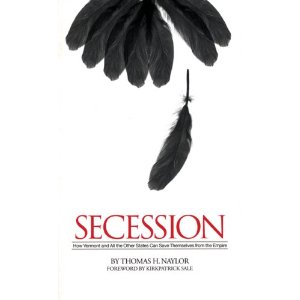
Review: Secession–How Vermont and All the Other States Can Save Themselves from the Empire

5 Star, Secession & Nullification
Amazon Page

Elegant plain speaking, superb overview, November 4, 2008

Thomas H. Naylor

This book is a follow-on to The Vermont Manifesto, which I absorbed and reviewed in 2006 when I first realized that there existed a vibrant nation-wide network of secessionist movements, with Vermont being among the most ably represented.

I strongly recommend this book for every citizen. Regardless of who “wins” this mock election, we all lose–the two-party bi-opoly is a crime family, and absent electoral reform the Republic is dead. As the author of this book puts it, “our” government is corrupt to the core.” I will be speaking briefly to the annual reunion of the two dozen secessionist movements in New Hampshire on 15 November 2008, and I will be encouraging every one of the movement to announce an intent to exercise its right to withdraw from a corrupt Union *unless* the pseudo-President agrees to implement four core reforms (they are outlined, along with the legitimate grievances of the varied secessionist movements, in Election 2008: Lipstick on the Pig (Substance of Governance; Legitimate Grievances; Candidates on the Issues; Balanced Budget 101; Call to Arms: Fund We Not Them; Annotated Bibliography).

This book opens with a tremendous introduction by Kirkpatrick Sale, author of Human Scale and dean of the Middlebury Institute that furthers the secessionist movement.

The book then offers a summary of the earlier work, eight points in the manifesto:
1) increasingly difficult to protect ourselves from big everything
2) government is too everything, including intrusive and unresponsive
3) US government has lost its moral authority both at home and abroad
4) we have a single (criminal) political party [I for one weep at the charade that the Democrats have put on with 700 million in largely illegal contributions made possible by Obama not being able to honor his word to the public)
5) The “American way” is a way of greed, exploitation, and waste
6) America's foreign policy is immoral and illegal as well as unconstitutional
7) To be a part of the Empire is to invite terrorist attack
8) The existing “nation” is ungovernable, unfixable, and unsustainable.

Beginning on page 43 the author addresses each of the options he can think of (the author is a professor emeritus from Duke):

1) denial
2) compliance
3) political reform
4) implosion
5) rebellion
6) dissolution

I am charmed by the author's overview of many of the emerging trends, mostly negative, that I have found in so many non-fiction books over these past few years. He outlines examples of domestic imperialism, calls into question the 9/11 “official story”, and lambastes both corporations and the federal government for fraudulent book-keeping.

On page 76 he lists the eight principles that are explained at length in the earlier work:

1) Political Independence
2) Human Scale
3) Sustainability
4) Economic Solidarity (some would call this “buy local”)
5) Power Sharing
6) Equal Opportunity
7) Tension Reduction
8) Mutuality

This program is achieved in four steps that are discussed in detail by the author:

1) Denunciation (I have certainly tried to do that with my own reviews)
2) Disengagement
3) Demystification (i.e. secession is NOT sedition, it cannot be)
4) Defiance

The middle of the book is a description of Vermont in compellingly attractive terms, and two points stay with me: they outlawed billboards; and Vermont is one of two states whose banks did not fail in the Great Depression, and one of three states whose banks did not fail in the 1980's.

The author observes that the Inter-State Commerce Act is used to force Wal-Mart into Vermont, and sadly notes the reality that too many Vermonters do not understand that cheap prices from Wal-Mart are achieved by destroyed local jobs and the rest of the earth (see among many works, Wal-Mart: The High Cost of Low Price.

The author provides a very helpful overview of Constitutional History of Secession which is the thickest book in my secession reading pile, and the last I will get to. Bottom line: every state has a right to secede from the Union, and it is the Constitution, not the Union, that we are all sworn to uphold.

The author provides a fine overview of how Eastern Europe led the way in modern secession, with favorable references to Vaclav Havel and his book, Power of the Powerless: A Brother's Legacy of Love (Crossroad Book).

The book moves to a conclusion in observing that Alaska, Hawaii, Texas, and California (the latter with three secessionist movements calling for three separate republics to be made out of the state, the eighth largest economy on the planet per the author), are all ripe for activism. The author does not make this point so I will: the best time for any group to secede is when the larger group is bogged down in a foreign war that is bankrupting the whole.

He ends by citing Switzerland, with 7.3 million people total, as an excellent model for the Second Vermont Republic by itself, but his own hope is for a New Arcadia consisting of the eastern part of Canada with New Hampshire, and Main joining Vermont. This presumes Quebec's eventual success (and one can also anticipate Alaska moving on the Empty Quarter while British Columbia links up with Washington and Oregon and the sane part of California (the northern part). See The Nine Nations of North America, still the best overview around.

I cannot say enough good things about this book, I consider it a core reading for any adult with brain who cares about the Constitution, the Republic as it was conceived by the Founding Fathers, and the cause of life, liberty, and the pursuit of happiness which our federal government is supposed to be about, but is not.

Three others books within my ten link allowance:
The Tao of Democracy: Using Co-Intelligence to Create a World That Works for All
A Power Governments Cannot Suppress
Collective Intelligence: Creating a Prosperous World at Peace

I do not favor secession IF (big IF) we can force the matter of the four reforms on the pseudo-President at the Citizens Summit that will take place in Denver in February 2009.

Vote and/or Comment on Review

Review: Is Secession Treason?

5 Star, Secession & Nullification

secession treason1866 treatise, exquisitely relevant and valuable today, November 4, 2008

Albert Bledsoe

This book, self-published in 1866 (Eighteen Sixty Six) is a treasure. The author did such a good job that his work was used in defending Jefferson Davis against charges of treason. I am impressed on every page with the diligence that went into looking at the original papers, the early drafts of the Constitution, the records of the debates, and the personal correspondence of the Founding Fathers thereafter.

The book centers on three questions:

1) Was the Constitution a compact–a voluntary agreement?
2) Were the STATES the parties to the compact?
3) If so, did the STATES reserve the right to withdraw from the compact?

I have been enthralled with this book tonight, especially as I compare it to the mockery of what passes for democracy in this country–grand theater that will give us a pseudo-President, the lite side of the bi-opoly crime family, and no attention at all to the substance of governance (for amplification, including everything the two candidates did NOT address in this pathetic campaign of dissemblance, see Election 2008: Lipstick on the Pig (Substance of Governance; Legitimate Grievances; Candidates on the Issues; Balanced Budget 101; Call to Arms: Fund We Not Them; Annotated Bibliography) which is also free online (as are all my books).

Chapter 1 explains why this question mattered in 1866: if it was treason, Lee and Jackson and Davis and others were traitors. If not treason, then heroes.

The heart of the book is eight chapters, each of which examines a different means of demonstrating that the Constitution was a compact among the sovereign states, and that they all therefore have retained the right of secession.

Throughout the book the author is severely dismissive of Daniel Webster, who has been lionized, as has Abe Lincoln, for defending the Union, but as the author demonstrates, Webster was all too willing to fabricate the facts to suit his argument (others have made this point about Lincoln).

Key points for me early on, as made by the author:

1) 1833 was the first time anyone sought to advance a doctrine of an indivisible union.

2) In the drafting of the Constitution, those assembled explicitly rejected “national government” and went instead with “a government of the United States,” i.e. the federal government is an administrative entity created by the states to serve a common purpose, NOT a “national” authority with sovereign status over the states or for that matter the people.

The author spends time on the confusion caused by the first words of the Constitution, “We the People,” and rolls out a dazzling array of quotes from early drafts and correspondence that conclusively say:

1) At first all of the States were listed by name.

2) Only after all the provisions had been agreed to was the full document (still having all the states listed in the first sentence) referred to “a committee on style” (quotes in the original).

3) It was the Committee on Style that dropped the list of states and substituted We the People

4) All those engaged in this endeavor did not protest because they all knew the intent of the words was stylistic rather than a conveyance of sovereign authority.

Other interesting discussions:

1) Massachusetts objected to the Louisiana purchase, resolving in its legislature that such a purchase far exceeded the authority granted to the federal (not national) government, and that the purchase if carried out would by its very nature abolish the original union of the thirteen colonies.

2) Thomas Jefferson is quoted from one of his resolutions, “Resolved, where powers are assumed which have not been delegated, a nullification of the act is the rightful remedy.”

3) Commerce regulation for mutual benefit was the original intent, which has morphed into a monster intruding into every aspect of state and local life.

Chapter 15 focuses on how each of the colonies was a realm unto itself, with very specific territories, identities, and interests.

Chapter 16 summarizes seven arguments in favor of secession as a right:
1) Doctrine of Reserved Rights
2) Sovereignty of the States
3) Silence of the Constitution
4) Fundamental Principle of the Union
5) Right of Self-Government
6) Opinion of Well-Informed and Intelligence Foreign Observers (here De Tocqueville is the most prominent, but there are others)
7) Virginia Ordinance of Ratification

The author in Chapter 17 provides a good faith summary of the arguments against secession, but in fairness to his disposition other books would have to be consulted.

The book concludes with observations on the causes of secession of the South, which the author is certain was legitimate:
1) Destruction of the balance of power between South and North
2) Section legislation that exchanged poverty of North for wealth of South
3) Formation of “the party of the North” pledged against the South
4) “utter subversion and contemptuous disregard for all the checks of the Constitution” (I cannot help but think of Dick Cheney and the treasonous betrayal of the public trust by both “parties”)
5) Unjust treatment of the slavery question which was explicitly excluded from the Constitution
6) “Sophistry and hypocrisy of the North”
7) “Horrible abuse and slander” of the South by the North (loss of face)
8) “Contemptuous denial of the right of secession

The last quote on the last page (202) cites one Mr. Grayson (first name not in text or index), “Republics, in fact, oppress more than monarchies.”

For now, with several more books on secession pending this week as I prepare for the New Hampshire meeting on 15 November, I simply have to say that I buy in to what this author sought to communicate. We live in a United States of America, not a United Peoples of America (that would have required respect for both slaves and Native Americans).

Other books on secession:
Secession: How Vermont and All the Other States Can Save Themselves from the Empire
One Nation, Indivisible? A Study of Secession and the Constitution
Constitutional History of Secession

As a free concise primer, look online for the Stanford Encyclopedia of Philosophy entry on Secession written by Allen Buchanan.

Three books on the idiocy and criminality that have prevailed:
The Bush Tragedy
Vice: Dick Cheney and the Hijacking of the American Presidency
Breach of Trust: How Washington Turns Outsiders Into Insiders

Three books of hope:
The Tao of Democracy: Using Co-Intelligence to Create a World That Works for All
Society's Breakthrough!: Releasing Essential Wisdom and Virtue in All the People
Collective Intelligence: Creating a Prosperous World at Peace

I do not wish to dissolve the Union. I do wish to dissolve the illegal aspects of the government we have now, including Congressional gerrymandering, vote fixing, electoral fraud, bribery on demand, and a dismissal of the policy process in favor of ideological lunacy.

Whoever wins this election will be impotent UNLESS they connect directly to the people and choose with great deliberation to break the backs of the two criminal parties while asserting the public interest and demanding the four reforms (electoral, governance, intelligence, and national security).

noble gold