Patrick Meier: China Case Study in Disaster Response from Government versus Crowd-Sourced

Crowd-Sourcing, Geospatial
0Shares
Patrick Meier
Patrick Meier

How Crowdsourced Disaster Response in China Threatens the Government
In 2010, Russian volunteers used social media and a live crisis map to crowdsource their own disaster relief efforts as massive forest fires ravaged the country. These efforts were seen by many as both more effective and visible than the government’s response. In 2011, Egyptian volunteers used social media to crowdsource their own humanitarian convoy to provide relief to Libyans affected by the fighting. In 2012, Iranians used social media to crowdsource and coordinate grassroots disaster relief operations following a series of earthquakes in the north of the country. Just weeks earlier, volunteers in Beijing crowd-sourced a crisis map of the massive flooding in the city. That map was immediately available and far more useful than the government’s crisis map. In early 2013, a magnitude 7  earthquake struck Southwest China, killing close to 200 and injuring more than 13,000. The response, which was also crowdsourced by volunteers using social media and mobile phones, actually posed a threat to the Chinese Government.

. . . . . . .

Aided by social media and mobile phones, grassroots disaster response efforts present a new and more poignant “Dictator’s Dilemma” for repressive regimes. The original Dictator’s Dilemma refers to an authoritarian government’s competing interest in using information communication technology by expanding access to said technology while seeking to control the democratizing influences of this technology. In contrast, the “Dictator’s Disaster Lemma” refers to a repressive regime confronted with effectively networked humanitarian response at the grassroots level, which improves collective action and activism in political contexts as well. But said regime cannot prevent people from helping each other during natural disasters as this could backfire against the regime.


Read full post.

Howard Rheingold: 19 June – 26 July Think-Know Tools Webinar

Culture, Knowledge
0Shares
Howard Rheingold
Howard Rheingold

I'm offering Think-Know Tools again June 19 -July 26. All the details about what we'll co-learn, the schedule, missions, how we go about participative and collaborative learning, can be found at http://socialmediaclassroom.com/host/think2/  Price is $300 via PayPal. $250 if you've taken a Rheingold U course before ($200 if you've taken two courses, etc.). $500 if your company reimburses.

It's all about the theory and practice of personal knowledge management. We'll look at the theory and conceptual frameworks around intellect augmentation and the extended mind. We'll also actively practice social bookmarking as a collective intelligence activity, concept mapping, and building knowledge-plexes with Personal Brain (you can see the web-brain version of the syllabus at http://webbrain.com/brainpage/brain/EB72D74A-199F-8994-4938-88ACDA8049EF )

Feel free to contact me about questions. Participation is limited to 30 co-learners, so let me know soon if you want me to reserve a place for you.

Please feel free to forward to anyone who might be interested.

Regards,

Howard Rheingold
http://www.rheingold.com
what it is —> is —>up to us

SmartPlanet: India Pioneering Web Search Via Text Message —

Advanced Cyber/IO
0Shares

smartplanet logoIndia has 900 million mobile users, but only 8 percent of those enjoy mobile Internet access. Thanks to four college drop-outs, the other 92 percent can now search the Web, too–by text. Read on.

In India, browse the web through texts

By | May 20, 2013

DELHI — In 2009, four students dropped out of an engineering college in a small town in southern India to pursue their dream. They wanted to channel the vast sea of knowledge floating on the Internet through text messages to millions of people who don’t have access to the web.

Now their creation, called SMS Gyan (gyan means knowledge), a search engine available on mobile phones, has 120 million users in India, the Middle East and Africa submitting over five million queries every day. And their company Innoz Technologies has expanded to 45 employees, and it earned $2.5 million worth of revenue last year.

The company’s founders say that Innoz is set to become the world’s largest offline search engine in 2015, with projections of 10 million monthly unique users and more than 55 million searches per day.

. . . . . . . .

Air Tel made the service available to its users in India (it has total of 230 million in 19 countries) who can text questions to 55444 for one rupee, or two cents.

Mohammed Hisamuddin, 26, another co-founder, said that Innoz had designed a special algorithm that crawls their Internet partner sites like Wikipedia and Zomato for information, and then optimizes the most relevant bits into a text-response of 480-characters to make it user friendly.

Read full article.

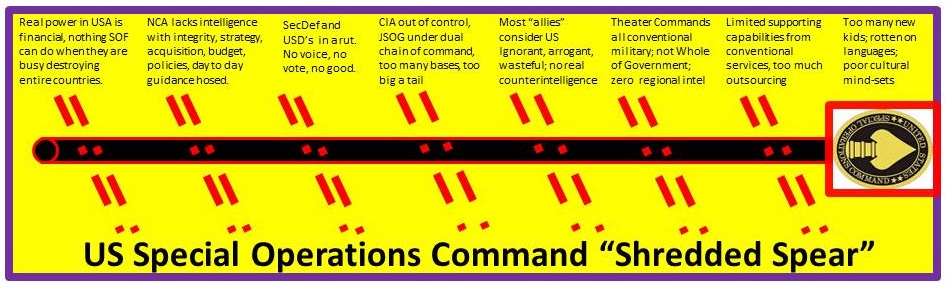
Berto Jongman: US Special Operations Command Goal — Prevent Wars, Bottom Up Community Based Resilience — Never Mind Strategic-Level Blunders, Ideology, & Predatory Policies, Drones, Dictators…1.1

Ethics, Military
0Shares
Berto Jongman
Berto Jongman

Socom's goal: Pre-empt wars

Tampa is headquarters for the commandos who are gaining a bigger role in military operations around the globe. Military writer Howard Altman travels with them this month in Afghanistan.

By Howard Altman | Tribune Staff

Tampa Tribune,  May 19, 2013

They make small footprints at the edges of the Earth.

Click on Image to Enlarge

Sometimes they hunt and kill. Sometimes they teach rural tribes how to govern and farm.

But after more than 12 years of war, special operations forces are frayed — and in more demand than ever. With the military facing big spending cuts and a new emphasis on places around the globe, U.S. Special Operations Command, headquartered at MacDill Air Force Base, is working to adapt to new realities.

Where will they make footprints next?

“There has been a shift in strategy away from war to defensive tactics,” said Stuart Bradin, an Army colonel helping bring a new global special operations network to life.

Click on Image to Enlarge

“The primary pieces are a pivot to Asia while keeping a very strong eye and focus on the Middle East, as well. We are going to go out in small footprints and work with key partners to ensure that small regional issues don't become major theater operations. We can't afford that in blood or treasure.”

The new network has a name, “Global SOF Network,” and a theme, “you can't surge trust,” and it's the vision of Socom commander Adm. William McRaven.

Full story and PBI comment below the line.

Continue reading “Berto Jongman: US Special Operations Command Goal — Prevent Wars, Bottom Up Community Based Resilience — Never Mind Strategic-Level Blunders, Ideology, & Predatory Policies, Drones, Dictators…1.1”

Jean Lievens: Why the Sharing Economy is Growing

Uncategorized
0Shares
Jean Lievens
Jean Lievens

Why The Sharing Economy Is Growing

People get into it for the money, but they stay with it for love.

Most people who share, do it because they want to make the world a better place, according to a new national survey commissioned by AirBnb.

The sharing economy has an estimated $26 billion value, including online platforms that make it easy to do everything from renting out spare rooms in your home (AirBnb) to carsharing (Zipcar), clothing swaps (ThredUP), even sharing extra portions from homecooked meals ( Shareyourmeal, of course).

Read full article