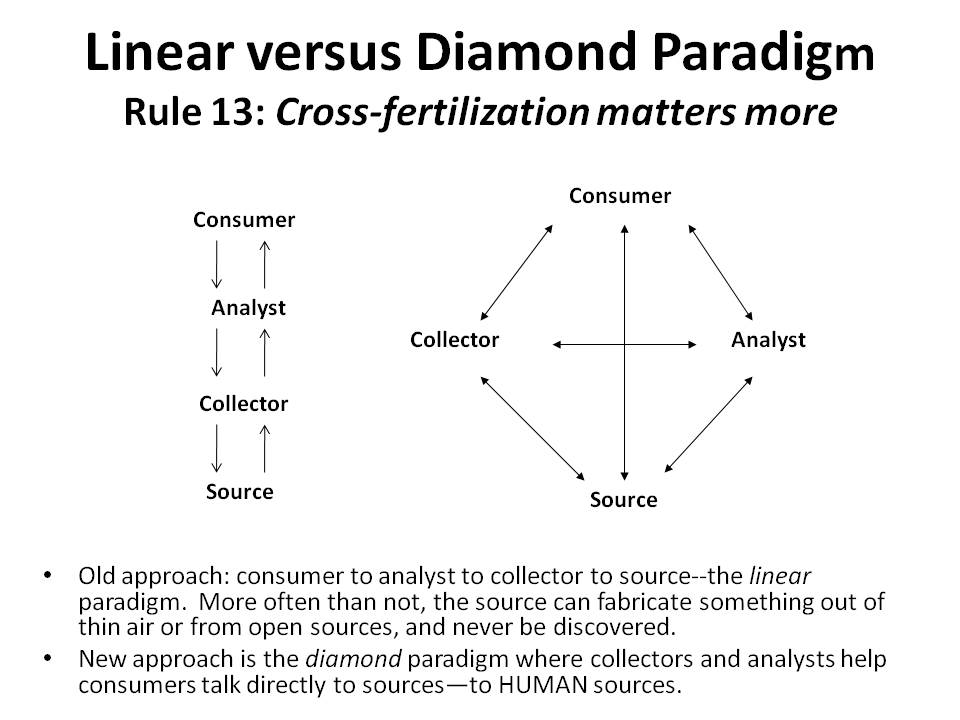
Graphic: Linear versus Diamond Paradigm

Advanced Cyber/IO, Analysis, Balance, Collection, Innovation, Leadership-Integrity, Multinational Plus
0Shares
Linear versus Diamond Paradigm

First presented in Canada in 1994, this was the first depiction of how out-of-date the existing government intelligence communities are.  They are hierarchical Weberian stove-pipes out of touch with reality and anyone who is actually steeped in reality.

The old intelligence paradigm is on the left–a very controlled hierarchical stovepipe process that is best characterized as twelve-month planning cycles followed by three-month writing cycles and eighteen-month editing cycles.  Most of what we produce is too late, not right, and not useful.

The new intelligence paradigm makes the acme of skill “knowing who knows” (with a tip of the hat to Stevan Dedijer) and the ability to put a consumer with a question in touch with a source (or multiple sources) who can create new tailored knowledge in the instant.
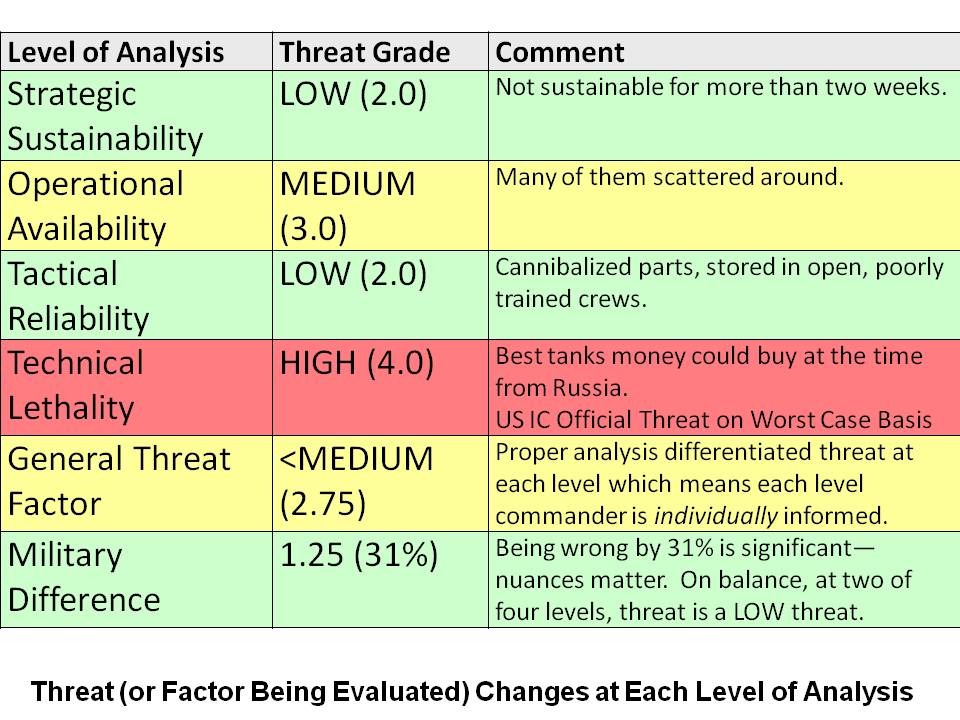
Graphic: Threat Level Changes Depending on the Level of Analysis

Advanced Cyber/IO, Analysis, Strategy-Holistic Coherence, Threats
0Shares
Threat Level Changes

Hard to believe, but we are not making this up.  The U.S. Intelligence Community still does not routinely depict threats in relation to the level of analysis, only in absolute terms and generally in worst-case technical threat terms assuming idealized scenarios favoring the enemy.  And when that is not good enough, field grade officers are assigned to manipulate the data bases and fabricate threat capabilities.

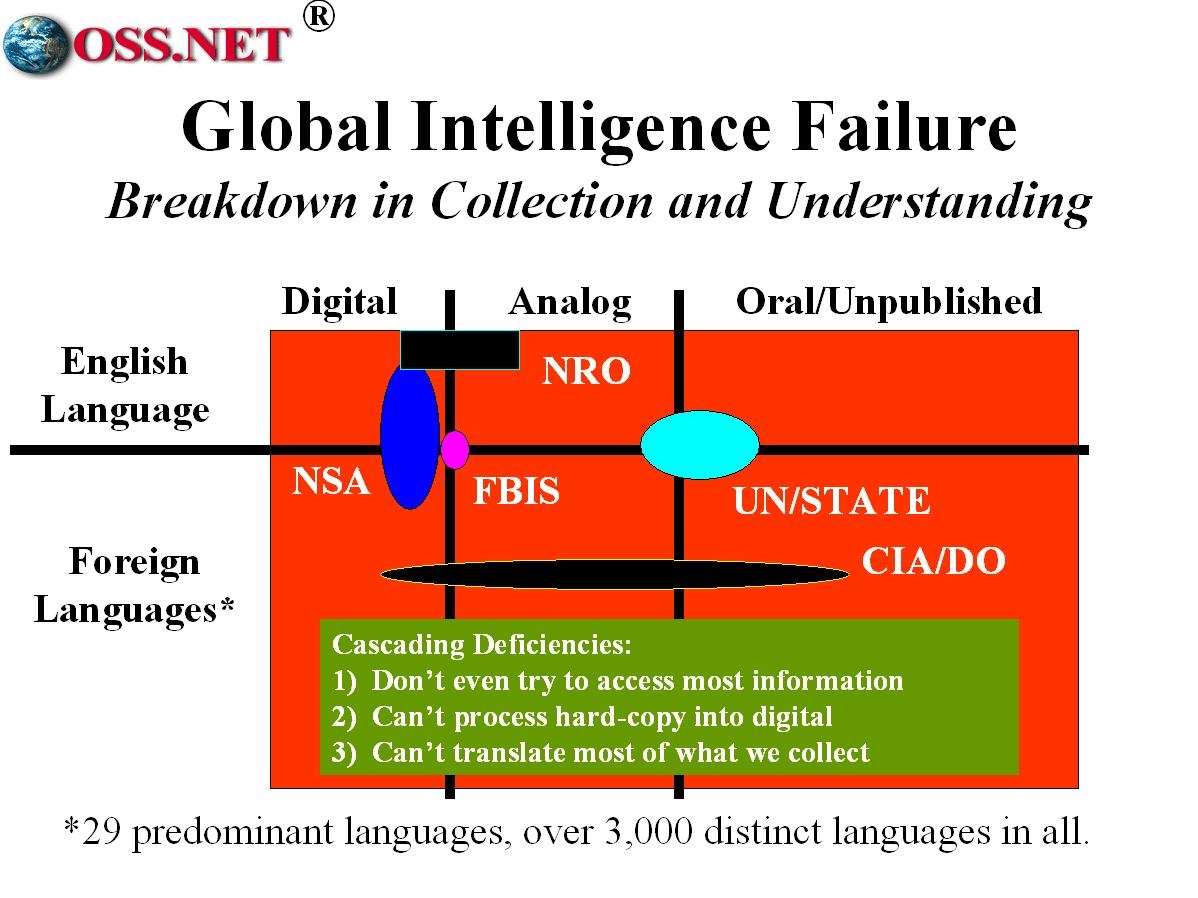
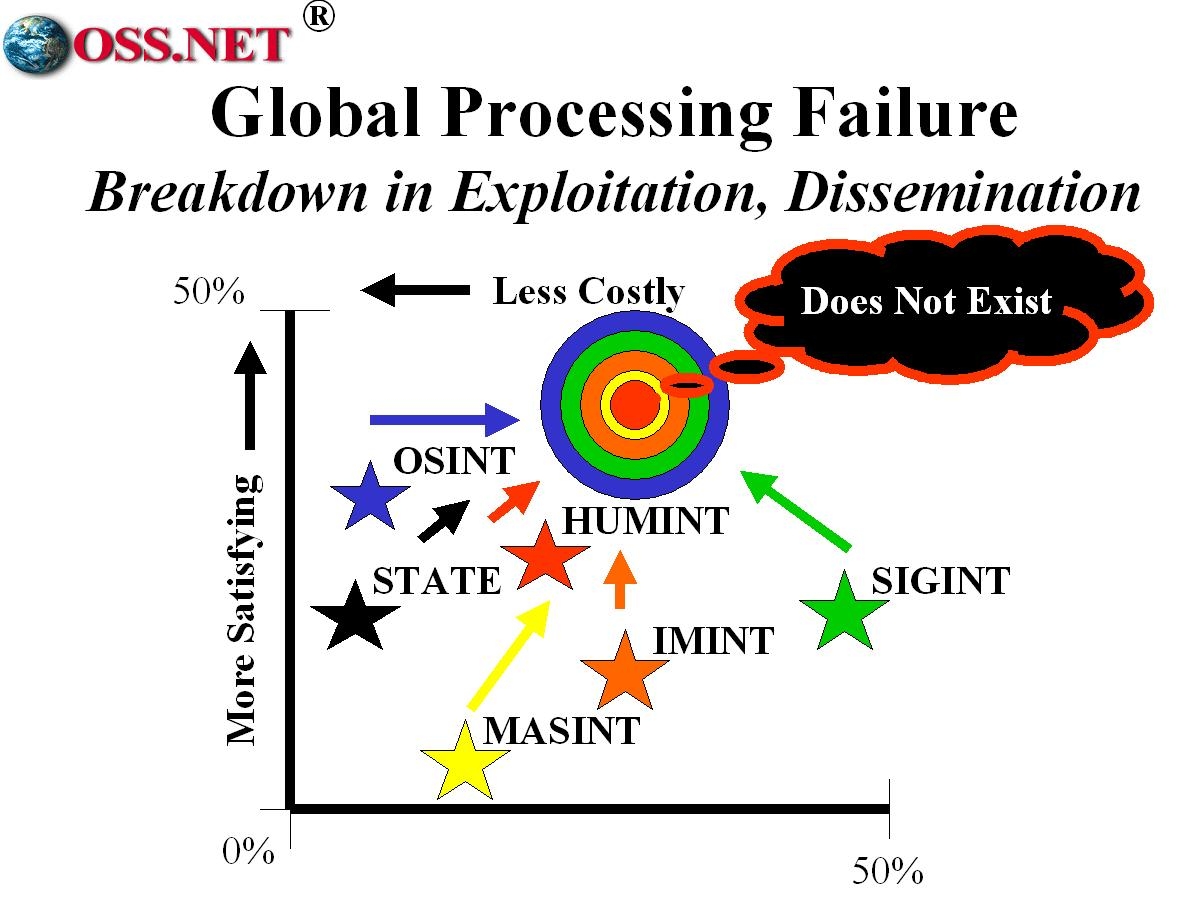
Graphic: Global Intelligence Processing Failure

Advanced Cyber/IO, Analysis, Balance, Capabilities-Force Structure, Processing, Strategy-Holistic Coherence
0Shares
Processing Failure
Processing Failure

This slide, less the bulls-eye that still does not exist, was created by the Collection Requirements & Evaluation Staff (CRES) of the Directorate of Intelligence (DI) at the Central Intelligence Agency (CIA), in the mid to late 1990's.  It is still more or less on target, which should give the Director of the Defense Intelligence Agency (DIA) something to think about–MASINT is a bust, HUMINT is inept, and OSINT is underfunded.  Time for leadership.

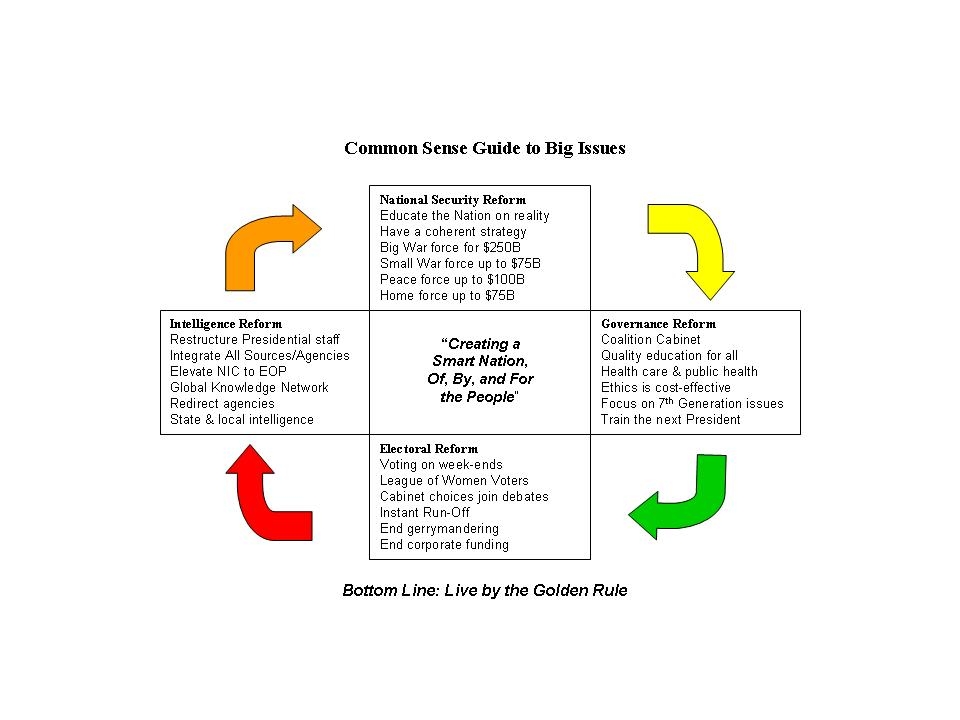
Graphic: Four National Reforms

Advanced Cyber/IO, Balance, Capabilities-Force Structure, Leadership-Integrity, Reform, Strategy-Holistic Coherence
0Shares
Click on Image to Enlarge

See Also:

2013 Public Governance in the 21st Century: New Rules, Hybrid Forms, One Constant – The Public [Work in Progress]

2008 Election 2008 Chapter: The Substance of Governance

2002 Robert Steele: Citizen in Search of Integrity (Full Text Online for Google Translate)

1995 GIQ 13/2 Creating a Smart Nation: Strategy, Policy, Intelligence, and Information

1992 E3i: Ethics, Ecology, Evolution, & intelligence (An Alternative Paradigm)

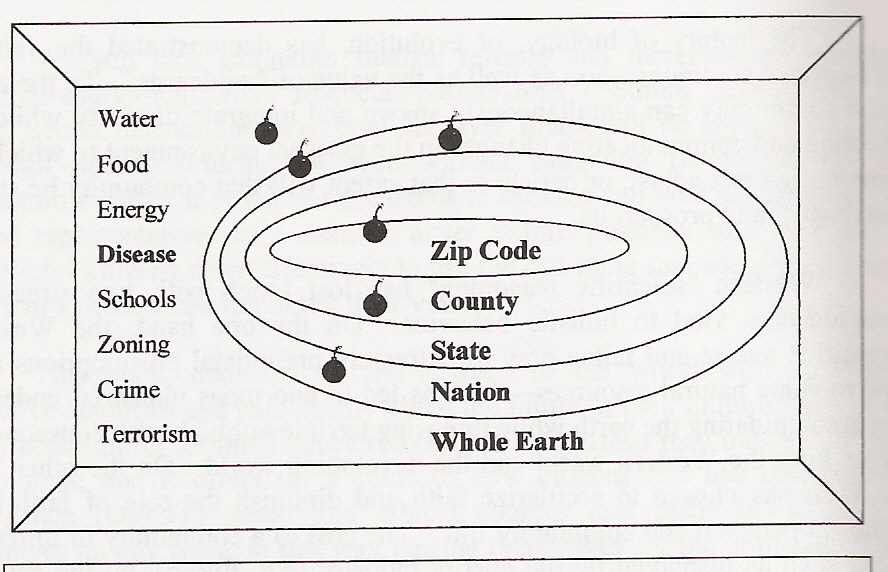
Graphic: Citizen-Centered Intelligence II (Warning)

Citizen-Centered
0Shares
OSINT Citizen-Centered Warning

Also created for THE NEW CRAFT OF INTELLIGENCE.  With geospatial tagging where it is today (as the General Defense Intelligence Council was told it needed to be in 1988), there is no reason why all policy, budget, and consequence assessment information cannot be sliced and diced down to the zip code and neighborhood level.  The reality is that information asymmetries and handicaps perpetuate the excessive consumption of the few at the expense of the many.  Absent a revolution in human affairs–which we do believe is imminent–weapons of mass deception will be the norm in America and everywhere else.