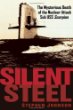
Review: Silent Steel–The Mysterious Death of the Nuclear Attack Sub USS Scorpion

5 Star, Empire, Sorrows, Hubris, Blowback, Executive (Partisan Failure, Reform), Intelligence (Government/Secret), Power (Pathologies & Utilization), Security (Including Immigration)
Silent Steel
Amazon Page

First-Rate Cover Story Great Human Interest, Service Loyalty, February 6, 2008

Stephen Johnson

EDIT of 9 Feb 09: There is evidently a very strong community of submariners, mostly officers, none of whom were in service at the time the incident happened, most of whom have little intelligence experience and very small libraries, who feel they and only they are qualified to judget between the two books. My two reviews stand. Normal people will find the other book much better in terms of trying to get to a reasonable semblance of the truth. Better yet, skip both books and go right to those I list below.

This a superb individual effort using normally available materials. It fully merits five stars because it can be bought and read simultaneously with Scorpion Down: Sunk by the Soviets, Buried by the Pentagon: The Untold Story of the USS Scorpion, which leverages Freedom of Information demands, direct invesdtigative journalism (HUMINT), and the end of the Cold War which produced a treasure trove of valuable primary materials. If you buy only one book, buy the other one but I find reading books in twos and threes is more interesting.

See for context, other reviews and if attractive, the books also:
The Rules of the Game: Jutland and British Naval Command
Very Special Intelligence: The Story of the Admiralty's Operational Intelligence Centre 1939-1945
Lost History: Contras, Cocaine, the Press & ‘Project Truth'
The Age of Missing Information (Plume)
Fog Facts: Searching for Truth in the Land of Spin
Legacy of Ashes: The History of the CIA
Manufacturing Consent: The Political Economy of the Mass Media
The Pathology of Power – A Challenge to Human Freedom and Safety
The Sorrows of Empire: Militarism, Secrecy, and the End of the Republic (The American Empire Project)

Vote on Review

Review: The Culture of National Security

4 Star, Complexity & Catastrophe, Congress (Failure, Reform), Culture, DVD - Light, Empire, Sorrows, Hubris, Blowback, Power (Pathologies & Utilization), Security (Including Immigration)
Culture Security
Amazon Page

4.0 out of 5 stars Great from an academic point of view, missing some pieces

January 19, 2008

Peter J. Katzenstein

I confess to some impatience with this book, published in 1996. It is very much state-centric, although to its credit in the conclusion it postulates a need to focus more on non-military resources and objectives, and on non-state actors.

The book opens with the statement that the key to understanding is to focus on how people view their interests and how that changes, but I searched in vain for any differentiation among the eight tribes that define my own study of international and internal relations: government, military, law enforcement, academia, business, media, non-governmental and non-profit (and in the US, especially, foundations), and finally, civil including religion, labor, and advocacy groups. This book may well be one of the last gasps of “state uber alles” literature.

I have a note, bridge between the European literature of the 1980's and the new view emerging in the post 9-11 environment, where most of us now recognize that security in all its forms, including human, food, and water security, are easily as important and often more important than military security.

The editors themselves recognize that all the theories were wrong, and that academia slept through the revolution, failing to foresee or explain.

I am amused by the discussion of identity, and how this presents the academics–poor dears–with moral issues.

I love footnotes, and this book has many of them, but as I went on and on I felt two things: 1) holy cow, the best of the best talking to themselves; and 2) where is everything else? This book strives to examine the fault line between Kennedy's focus on resources and Fukiyama's focus on ideology, while missing the impact of technology on the rise of indigenous peoples. In some ways, this book marks the end of the state-centric academic era, and the rise of the practitioner non-state actor era. There is now more to be learned outside the university than inside.

On balance, I would recommend this book as torture for aspiring PhD's who need to be steeped in the arcane debates among the varied schools of international politics and the effect of domestic politics on foreign policy, but very candidly, I find the books listed below to be a better investment of time and more accessible to broader minds.

Modern Strategy
Security Studies for the 21st Century
The Unconquerable World: Power, Nonviolence, and the Will of the People
The Paradox of American Power: Why the World's Only Superpower Can't Go It Alone
A More Secure World: Our Shared Responsibility–Report of the Secretary-General's High-level Panel on Threats, Challenges and Change
High Noon 20 Global Problems, 20 Years to Solve Them
Preparing America's Foreign Policy for the 21st Century
Global Assemblages: Technology, Politics, and Ethics as Anthropological Problems
Global Brain: The Evolution of Mass Mind from the Big Bang to the 21st Century
The Wealth of Networks: How Social Production Transforms Markets and Freedom

Vote on Review
Vote on Review

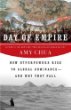
Review: Day of Empire–How Hyperpowers Rise to Global Dominance–and Why They Fall

4 Star, Country/Regional, Empire, Sorrows, Hubris, Blowback

Day of EmpireDisappointing, Oversold, Original as far as it goes, January 11, 2008

Amy Chua

I like the author and gave her first book, World on Fire high marks. I found her treatment of the Chinese diaspora in that book to be quite valuable.

This book is disappointing for a number of reasons, not least of which is the treatment of “America” as a monolyth, a generic “hyperpower,” never mind any of the following:

Vice: Dick Cheney and the Hijacking of the American Presidency
Running On Empty: How The Democratic and Republican Parties Are Bankrupting Our Future and What Americans Can Do About It
The Battle for the Soul of Capitalism
The Cheating Culture: Why More Americans Are Doing Wrong to Get Ahead

I happen to be familiar with China's new strategy, a one-page memorandum can be found by looking for <steele chinese irregular warfare.> The Chinese have neutralized US weapons and mobility systems, and are waging peace on a global scale.

What troubled me about this book was the combination of glorious generalizations with a lack of specifics, for example, China right now has a potentially catastrophic combination of water and energy outages with continuing potential for a pandemic.

The eight challengers the Earth Intelligence Network has identified are Brazil, China, India, Indonesia, Iran, Russia, Venezuela, and Wild Cards like the Congo.

America is on the ropes because we are coming off a quarter century of a two party spoils system that knew all about Peak Oil in 1974, and decided to betray the public trust and ignore the problem. Similarly are water and food security, our public health, all are abyssmal because of a series of venal leaders among whom Dick Cheney stands out for evil, and young Bush for stupid.

I am also troubled because the author, while serving up an interesting overview, does not trouble to review the lessons of history from others, for example, Will and Ariel Durant or John Lewis Gaddis. Morality is a strategic asset of incalculable value. Time is the one asset that cannot be bought nor replaced. Our ignorance of history makes the past a “denied area” of little use to using the present to plan for the future.

On balance this book comes across as a one page outline fleshed out. The Technical Preface by Robert Garigue, RIP, to Information Operations: All Information, All Languages, All the Time is still the best statement published: it's about long-term education of mind of man, with morality, legitimacy, and dignity. Get that right and everything else takes care of itself. Visit Earth Intelligence Network to learn more.

I was also hoping to see more about emerging solutions and the wealth of networks. If we have one thing going for us in America, it is that 66 languages are spoken in Queens, NY, 183 languages across the Nation, and we could, if we wanted to, rapdily recruit 100 million volunteers able to educate the 5 billion poor one cell call at a time, in their own language.

I do not regret buying this book, but in my view, it delivered no more than 50% of its potential while being way too indiscriminate about the details. There is too much missing from this book. See my lists.

See also
The Search for Security: A U.S. Grand Strategy for the Twenty-First Century
High Noon 20 Global Problems, 20 Years to Solve Them
The Wealth of Networks: How Social Production Transforms Markets and Freedom
The Fortune at the Bottom of the Pyramid: Eradicating Poverty Through Profits (Wharton School Publishing Paperbacks)