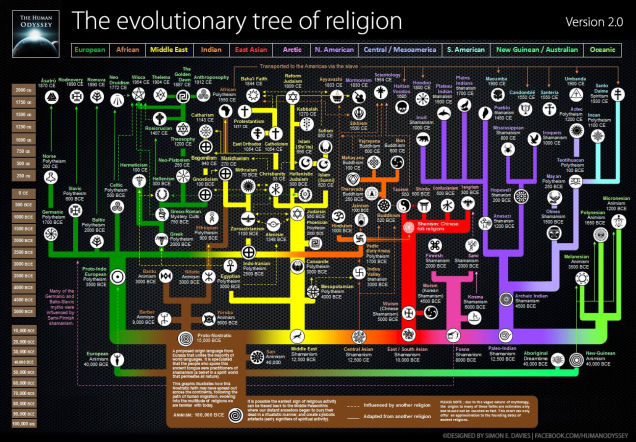
I've been discussing the concept of Open Faith and have been getting very positive responses – its of our time, its an extension of the information age, based in Open Source Culture and For the first time in the history of the world – All the world's spiritual traditions are available to us.Some possible guiding principles (wording, phrasing to be developed):
Transcend and Include Alignment of: Spirituality, Science, Philosophy, and Culture The Golden Rule
Harmony with nature
Integral framework: all quadrants
Community of Practice
Local Resilient Community
Holonic framework: complexity and unity
All is mind – consciousness is primary
Deep Evolution: holonic evolution of universe
Development of the whole person
Sacred Activism
My recent attendance at Findhorn's New Story Summit, combined with my reading of two books, Micah Sifry's The Big Disconnect: Why the Internet Hasn't Transformed Politics (Yet) and Darrell West's Billionaires: Reflections on the Upper Crust, have come together to inspire a new book that seeks to unify the tribes with open source tools and aggregated money from four pots — UN SDG, Black Sheep Bilionaires, CEOs with angst, and USG. This is my winter project. North Atlantic Books, publisher of The Open Source Everything Manifesto: Transparency, Truth, and Trust, is on board contingent of course on my actually producing a useful book for their editor to work with — I cannot say enough good things about the editor that cut OSE in half and reduced all words by one syllable. Below is an early outline. I would be deeply grateful if you cared to read over the outline and give me feedback. At this point I am just asking two questions: 01 Do the phrases resonate? Should any of them be modified? 02 What am I missing — this is supposed to be a guide that brings us together for action rooted in spirituality, an end to lip service and me me me my hashtag or none fauz activism. What would you be looking for in such a book? Thank you for anything that might occur to you. I am most optimistic about the future. Blessings to you all, Robert
Amid the Syrian warzone a democratic experiment is being stamped into the ground by Isis. That the wider world is unaware is a scandal
In 1937, my father volunteered to fight in the International Brigades in defence of the Spanish Republic. A would-be fascist coup had been temporarily halted by a worker’s uprising, spearheaded by anarchists and socialists, and in much of Spain a genuine social revolution ensued, leading to whole cities under directly democratic management, industries under worker control, and the radical empowerment of women.
Spanish revolutionaries hoped to create a vision of a free society that the entire world might follow. Instead, world powers declared a policy of “non-intervention” and maintained a rigorous blockade on the republic, even after Hitler and Mussolini, ostensible signatories, began pouring in troops and weapons to reinforce the fascist side. The result was years of civil war that ended with the suppression of the revolution and some of a bloody century’s bloodiest massacres.
I never thought I would, in my own lifetime, see the same thing happen again. Obviously, no historical event ever really happens twice. There are a thousand differences between what happened in Spain in 1936 and what is happening in Rojava, the three largely Kurdish provinces of northern Syria, today. But some of the similarities are so striking, and so distressing, that I feel it’s incumbent on me, as someone who grew up in a family whose politics were in many ways defined by the Spanish revolution, to say: we cannot let it end the same way again.
The mass media and political elite has been demonizing Russian President Vladimir Putin for resisting the events flowing from the US inspired coup in Ukraine. Attached is a speech that reveals Putin’s view the Russian idea, and by extension of himself, or at least how he would like people to think of him. No doubt, there are parts of this speech readers will disagree with — but it is well worth reading and thinking about.
Vladimir Putin spoke before the final plenary meeting of the Valdai International Discussion Club, outlining Russia’s urgent need for a united national idea in order to succeed in a global environment. [Official translation]
This is a great blog post by Clark Quinn, e-learning guru whom I think highly of. His post talks about whether there is a science to learning (spoiler: there is) and how e-learning professionals should frame it as learning engineers. It got me wondering how content engineers and other technical communicators beyond those in the e-learning field approach this.
In other fields of endeavors, there is a science behind the approaches. In civil engineering, it’s the properties of materials. In aviation, it’s aeronautical engineering. In medicine, it’s medical science. If you’re going to be a professional in your field, you have to know the science. So, two questions: is there a science of learning, and is it used. The answers appear to be yes and no. And yet, if you’re going to be a learning designer or engineer, you should know the science and be using it.
There is a science of learning, and it’s increasingly easy to find. That’s the premise behind the Serious eLearning Manifesto, for instance (read it, sign it, use it!). You could read Julie Dirksen’s Design for How People Learnas a very good interpretation of the science. The Pittsburgh Science of Learning Center is compiling research to provide guidance about learning if you want a fuller scientific treatment. Or read Bransford, et al’s summary of the science of How People Learn, a very rich overview. And Hess & Saxberg’s recent Breakthrough Leadership in the Digital Age: Using Learning Science to Reboot Schoolingis both a call for why and some guidance on how.
Among the things we know are that rote and abstract information isn’t retained, knowledge test doesn’t mean ability to do, getting it right once doesn’t mean it’s known, the list goes on. Yet, somehow, we see elearning tools like ‘click to learn more’ (er, less), tarted up quiz show templates to drill knowledge, easy ways to take content and add quizzes to them, and more. We see elearning that’s arbitrary info dump and simplistic knowledge test. Which will have a negligible impact on anything meaningful.
We’re focused on speed and cost efficiencies, not on learning outcomes, and that’s not professional. Look, if you’re going to do design, do it right. Anything less is really malpractice!