
Bottom line: for one third of what we spend on war, we can eradicate all ten high level threats to humanity.

Here is a more recent graphic from Medard Gabel:

The truth at any cost lowers all other costs — curated by former US spy Robert David Steele.
Bottom line: for one third of what we spend on war, we can eradicate all ten high level threats to humanity.
Here is a more recent graphic from Medard Gabel:
We keep wondering: ‘Why do they hate us?'
Well, maybe some people are mad because we are doing things
that we would regard as unjustified and heinous acts of war
if anyone dared to do them to us.
— Stephen M. Walt in Foreign Policy magazine
A nation that continues year after year to spend more money
on military defense than on programs of social uplift
is approaching spiritual doom.
— Martin Luther King, Jr.
As noted in Empathy Note #1, we live in a world where smaller and smaller groups have access to more and more destructive capability. This technology-driven danger presents us with an odd transformational imperative in which proactive love, trust and caring for each other have become more practical – I repeat: practical – than our usual strategies for self-protection.
Self-protection at the national level usually goes by two names: “defense” and “security”. Unfortunately, those two words have often been used as PR cover for policies that looks more like empire – the use of military, diplomatic, and economic force (informed by surveillance and supported by educational and cultural dominance) to make sure that other peoples do what the power center wants them to do.
Continue reading “Tom Atlee: Real Security From Empathy Not Empire”
Somalia’s al-Shabaab Has A Coup
Six months ago I wrote Clearing Somalia Of al-Shabaab. Today I was reading Will Somali Islamist Purge Strengthen al-Shabaab? and I see they have not updated their map of who controls what since then, even though the situation is clearly changing.
Read full post with two graphics.
Phi Beta Iota: We consider Somalia and Yemen to be two perfect candidates for any coalition that wishes to wage peace instead of war. Bury them in solar power, desalinated water, hydroponic agriculture, and free celluar and Internet access. Then get out of the way as they create wealth and with wealth, legitimacy and stability.
See Also:

Unmasking organised crime networks with data
Military software engineers have developed a program that can predict the social structures of street gangs. Philip Ball explains how it could help fight crime.
One of the big challenges in fighting organised crime is precisely that it is organised. It is run a bit like a business, with chains of command and responsibility, different specialised “departments”, recruitment initiatives and opportunities for collaboration and trade. Their structures often make crime syndicates and gangs more able to evade attempts by law enforcers to disrupt their activities.
That’s why police forces are keen to discover how these organisations are arranged – to map the networks that link individual members. While gang structures are typically fluid and informal compared to most legitimate businesses, they are far from random. In fact, violent street gangs seem to be set up along similar lines to insurgent groups that stage armed resistance to political authority, such as guerrilla forces in areas of civil war. These kinds of organisations tend to be composed of affiliated cells, each with its own leader.
For this reason, some law-enforcement agencies are hoping to learn from military research. A team at the West Point Military Academy in the US state of New York has just released details of a software package it has developed to aid intelligence gathering by police dealing with street gangs. The program, called Orca (Organization, Relationship, and Contact Analyzer), can use real-world data acquired from arrests and the questioning of suspected gang members to deduce the network structure of a gang.
Understanding and Tackling Violence Outside of Armed Conflict Settings
Lind, J. and Mitchell, B.
IDS Policy Briefing 37
Download this publication free of charge
Understanding and tackling violence that occurs outside of armed conflict settings is essential to improving the wellbeing of some of the world’s poorest communities.
Whilst advances have been made in terms of designing policies that address violence in fragile or conflict-affected countries, progress has been slower in relation to dealing with violence happening outside of these settings.
New forms of violence, such as organised crime and political instability, often arise in states which have undergone rapid economic growth and social transformation. These forms of violence are difficult to address because they are part of the very structures and processes that drive and shape development.
Fresh approaches are required. They need to be driven by communities, civil society and young people, as well as the state and international donors. They must also be underpinned by a better understanding of how violence affects the poor and what works in terms of interventions.
ROBERT STEELE: I have elected to answer this personally. It may well be the most fundamental question this web site has received in that any corruption in the answer to this question assures the failure of any strategy, policy, acquisition, or operation that is spawned from an inherently corrupt — a deliberately corrupt — refusal to take the question seriously.
There are several ways to address this. The first is the most obvious, which is to say that the traditional threat is state on state conventional forces, and the non-traditional threats are everything else. Here in one chart is what General Al Gray, USMC, then Commandant of the Marine Corps, with my assistance as his ghost-writer, put in “Global Intelligence Challenges in the 1990's” (American Intelligence Journal, Winter 1989-1990).
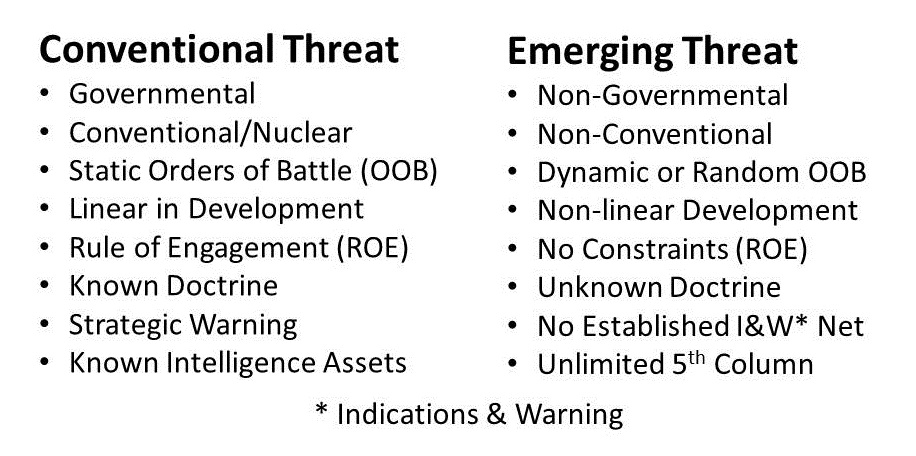
The whole point of that article was to suggest that both the US Intelligence Community and the US Department of Defense needed to radically alter how they trained, equipped, and organized. I now realize that it was corruption, not stupidity, that buried this message. As SOCOM and Navy Irregular Warfare said in defending their decision not to go after the Somali pirates from 2005-2008 and later, “it's not an expensive enough problem.”
Continue reading “2013 Robert Steele Reflections on [Search:] non+traditional+threat 1.2”

Available Now!
A Collection of Essays
Edited by Llewellyn Vaughan-Lee
The Zen Master Thich Nhat Hanh was asked what we need to do to save our world.
“What we most need to do,” he replied,
“is to hear within us the sound of the earth crying.”

Our present ecological crisis is the greatest man-made disaster this planet has ever faced—its accelerating climate change, species depletion, pollution and acidification of the oceans. A central but rarely addressed aspect of this crisis is our forgetfulness of the sacred nature of creation, and how this affects our relationship to the environment. There is a pressing need to articulate a spiritual response to this ecological crisis. This is vital and necessary if we are to help bring the world as a living whole back into balance.
Contributors include: Chief Oren Lyons, Thich Nhat Hanh, Sandra Ingerman, Joanna Macy, Sister Miriam MacGillis, Satish Kumar, Vandana Shiva, Fr. Richard Rohr, Bill Plotkin, Jules Cashford, Wendell Berry, Winona LaDuke, Mary Evelyn Tucker, Brian Swimme, and others.
