Below find excerpts of Harvard Professor Linda Bilmes latest analysis of the costs of the Wars in Iraq and Afghanistan. Note that the costs are now estimated to lay somewhere between $4 trillion and $6 trillion.
N.B. The final sentence: “In short, there will be no peace dividend, and the legacy of Iraq and Afghanistan wars will be costs that persist for decades.”
It's not going to be a “peace dividend;” it is going to be a decades long and gigantic expense–in addition to the moral tragedy.
The excerpts from her cogent, well written text explain how she got to her conclusion. (The relevant page numbers are noted in parentheses.)
For a case study in incestuous amplificationand a detailed description of how it infects an entire culture, watch this video, which first aired in 2007.
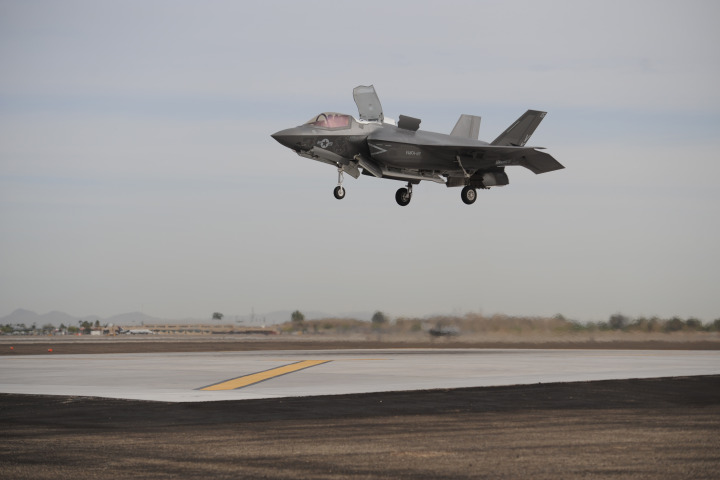
The Marines issued a flashy press release last week: “first operational F-35B conducts initial Vertical Landing.” It was an amateurish, somewhat slimy piece of hype.In one important way, the press release contradicted itself, and in another it inadvertently revealed one of the many reasons why the Marines' Short Take-Off and Vertical Landing (STOVL) version of the F-35 – that's the F-35B – will never be the battlefield-based close-combat support bomber the Marines like to advertise it as.
The corps' headquarters' release repeatedly described the “operational” nature of “the first STOVL flight for an F-35B outside of the test environment.” It also characterized the event as “another milestone” toward “revolutionizing expeditionary Marines air-ground combat power,” that perhaps-the press released tried hard to imply-would be available for combat use as soon as “late 2013.”
The press release, which was formatted as if it were some sort of news article, inadvertently cued alert readers to the fact that this “first” “operational” “STOVL flight for an F-35B outside of the test environment” was flown by a testpilot.
Click on Image to Enlarge Note Special Pad, Cannot Land on Normal Surfaces
His name is Maj. Richard Rusnok, as the press release says, and as a different Marine Corps press exercise reveals, he has been flying for 13 years.
In the world of F-35-double-talk, it is apparently reasonable to announce flights as operational when they are flown by test pilots.
The term “operational” was stretched even further in a second respect in the press release, which featured the photograph above showing the F-35B landing vertically with its lift fan doors open and its flaps deflected. Note the area below the aircraft; note that same area in the later stages of a video at YouTube also released by the Marines' PR team.
A Department of Defense instruction issued on Friday reinforces the policy that the DoD Office of Inspector General (OIG) is to have full access to all records, including classified records, that it needs to perform its function, and that no DoD official other than the Secretary himself may block such access.
“The OIG must have expeditious and unrestricted access to all records…, regardless of classification, medium (e.g. paper, electronic) or format (e.g., digitized images, data) and information available to or within any DoD Component, and be able to obtain copies of all records and information as required for its official use once appropriate security clearances and access are substantiated for the OIG DoD personnel involved,” the instruction states. See “Office of the Inspector General of the Department of Defense Access to Records and Information,” DoD Instruction 7050.03, March 22, 2013.
By stressing that the Inspector General's access is independent of a record's classification, medium or format, this language elaborates and bolsters the text of a previous version of the instruction, which did not make those distinctions.
Furthermore, the new instruction specifies, “No officer, employee, contractor, or Service member of any DoD Component may deny the OIG DoD access to records.” Only the Secretary of Defense may invoke a statutory exemption to limit IG access to certain intelligence, counterintelligence, or other sensitive matters, which he must then justify in a report to Congress.
As a result these robust access provisions, the DoD Inspector General is well-positioned to conduct internal oversight not only of the Pentagon's extensive classified programs, but also of the classification system itself, particularly since the Department of Defense is the most prolific classifier in the U.S. government.
In fact, the Inspector General of each executive branch agency that classifies national security information is now required by the Reducing Over-Classification Act of 2010 to evaluate the agency's classification program. Each Inspector General was directed “to identify policies, procedures, rules, regulations, or management practices that may be contributing to persistent misclassification of material.”
The first evaluation is due to be completed by September 30, 2013. Vexingly, the Act did not provide a functional definition of “over-classification” or “misclassification.” Therefore, the first hurdle that the IG evaluations must overcome is to determine the nature and the parameters of the problem of over-classification.
DOD is circling the wagons to keep the F-35 propped up in the declining Pentagon budget. Importantly, as noted by a prime Lockheed mouthpiece offering his thankfulness for it, GAO's newest report on the F-35 offers a conclusion that the F-35 is on track for improvement–the data notwithstanding. In point of fact, what the GAO conclusion does show is that some long term negative–and management induced–trends have gone viral in the investigatory agency where I once worked. As a result, DOD has been allowed unseen influence on a GAO report. Skeptical? The latter half of a new piece at Foreign Policy explains.
The magazine's title for my article only off-handedly hints at the nature of the problem; it is not so much a “conspiracy” as the effects of an equal relationship between GAO and DOD. The piece is available at http://www.foreignpolicy.com/articles/2013/03/22/error_report and below:
Is there a government conspiracy to save the F-35?
BY WINSLOW WHEELER | MARCH 22, 2013
Until recently, the F-35 Joint Strike Fighter had been having a pretty rough time.
In 2012, its estimated average “program acquisition unit cost” was reported to have doubled, from the $81 million per copy anticipated in 2001 to $161 million, flight tests revealed deficiencies in achieving the F-35's modest performance requirements, and scheduled full-rate production was delayed to 2019.
Ten years later after the start of the Iraq war, the neocons still don’t see the error of their ways. Mother Jones’ David Corn and author Ron Suskind join Hardball to discuss.
Highlights: Cheney, Wolfowitz, and Perle skewered in detail, airing their past words and their present insouciance. Cheney is called sadistic, all of them are called shameless. Hard-hitting. Bottom line: the 935 now-documented lies were deliberate, with the invasion of Iraq as the primary US military objective in the first Bush -Cheney Administration.
Phi Beta Iota: This is the single best 15 minute overview of the treason against the Republic by Dick Cheney, Donald Rumsfeld, Paul Wolfowitz, and Richard Perle, among others. Ron Susskind, perhaps the single best author on insider politics in the US Executive, is now lighting a fire in the public mind.