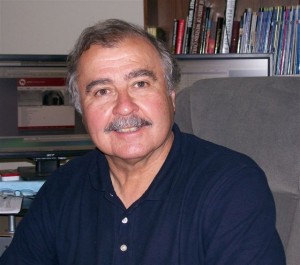
Greg Newby on Cognitive Space & Exosomatic Memory

Advanced Cyber/IO, Collective Intelligence, Cultural Intelligence
Dr. Greg Newby
Dr. Greg Newby

Why I'm an information scientist

  • I believe that information is one of the most powerful phenomena. The ability to access and utilize information can help to overcome obstacles and solve problems. I want to make information more readily available to all people.There are many ways of providing access to information:
    • Through better information systems, including information retrieval systems. Thus, IR is one of my main research areas.
    • By providing the means of accessing information. Computer & information literacy training is therefore a big part of my curriculum interests at UNC. I also worked to bring about better information access via Prairienet (a community computing system) and iBiblio.
    • By actually creating information availability — authoring Web pages and articles and providing unrestricted access. I also work with Project Gutenberg to provide free electronic books (over 100 new [generally pre-1923] books per month).

Major themes in my research

Continue reading “Greg Newby on Cognitive Space & Exosomatic Memory”

Eagle: Future of the Internet Debated

Advanced Cyber/IO, IO Impotency
300 Million Talons...
300 Million Talons…

Future of the internet debated at NetMundial in Brazil

A meeting to determine how the internet should be governed is under way in Sao Paulo, Brazil.

The country's president, Dilma Rousseff, organised the two-day NetMundial event following allegations the US National Security Agency (NSA) had monitored her phone and emails.

Last month the US announced plans to give up its oversight of the way net addresses are distributed. But campaigners have warned the move could backfire.

The US currently determines who runs the Internet Assigned Numbers Authority (IANA), the body responsible for regulating the internet's codes and numbering systems. But Washington now aims to pass the duty over to the “global multi-stakeholder community” by September 2015. Human rights group Article 19 supports that idea, but said there were potential pitfalls.

Continue reading “Eagle: Future of the Internet Debated”

Yoda: Hypertemporal Multispectral Imaging & Intelligence

Advanced Cyber/IO
Got Crowd? BE the Force!

Fun this is.

Hypertemporal imaging: the next Big Challenge for high-performance embedded computing

, Editor

Military & Aerospace Electronics, 1 April 2014

It might be a fun exercise to sit with the leading practitioners of high-performance embedded computing (HPEC) to trade opinions about what are the toughest, gnarliest, most knee-buckling HPEC challenges in the foreseeable future.

We would hear the usual — bistatic radar, adaptive electronic warfare (EW), and wide-area communications intelligence. Well, I've got one that's a real beaut, and one that I think we're all going to be hearing a lot more about: hypertemporal imaging for persistent surveillance.

Yeah, it was a new one on me, too. Put simply, hypertemporal imaging involves multispectral or hyperspectral imaging over time. Where persistent surveillance is concerned, it's also a gigantic exercise in gathering gazillions of bits of data, and then throwing most of them away.

Multispectral and hyperspectral imaging involves slicing an image into a few or even many different spectral bands to uncover details that otherwise might be lost. This alone already present a formidable digital signal processing challenge. Now add the dimension of time and the problem grows by orders of magnitude.

Continue reading “Yoda: Hypertemporal Multispectral Imaging & Intelligence”

Stephen E. Arnold: Google Glass as Goose Poop

IO Impotency
Stephen E. Arnold
Stephen E. Arnold

Glass: Looking through the Obvious

I read “How Google Screwed Up Google Glass.” The capitalist tool does not have its heart in the analysis. Here’s the tip off: “It really is a great idea.”

What exactly is great about a virtual reality headset? As I wrote in Information Today, I have two or three devices that connect on my shelves. What became of them? Not too much.

In my view, Glass is less about wearing crazy eye glasses and more about dragging red herrings across real journalists’ paths, than a different play. I a report I prepared for an investment bank, I focused on the technology which is used to create the headgear and the contact lens demonstration.

The key figure in this technology is a fellow named Dr. Amir Parviz (aka Babak Parvis, Babak Parviz, Babak Amirparviz, and other variations). He studied at the elbow of Dr. George Whitesides at Harvard. This dynamic duo has demonstrated some chemistry in their research and patents. The contact lens work has roots which reach back to Dr. Parviz’s days at the University of Washington and its research group.

I am not going to rehash the information presented in the Information Today article and the financial institution’s report. Suffice it to say that Glass is less about wearing wonky headgear and more about nanoengineering. Is this self assembly work related to robots. By the way, yummy photos of Google’s X Lab at http://read.bi/1hkHTKl do not include the biomedical facilities. Slight oversight or Loon misdirection?

Seeing through Glass is important. There are strong personal motivations for Google’s top dogs behind the biological engineering research. Maybe running a query on Glass will sharpen the focus?

Stephen E Arnold, April 22, 2014

Berto Jongman: 5 Short Videos – Big Data, ICTs and New Media in Times of Crisis

Advanced Cyber/IO
Berto Jongman
Berto Jongman

Big Data, ICTs and New Media in Times of Crisis

On March 28, the ISN hosted a Roundtable Discussion on “Big Data, ICTs and Social Media in Times of Crisis,” which featured Mr Sanjana Hattotuwa, who is both a TED Fellow and a Special Advisor to the ICT4Peace Foundation. Our purpose today is to share Mr Hattotuwa’s lively presentation, which among other things focuses on how web- and mobile-based media have enhanced our ability to respond to complex emergencies, and to participate in ‘organic’ political processes. The presentation is then augmented by the question and answer session that followed in its wake.

In our first video, Sanjana Hattotuwa outlines how Big Data, as disseminated by ICTs and social media, is increasingly functioning as the “nervous system of the world.”

In the next video, Mr Hattotuwa performs two tasks – he elaborates on the links between Big Data and traditional media reporting, and then details how data derived from ICTs has been increasingly used to cope with natural disasters and other complex emergencies.

Continue reading “Berto Jongman: 5 Short Videos – Big Data, ICTs and New Media in Times of Crisis”

Reference: DARPA’s 14 Advanced Projects

Advanced Cyber/IO

14 Advanced Military Projects That Could Change The World Forever

LIST ONLY

Arctic Awareness (Distributed Sensors)
Biofuels
Cyber Range
Energy (Renewable At Sea)
Internet Content-Based Mobile Edge Networking
Internet Fiber (Photonics)
Internet Fixed Wireless at a Distance
Internet Mobile Hotspots
Laser Defense
Laser Weapons
Spectrum Mapping
Surveillance (Building Interiors)
Surveillance (Persistent, Stratospheric)
Thermal Ship Decking

Stephen E. Arnold: Small Analytics Firms Prospering on Big Data Investment Spillover

Advanced Cyber/IO
Stephen E. Arnold
Stephen E. Arnold

Small Analytics Firms Reaping the Benefit of Investment Cycle

Small time analytics isn’t really as startup-y as people may think anymore. These companies are in high demand and are pulling in some serious cash. We discovered just how much and how serious from a recent Cambridge Science Park article, “Cambridge Text Analytics Linguamatics Hits $10m in Sales.”

According to the story:

Linguamatics’ sales showed strong growth and exceeded ten million dollars in 2013, it was announced today – outperforming the company’s targeted growth and expected sales figures.  The increased sales came from a boost in new customers and increased software licenses to existing customers in the pharmaceutical and healthcare sectors. This included 130 per cent growth in healthcare sales plus increased sales in professional services.

This earning potential has clearly grabbed the attention of investors. This, is feeding a cycle of growth, which is why the Linguamaticses of the world can rake in impressive numbers. Just the other day, for example, Tech Circle reported on a microscopic Mumbai big data company that landed $3m in investments. They say it takes money to make money and right now, the world of big data analytics has that cycle down pat. It won’t last forever, but it’s fun to watch as it does.

Patrick Roland, April 22, 2014

Sponsored by ArnoldIT.com, developer of Augmentext

noble gold