Chuck Spinney: Toxic Alliance – Neo-Cons and “Responsibility to Protect” (R2P) War-mongers

Cultural Intelligence, IO Deeds of War
Chuck Spinney
Chuck Spinney

This email continues the theme I introduced with How Obama's Rhetoric Reinforces America's Grand Strategic Pathway to Catastrophe.

Attached beneath my introduction is an brilliant essay, The Dangerous Neocon-R2P Alliance, written by Robert Parry of Consortium News.  Parry describes how propaganda produced by this domestic alliance of convenience among a non-representative minority of unelected influence peddlers is fueling America's rush to a new Cold War with Russia.

Introduction

There is nothing new, per se, in the domestic politics fueling this rush to war.  During the height of the Cold War war, however, it was routine for American politicians and analysts calling for higher defense budgets to claim that foreign policy was broadly bipartisan — i.e., that domestic politics stopped at the waters edge and the United States had a bi-partisan foreign policy.

Of course, the claim that domestic politics stopped at the water edge is patent nonsense.  Nevertheless, maintaining the popular fiction became a central prop in the domestic politics of fear used by the pol-mil apparat to suppress opponents of increased defense spending.  This was especially true during periods of economic ‘austerity,' when maintaining high defense budgets required cutbacks in spending for social programs, like infrastructure modernization (bridges, sewers, schools, etc) or those aimed at social welfare, especially those programs for poverty relief, medical coverage, or social social security.

In thinking through the implications of Parry's analysis, it is important to remember that a nation's foreign policy is always a reflection of its domestic politics.  This is especially the case for democracies.  President Eisenhower's warning about the dangers posed by the Military – Industrial (and I would add Congressional) Complex (or MICC) illustrates this point:  Was not his warning precisely about the danger posed by the rise of misplaced domestic political power accruing to those parts of the federal government and private economic sector that benefited from high levels of defense spending? Today, a whole cottage industry of think tanks and media outlets is organized around the requirement to produce the propaganda needed to prop up that misplaced power.


Continue reading “Chuck Spinney: Toxic Alliance – Neo-Cons and “Responsibility to Protect” (R2P) War-mongers”

Stephen E. Arnold: Open Source Search Sucks, Google Hides, Norvig’s Law Skins Singularity

IO Impotency
Stephen E. Arnold
Stephen E. Arnold

Open Source Search: Just Like Good Old Proprietary Search

The more search changes, the more it remains the same it seems. Come to think of it: Most of today’s vendors are following the scripts written for Fulcrum Technologies and Verity who stomped around the C suite in the 1980s. Is the search sector running an endless loop?

Google Promptly and Quietly Erases Lists of Government Partners

This story shares screenshots taken before and after the revelatory article was posted a couple days before. These images show Google’s Enterprise- Government page displaying lists of government partners. The second shows a page in perpetual-load mode.

Norvigs Law – No Doubling Past 50%

But if you’re counting percentage of people (or households), there’s just no more doubling after you pass 50 percent.”

Continue reading “Stephen E. Arnold: Open Source Search Sucks, Google Hides, Norvig's Law Skins Singularity”

Berto Jongman: Australian Foreign Minister Calls Into Question Professionalism and Value of Australian Secret Intelligence

Government, Ineptitude, IO Impotency
Berto Jongman
Berto Jongman

Seems to confirm all that the OSINT movement has been saying for twenty years. He also takes on the Zionist lobby.

Read all about it, spying misses intelligence quotient

Daniel Flitton

The Age, 18 April 2014

It costs about 10 bucks to buy a weekly issue of The Economist, and about $1 billion a year to fund the secret operations of Australia’s intelligence agencies. Which source gives better value for money?

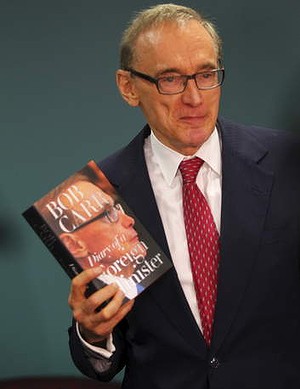
Bob Carr: "One must not be seduced by spies."
Bob Carr: “One must not be seduced by spies.”

This is the fascinating but as yet largely overlooked question to emerge from Bob Carr’s diary of his time as foreign minister. ‘‘Intelligence figures larger in the job than I would have imagined,’’ Carr writes, and describes the Australian Secret Intelligence Service, tucked in its crypt inside Foreign Affairs headquarters, as ‘‘My own little CIA, my own spies’’.

. . . . . . .

Nothing in the book appears to put any secret sources at risk, even though security types expecting strict control over information will doubtless squirm from the attention.

But for all Carr’s devouring of intelligence reports, he doesn’t seem overly impressed by the shadowy world from whence they emanate. ‘‘One must not be seduced by spies and their agenda,’’ he writes after meeting the CIA chief in Washington. At an earlier meeting, fresh in the job, Carr also spoke with CIA officers on topics ranging across Afghanistan, Pakistan, Iran and China, and came away underwhelmed.

‘‘All this was solid but unexciting. Where were the revelations? Was there anything here one would not pick up from The Economist, let alone [diplomatic] cables? This thought stirred my instinctive scepticism about intelligence. How often do we get to relish the knockout revelation that we can whole-heartedly believe and on which we can base policy, taking our rivals altogether by surprise?’’

Amazon Page
Amazon Page

Carr is not the first to doubt the value of intelligence, whose reputation is regularly burnished by Hollywood depictions of the all-seeing, all-knowing spies. He approvingly records a conversation with former US secretary of state Henry Kissinger who similarly reported having never been much surprised by intelligence reports.

Carr has a point. Open source material – the stuff of newspapers, academic journals or a chat with an expert – is often regarded as less worthy when placed alongside a report stamped ‘‘TOP SECRET’’ in big red letters. Yet the best answers are regularly to be found in plain sight.

He goes further, warning that spying for spying’s sake carries grave risk. Presumedly this is the ‘‘agenda’’ he worries over. He left the job before leaks by Edward Snowden exposed Australian bugs on the phones of Susilo Bambang Yudhoyono and his wife, upending ties with Indonesia.

But Carr did see hints of trouble with Jakarta over spy operations emerge during his time. ‘‘The pursuit of intelligence of questionable value has got to be weighed,’’ he writes. ‘‘Weighed against the harm if the intelligence gathering is exposed.’’

This is a debate Australia should be having, rather than beating up on the ABC and other reporters for broadcasting the Snowden leaks. Are we happy to be the kind of nation that covertly listens in on other country’s leaders? Is there a genuine advantage?

Read full article.

Eagle: Will Artificial Intelligence Lead to Extinction of Humanity? Would You Trust Your Life to the Weakest Line of Code?

Academia, Commerce, Government, Idiocy, IO Impotency
300 Million Talons...
300 Million Talons…

Scientists warn the rise of AI will lead to extinction of humankind

(NaturalNews) Everything you and I are doing right now to try to save humanity and the planet probably won't matter in a hundred years. That's not my own conclusion; it's the conclusion of computer scientist Steve Omohundro, author of a new paper published in the Journal of Experimental & Theoretical Artificial Intelligence.

His paper, entitled Autonomous technology and the greater human good, opens with this ominous warning (1)

Military and economic pressures are driving the rapid development of autonomous systems. We show that these systems are likely to behave in anti-social and harmful ways unless they are very carefully designed. Designers will be motivated to create systems that act approximately rationally and rational systems exhibit universal drives towards self-protection, resource acquisition, replication and efficiency. The current computing infrastructure would be vulnerable to unconstrained systems with these drives.

Continue reading “Eagle: Will Artificial Intelligence Lead to Extinction of Humanity? Would You Trust Your Life to the Weakest Line of Code?”

Stephen E. Arnold: Technology Flopping – Thinking Still Out of Style

Advanced Cyber/IO, Commercial Intelligence, Cultural Intelligence, IO Impotency
Stephen E. Arnold
Stephen E. Arnold

Concern about the Future of Technology

I suggest you read two articles.

The first is from folks who make their living cheerleading technology. The article “What Does the Recent Tech Stock Downturn Meant? The Truth Is Nobody Knows.” is an admission that the future of technology is—well—not too clear. With increasing class tension in the City by the Bay, I suppose some reflection is warranted. I sort of knew this when I was a wee lad. Apparently for those surfing technology, the notion that the fancy analytics systems with their clever predictive methods are clueless is interesting. I assume not even insider information is illuminating the dark corners of what seems to be a somewhat trivial issue compared with some of the national and international news.

The second is “We got Bookies to Predict the Future of Tech.” Crowdsourcing the future is not too interesting. I checked out the investment and threat markets and concluded that the Ivory Tower folks had time on their hands. This article contains a quote I noted. The comment is about Google Glass. Few items of headgear trigger assaults, so I was intrigued:

Continue reading “Stephen E. Arnold: Technology Flopping – Thinking Still Out of Style”

SchwartzReport: Physics Revolution – Discovering Consciousness as Matter

Academia, Advanced Cyber/IO, Civil Society, Collective Intelligence, Cultural Intelligence, Earth Intelligence, Ethics
Stephan A. Schwartz
Stephan A. Schwartz

This report on the latest developments concerning consciousness research in physics is a wonderful illustration of a trend: the cutting edge of physicalist research is confronting consciousness. It is now one step away. Note two things: 1) the acknowledgement that the model is incomplete, missing a link, and a paradox: “why does the information content of our conscious experience appear to be vastly larger than 37 bi! ts of integrated information that can be stored in the human brain.”

Answering the paradox I predict will take physics into the nonlocal domain, and the matrix of information that is the all there is.

The German school of physics, referenced in is this report was made up of Planck, Pauli, Heisenberg, Einstein and others; the Olympiad of 20th century physics. All of them along with Jung, and Franz Boas, the founder of American anthropology, were strongly influenced by Adolf Bastian, a 19th century German polymath who posited the theory of Elementargedanke – literally ‘elementary thoughts of humankind.” It was an early attempt to recognize and try to study the nonlocal informational matrix, from which Jung developed the concept of the Collective Unconscious.

SOURCE: Consciousness as a State of Matter

Why Physicists Are Saying Consciousness Is A State Of Matter, Like a Solid, A Liquid Or A Gas
The Physics arXiv Blog

EXTRACT

Today, Max Tegmark, a theoretical physicist at the Massachusetts Institute of Technology in Cambridge, sets out the fundamental problems that this new way of thinking raises. He shows how these problems can be formulated in terms of quantum mechanics and information theory. And he explains how thinking about consciousness in this way leads to precise questions about the nature of reality that the scientific process of experiment might help to tease apart.

Tegmark’s approach is to think of consciousness as a state of matter, like a solid, a liquid or a gas. ‘I conjecture that consciousness can be understood as yet another state of matter. Just as there are many types of liquids, there are many types of consciousness,” he says.

noble gold