Martin Smith, Chief Revenue Officer at Noodle, has written an interesting article highlighting how the future of universities is about to be completely transformed, and how, similarly to what is happening in the music industry, curators, or those organization acting in such role, will play a dramatically important role in the future of higher education.
For decades, vulnerable children from care homes and other institutions were booked to order by rich and powerful men, for abuse, rape and even murder. This is the allegation put forward in ‘Nightmares at Elm Guest House’, in an interview with Chris Fay of the National Association for Young People in Care. While the game may be over for former Tory Home Secretary, and David Cameron’s £500-a-day Trade Advisor Leon Brittan – once Brittan falls, the full and almost unbelievable horror of this case must come to light.
A new study of 24 major surveys in the U.S. shows clearly that partisan gridlock in Washington DC is not the result of partisan disagreements over policy out in the districts and states that are supposedly represented in Congress. If elected public officials heeded the expressed policy preferences of their constituents, bipartisan policies would be readily formulated on more than 2/3 of the issues facing the nation.
The researchers found “remarkably little difference between the views of people who live in red (Republican) districts or states, and those who live in blue (Democratic) districts or states… Most people living in red districts/states disagreed with most people in blue districts/states on only four percent of the questions… For a large majority of questions – 69 percent – there were no statistically significant differences between the views in the red districts/states and the blue districts/states.”
Well!! What a surprise! You’d never know it from the sounds emanating from Congress and the pundits!
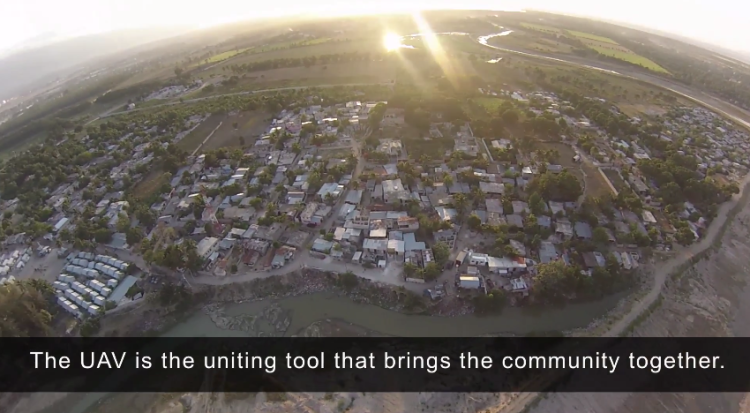
“What if, to solve our problems, we simply need to rise above them?” CartONG and France’s OpenStreetMap (OSM) community recently teamed up to support OSM Haiti’s disaster risk reduction efforts by deploying a small UAV, “which proved very useful for participatory mapping.” The video documentary below provides an excellent summary of this humanitarian UAV mission which took place just a few weeks ago.
Click on Image to Enlarge
As I noted in this earlier blog post on grassroots UAVs, the use of UAVs at the community level can be viewed as an extension of community and participatory mapping, which is why community engagement is pivotal for humanitarian UAV deployments. In many ways, a micro-UAV can actually bring a community together; can catalyze conversations & participation, which should be taken as more than simply a positive externality. Public Participatory GIS Projects (PPGIS) have long been used as a means to catalyze community conversations and even conflict resolution and mediation. So one should not overlook the positive uses of UAVs as a way to convene a community. Indeed, as CartONG and partners rightly note in the above video documentary, “The UAV is the uniting tool that brings the community together.”
“Many projects around the world provide solutions in local contexts. It is our mission to showcase these achievements, and to bring committed but often isolated innovators, their ideas and creative solutions to the greater community,” explained Stavros Yiannouka, CEO of the World Innovation Summit of Education, which is an initiative of the Qatar Foundation. We talked about the evolution of the Summit, education innovation around the world, challenges to global progress, and why partnership and collaboration are critical to scaling solutions.
Between 1900 and 2006, campaigns of nonviolent resistance against authoritarian regimes were twice as likely to succeed as violent movements. Nonviolent resistance also increased the chances that the overthrow of a dictatorship would lead to peace and democratic rule. This was true even in highly authoritarian and repressive countries, where one might expect nonviolent resistance to fail. Contrary to conventional wisdom, no social, economic, or political structures have systematically prevented nonviolent campaigns from emerging or succeeding. From strikes and protests to sit-ins and boycotts, civil resistance remains the best strategy for social and political change in the face of oppression. Movements that opt for violence often unleash terrible destruction and bloodshed, in both the short and the long term, usually without realizing the goals they set out to achieve. Even though tumult and fear persist today from Cairo to Kiev, there are still many reasons to be cautiously optimistic about the promise of civil resistance in the years to come.
There is evidence at least 20 prominent paedophiles – including former MPs and government ministers – abused children for “decades”, a former child protection manager has claimed.
Peter McKelvie, whose allegations led initially to a 2012 police inquiry, said a “powerful elite” of paedophiles carried out “the worst form” of abuse.
He said the network extended into both the House of Lords and the Commons.
The government has already announced two reviews into claims of abuse.