
Marcus Aurelius: CSA Reflects on Whole of Government Deficiencies — Military Best for Strong on Strong, Not Strong on Weak

Government, Military
Marcus Aurelius
Marcus Aurelius

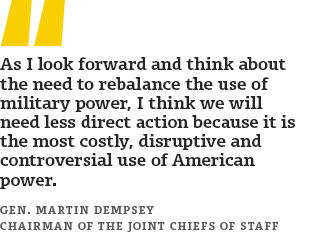
Dempsey Wants to ‘Rebalance the Use of Military Power’

By James Kitfield

Defense One, May 12, 2014

At the top of the United States military’s vast, global bureaucracy sits the chairman of the Joint Chiefs of Staff, the highest-ranking military officer in the land and the president’s senior military advisor. The chairman sits between the four-star service chiefs on one side, and the four-star combatant commanders on the other. The chiefs are responsible for developing, training and equipping the armed forces for the future. The commanders are responsible for deploying those forces, and their focus is on the application of military power to mitigate crises of the day. Between them in that “supply and demand” equation sits Gen. Martin Dempsey mitigating disputes and fashioning tradeoffs.

As U.S. combat forces withdraw from Afghanistan this year, the service chiefs are trying to manage a force drawdown across the military as combatant commanders cope with myriad crises and an unstable world. That has made Dempsey’s job one of the most difficult of any chairman of the Joint Chiefs in modern times. Defense One contributor James Kitfield recently discussed those challenges with Dempsey. Edited excerpts from their interview follow:

Defense One: Even before the U.S. has pulled its last combat troops out of Afghanistan, the administration is being widely criticized for its reluctance to use military force in response to numerous other crises. How do you balance the frequent demands for a U.S. military response with a stressed force and war-weary American public?

Dempsey: Well, I’m going to get a little philosophic with you here, but when you look at what the military instrument of power can accomplish, it is actually more effective in dealing with strength-on-strength situations than it is in dealing with strength-on-weakness scenarios. And we’re finding that a weakening of structures and central authority is pervasive in today’s world. The Middle East is a poster child for that dynamic. But if you look at almost any sector of civilization – from international organizations, to big corporations to places of worship – their authority has diminished over the past decade. That has to do with the spread of technology that has made information so ubiquitous in today’s world. But the result has been a weakened international order. And frankly, it’s harder to articulate the proper use of military power in that environment as opposed to a world with stronger centers of authority.
Continue reading “Marcus Aurelius: CSA Reflects on Whole of Government Deficiencies — Military Best for Strong on Strong, Not Strong on Weak”

Stephen E. Arnold: Using Real Data to Mislead

IO Sense-Making
Stephen E. Arnold
Stephen E. Arnold

Using Real Data to Mislead

Viewers of graphs, beware! Data visualization has been around for a very long time, but it has become ubiquitous since the onset of Big Data. Now, the Heap Data Blog warns us to pay closer attention in, “How to Lie with Data Visualization.” Illustrating his explanation with clear examples, writer Ravi Parikh outlines three common ways a graphic can be manipulated to present a picture that actually contradicts the data used to build it. The first is the truncated Y-axis. Parikh writes:

“One of the easiest ways to misrepresent your data is by messing with the y-axis of a bar graph, line graph, or scatter plot. In most cases, the y-axis ranges from 0 to a maximum value that encompasses the range of the data. However, sometimes we change the range to better highlight the differences. Taken to an extreme, this technique can make differences in data seem much larger than they are.”

The example here presents two charts on rising interest rates. On the first, the Y-axis ranges from 3.140% to 3.154% — a narrow range that makes the rise from 2008 to 2012 look quite dramatic. However, on the next chart the rise seems nigh non-existent; this one presents a more relevant span of 0.00% to 3.50% on the Y-axis.

Continue reading “Stephen E. Arnold: Using Real Data to Mislead”

SchwartzReport: 2013 Oil and Gas 7,662 Spills to Leaks (20 a Day)

05 Energy
Stephan A. Schwartz
Stephan A. Schwartz

This is a very important article because it gives us a sense of proportion and frequency concerning oil spills. The data should appall you.

America’s Oil And Gas Industry Averaged At Least 20 Spills Per Day In 2013
EMILY ATKIN – Think Progress

Despite missing data from one of the largest natural gas-producing states in the nation, an EnergyWire analysis released Monday found that the U.S. oil and gas industry was responsible for at least 7,662 spills, blowouts, and leaks in 2013 – an average of about 20 spills per day.

The figure represents an 18 percent increase in the number of spills EnergyWire counted in 2012, when 6,546 accidents were tallied. Though most of the spills were small, their combined volume added up to more than 26 million gallons of oil, gas, hydraulic fracturing fluid, and other substances, the report said.

Internet Society of New York: Net Governance – Play to Win

Advanced Cyber/IO
Home Page
Home Page

Net governance is a game – play it to win

by David Solomonoff

While we take the Internet for granted as an essential part of everyday life, decisions are being made behind the scenes that affect its future and the lives of everyone who relies on it. Net users are like players in a game where the rules are unknown and can change at any time. Decisions are made by technologists, government regulators and legislators, nonprofits and civil society groups — with a great deal of influence by special interests — far from public view or understanding.

Read full aticle.

Robert Young Pelton: VICE Saving South Sudan & Hunt for Kony

Cultural Intelligence, Peace Intelligence
Robert Young Pelton
Robert Young Pelton

The VICE documentary “Saving South Sudan” Part One is now online (Parts Two and Three will go up between now and Wednesday)

VICE Magazine “Saving South Sudan”  (The entire 50,000 word article is available free online. The first time VICE has dedicated an entire magazine to one article)

Article on the VICE Project

At the other end of the reading spectrum. Another article I did on the hunt for Kony was published today along with a profile of my company DPx Gear went live today

The Hunt for Kony in Defense Standard SOFIC edition

Daniel Villegas: Alternative Academic Credentials

04 Education
Danielle Villegas
Danielle Villegas

I found this article rather intriguing, as the student looked at both traditional and alternative methods of learning, and found that in some cases, alternative methods yielded the same or better results than traditional methods. As a former online grad student, I can tell you that it was a little difficult, even as recently as two years ago, to convince people that my MSPTC from a brick-and-mortar school taken entirely online was as stringent and comprehensive as if I went to classes in person.  I still see alternative education as a viable method, but as this student points out, since many alternative methods don't issue a “degree”, some sort of standard needs to be agreed upon by those supplying the alternative methods of learning to be able to provide a credential or “legitimize” the coursework taken.

Senior thesis: Evaluating alternative academic credentials

EXTRACT

“Part of why people get an education is to learn,” he said. “But part of it is to improve their lives by earning a meaningful and valuable credential that can hopefully earn them a job.”

In his thesis, “Diplomas of the Future? The Role and Value of Innovative Academic Credentials,” Francis examined two forms of alternative educational credentials: MOOCs and occupational “bootcamps,” which are nine-week-long intensive programs that cost more than $10,000 and help software engineers develop necessary technical and programming skills.

. . . . . . .

“Studies show that people learn similar amounts in an online class as they do in a lecture class, and my research found that people who graduate from developer bootcamps earn as much or more than the typical computer science graduate,” he said. “We know these alternative methods of education work.”

In addition to his research on the effectiveness of the programs, Francis interviewed recruiters and hiring managers from 20 high-tech Internet and software companies and learned what they value in a traditional college degree: selectivity, as someone else had already screened the candidate during the college admissions process; the on-campus experience that teaches interpersonal skills; and the broad intellectual foundation that teaches candidates how to think.

Read full post.

See Also:

Education @ Phi Beta Iota

MOOC @ Phi Beta Iota

Berto Jongman: NSA Tampering With US-Made Routers

IO Deeds of War, IO Secrets
Berto Jongman
Berto Jongman

Glenn Greenwald: how the NSA tampers with US-made internet routers

The NSA has been covertly implanting interception tools in US servers heading overseas – even though the US government has warned against using Chinese technology for the same reasons, says Glenn Greenwald, in an extract from his new book about the Snowden affair, No Place to Hide

See Also:

NSA Bugged Foreign-Bound Networking Equipment

noble gold