The article titled There’s a ‘Let Me Google That For You’ Bill on Talking Points Memo relates the substance of a bipartisan bill (sponsored by Tom Coburn and Clair McCaskill). The bills purpose is to save the taxpayer money by resorting to Google and eliminating the National Technical Information Service (NTIS). The article states,
“The bill is meant to cut down on “the collection and distribution of government information” by prioritizing using Google over spending money to obtain information from the National Technical Information Service (NTIS). NTIS, run by the Department of Commerce, is a repository of 3 million scientific, technical, engineering, and business texts. The bill would abolish the NTIS and move essential functions of the agency to other agencies like the National Archives.”
If the bill’s name sounds familiar, you have probably heard of the website it is named after, in which the website redirects you to Google. The bill is put forward to prevent waste by federal agencies in obtaining government documents for money when they are available online free of charge. Sounds like a no-brainer, especially since NTIS was founded in 1950, decades before the Internet was even a possibility. You can read the full bill here.
Lawrence Wilkerson, Colin Powell's long time principal assistant and Chief of Staff when he was Secretary of State, continuing a relationship dating back several decades, is a man whose observations should be taken seriously. These are amazing comments. Click through to see the video.
Americans are starting to understand that the U.S. is an oligarchy, rather than a democracy or a republic. (Even the chair of the Federal Reserve can’t really disagree.)
That’s true of war-making and foreign policy, as well.
Consummate insider Colonel Lawrence Wilkerson – former chief of staff to Colin Powell, the guy who wrote Powell’s famous speech on Iraqi weapons of mass destruction, and now distinguished adjunct professor of Government and Public Policy at William & Mary – notes:
Who’s behind the White House, and who’s therefore behind U.S. foreign policy, more or less?
I think the answer today is the oligarchs. Which would be the same answer, – incidentally, ironically, if you will – for Putin in Russia.
In recent months I’ve discovered that random selection offers unexpected gifts to our efforts to create more fair, functional, and intelligent politics and governance. I share a key dynamic that defines random selection and show how it has been applied historically and might be used more in specific institutions and instances today.
Until a few years ago I thought that random selection was just a great way to pick people who were a cross-section of the population, for a survey or a citizen deliberation. Random selection guarantees diversity and safeguards against manipulation, two very important factors in such exercises. I didn’t think to explore it further.
Then while researching my 2012 book Empowering Public Wisdom, I discovered that ancient Athenians staffed 90% of their government posts by drawing lots from the general citizenry. THAT was certainly a different way to govern!! Then this year, while helping on a few on-the-ground projects involving random selection, I had to learn about the unexpectedly diverse nitty-gritty issues of how people actually do such selections.
I began to realize that random selection is much more nuanced and filled with possibilities than I’d previously thought. I dug further into the subject, reading three books and a number of articles on what is also called lot, lottery, and sortition. I am starting – just starting – to get a handle on its counter-intuitive logic and its novel promise of remarkable power and potential….
You’ll hear more from me about all this over the coming months. Right now I want to share the main reason I think random selection is really important for us social change agents to understand:
Random selection is a perfect tool to address our most dangerous political problem – special interest manipulation.
Its potency includes and goes beyond the problem of “money in politics”. It potentially deals with manipulation of politicians and public officials (which generates corruption) … manipulation of information and social narratives (which generates ignorance and folly) … manipulation of public policy and budgets (which generates injustice and concentration of wealth and power) … and manipulation of elections and districts (which generates political malignancy and polarization). Collectively these forms of manipulation generate apathy, cynicism, low voter turnout, powerlessness, and suffering among the population at large while degrading prospects for future generations.
If you are reading this, the chances are you already know how toxic such dynamics are to democracy. Imagine what a gift it would be to be able to address them all in one powerful way.
There is lots of confirming evidence, with or without the Wayback Machine’s indirect proof–that if there was no internet activity on specific days, probably there was none during the interval within which they fall–that confirms it had been closed.
In addition to not being compliant with the requirements of the Americans with Disabilities Act (ADA), video footage shows that it was being used as a storage facility, where even The Newtown Bee reported that it was laden with asbestos and other bio-hazards. No student should have been there.
Empirical research on the neural correlates of attention is revealing a multi-functional system by which we balance the center of attention with the periphery, focus and scanning, allowing and suppressing attention to input. For students and those who are beginning to train their online infotention, it begins with strengthening the ability to ignore distractions. However, experts are also good at paying attention to perceptions on the periphery that might be important now or later (think of an expert aviator, scanning the horizon.)
Attention is only partly about what we focus on, but also about what we manage to ignore.
Neuroscientists have pinpointed the neural activity involved in avoiding distraction, a new study reports.
This is the first study showing that our brains rely on an active suppression system to help us focus on the task at hand (Gaspar & McDonald, 2014).
. . . . . . .
The study, published in the Journal of Neuroscience, involved 47 students carrying out a visual search task while their brain signals were monitored.
The finding may have important implications for psychological disorders which involve problems with attention.
The study’s senior author, John McDonald, said:
“…disorders associated with attention deficits, such as ADHD and schizophrenia, may turn out to be due to difficulties in suppressing irrelevant objects rather than difficulty selecting relevant ones.”
Consumers across the globe say they want less stuff.
Half of them say they’d happily live without most of the items they own in a global survey of 10,574 adults ages 16 and up in 29 nations. The survey, titled “The New Consumer and the Sharing Economy,” was done by the communication giant Havas Worldwide and will be released Tuesday.
Seventy percent of those surveyed said that overconsumption puts the planet at risk.
“Every step of the way, they are practicing less is more — and savoring the less,” says Andrew Benett, global CEO of Havas Worldwide.
Sixty-five percent of those surveyed said society would be better off if people shared more and owned less.
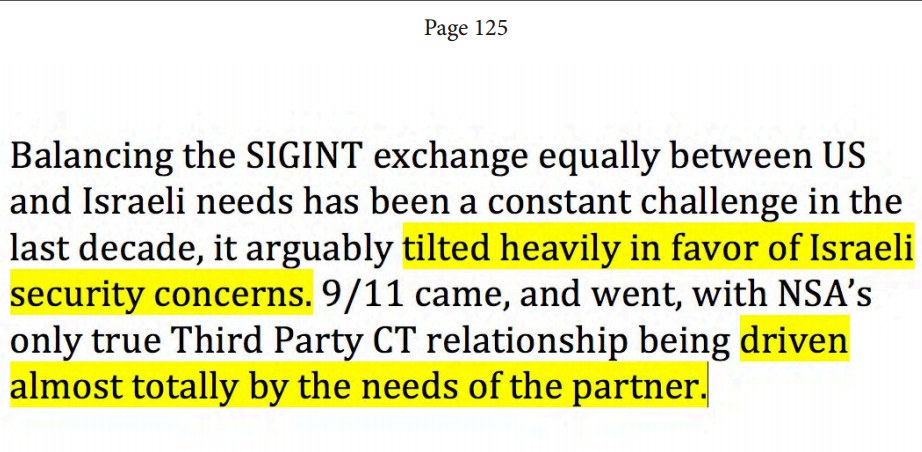
The following leaked slide from Edward Snowden was released today by Glenn Greenwald in his new book, No Place to Hide:
If you can’t read the slide, it says:
Balancing the SIGINT exchange equally between US and Israeli needs has been a constant challenge in the last decade, it arguably tilted heavily in favor of Israeli security concerns. 9/11 came, and went, with NSA’s only true Third Party CT relationship being driven almost totally by the needs of the partner.
That is a stunning statement. It implies that the signals intelligence exchange between the American and Israeli governments has been driven almost entirely by the NSA giving information to the Israelis, instead of Israel giving information to the U.S. … even though we were the ones attacked on 9/11.
Click on Image to Enlarge
Remember, the raw data in American citizens collected by the NSA is shared with Israel. As the Guardian reported in September:
The National Security Agency routinely shares raw intelligence data with Israel without first sifting it to remove information about US citizens, a top-secret document provided to the Guardian by whistleblower Edward Snowden reveals.
***
According to the agreement, the intelligence being shared would not be filtered in advance by NSA analysts to remove US communications. “NSA routinely sends ISNU [the Israeli Sigint National Unit] minimized and unminimized raw collection”, it says.
***
A much stricter rule was set for US government communications found in the raw intelligence. The Israelis were required to “destroy upon recognition” any communication “that is either to or from an official of the US government“. Such communications included those of “officials of the executive branch (including the White House, cabinet departments, and independent agencies), the US House of Representatives and Senate (member and staff) and the US federal court system (including, but not limited to, the supreme court)”.