Enterprise software vendor TIBCO has acquired Jaspersoft, an open source business intelligence company, for approximately $185 million. It’s not an earth-shaking deal, but it could be a sign of things to come in an analytics software market full of companies and products that have a hard time standing out from the crowd.
MBAs will drooling at the thought of business intelligence deal making if the article’s premise is correct.
But there are several other angles in this Tibco Jaspersoft tie up.
There are at least four contenders in the race to bring a cold-fusion powered heat-producing device to market in the near future. These are the Rossi E-cat project now based in North Carolina under the aegis of a new firm called Industrial Heat; the Brillouin and SRI effort to develop a nuclear reaction boiler out in California; the Defkalion Green Technology’s effort in Vancouver and Greece to market a heat producing device later this year; and finally BlackLight Power’s radically different ‘hydrino” technology which, if it proves to work at a commercial scale, could trump all the rest.
1. Deep State
2. Oligarchs (1%)
3. New Nobility
4. Upper Caste
5. State Nomenklatura (9% with Upper Caste)
6. Middle Class (20%)
7. Working Poor (30%)
8. State Dependents (20%)
9. Mobile Creatives (8%)
Eight of the nine classes are hidebound by conventions, neofeudal and neocolonial arrangements and a variety of false choices.
There are many ways to slice and dice America's power/wealth hierarchy. The conventional class structure is divided along the lines of income, i.e. the wealthy, upper middle class, middle class, lower middle class and the poor.
I've suggested that a more useful scheme is to view America through the lens not just of income but of political power and state dependency, as a Three-and-a-Half Class Society (October 22, 2012):
The three-and-a-half class society is comprised of: the “entrenched incumbents” on top (the “half class”), the high-earners who pay most of the taxes (the first class), the working poor who pay Social Security payroll taxes and sales taxes (the second class), and State dependents who pay nothing (the third class).This class structure has political ramifications. In effect, those paying most of the tax are in a pressure cooker: the lid is sealed by the “entrenched incumbents” on top, and the fire beneath is the Central State's insatiable need for more tax revenues to support the entrenched incumbents and its growing army of dependents.
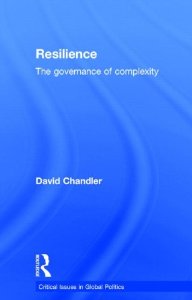
Forthcoming 14 May 2014. Resilience has become a central concept in government policy understandings over the last decade. In our complex, global and interconnected world, resilience appears to be the policy ‘buzzword’ of choice, alleged to be the solution to a wide and ever-growing range of policy issues. This book analyses the key aspects of resilience-thinking and highlights how resilience impacts upon traditional conceptions of governance. This concise and accessible book investigates how resilience-thinking adds new insights into how politics (both domestically and internationally) is understood to work and how problems are perceived and addressed; from educational training in schools to global ethics and from responses to shock events and natural disasters to long-term international policies to promote peace and development. This book also raises searching questions about how resilience-thinking influences the types of knowledge and understanding we value and challenges traditional conceptions of social and political processes.
Amazon Page
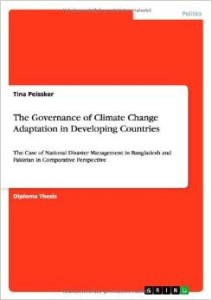
2013 Diploma Thesis from the year 2011 in the subject Politics – International Politics – Environmental Policy, grade: 1,3, University of Potsdam (Chair of International Poilitics), language: English, abstract: The prospects that global climate change will have adverse effects on human societies opened up a discourse about how adaptation should be managed. In order to finance adap-tation measures, the parties of the Kyoto Protocol recently established the Adaptation Fund in 2007. In view of the limited resources that are available for adaptation, scales for the prioritization of countries according to their suspected vulnerability have been developed in the literature. Indicators of vulnerability highlighted within this literature, only reflect the indicators of human development and therefore fail to capture the complex structures of vulnerability. The collective learning approach assumes that vulnerability can be significantly decreased when governance systems adapt to external changes through collective learning processes. The present thesis connects to this notion and therefore assesses the influence of collective learning processes on the vulnerability of the Bangladeshi and Pakistani society towards flood hazards. It does so in order to find a determinant of vulnerability that is able to capture its complexity. Following a case study comparison that is based on a systematic research on primary and secondary literature this study reconfirms that vulnerability can substantially be decreased in the presence of collective learning processes.
In this short essay, my attempt will be to articulate a conception of a world order premised on nonviolent geopolitics, as well as to consider some obstacles to its realization. By focusing on the interplay of “law” and “geopolitics” the intention is to consider the role played both by normative traditions of law and morality and the “geopolitical” orientation that continue to guide dominant political actors on the global stage.
Such an approach challenges the major premise of realism that security, leadership, stability, and influence in the 21st century continue to rest primarily on military power, or what is sometimes described as “hard power” capabilities. [1]
From such a perspective international law plays a marginal role, useful for challenging the behavior of adversaries, but not to be relied upon in calculating the national interest of one’s own country. As such, the principal contribution of international law, aside from its utility in facilitating cooperation in situations where national interests converge, is to provide rhetoric that rationalizes controversial foreign policy initiatives undertaken by one’s own country and to demonize comparable behavior by an enemy state. This discursive role is not to be minimized, but neither should it be confused with exerting norms of restraint in a consistent and fair manner.
My intention is to do three things:
• to show the degree to which the victors in World War II crafted via the UN Charter essentially a world order, which if behaviorally implemented, would have marginalized war, and encoded by indirection a system of nonviolent geopolitics; in other words, the constitutional and institutional foundations already exist, but inert form;
• to provide a critique of the realist paradigm that never relinquished its hold over the imagination of dominant political elites, and an approach has not acknowledged the obsolescence and dangers associated with the war system;
• and, finally, to consider some trends in international life that make it rational to work toward the embodiment of nonviolent geopolitics in practice and belief, as well as in the formalities of international law.
The range of speakers and topics is worth a look. There is no focus to open source at the same time that the main emphasis appears to be the role of the state rather than service to the public.
In recent years massive open online courses (MOOCs) have become a trend in online education. The term was coined in 2008 by David Cormier, manager of web communications and innovations at the University of Prince Edward Island. The first MOOC was created the previous year, at Utah State University.
MOOCs are designed like college courses but are available to anyone anywhere in the world, at no cost. You do not receive a college credit, but you will receive a certificate of completion when you complete all coursework. The courses span dozens of subjects and are taught by some of the leaders in those fields. The courses are designed to be interesting, fun and rigorous; the courses are not just in science, and not just in English.