
Reference (2014): Bill de Blasio Inauguration Speech (Mayor, New York City) + Early Transitions Commentaries

Cultural Intelligence
Bill de Blasio
Bill de Blasio (2014)

The following is the complete text of Mayor Bill de Blasio’s inaugural address, as prepared for delivery.

Thank you, President Clinton, for your kind words. It was an honor to serve in your administration, and we’re all honored by your presence. I have to note that, over 20 years ago, when a conservative philosophy seemed dominant, you broke through – and told us to still believe in a place called Hope.

Thank you, Secretary Clinton. I was inspired by the time I spent on your first campaign. Your groundbreaking commitment to nurturing our children and families manifested itself in a phrase that is now a part of our American culture – and something we believe in deeply in this city. It Takes A Village.

Bill de Blassio (1983)

Thank you, Reverend Fred Lucas Jr., Rabbi Joseph Potasnik, Monsignor Robert Romano, and Imam Askia Muhammad for your words of prayer.

Thank you, Governor Cuomo. Working with you at HUD, I saw how big ideas can overcome big obstacles. And it will be my honor to serve shoulder-to-shoulder with you again.
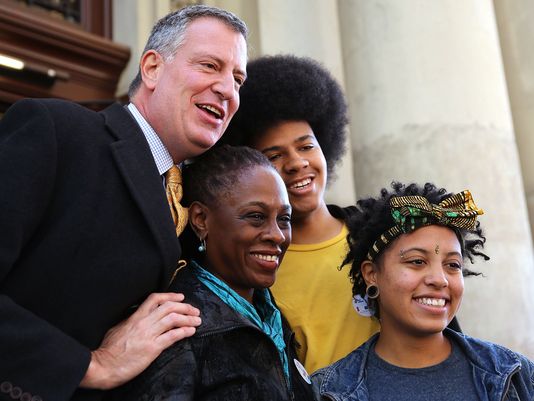
Bill de Blasio Family (2013)

Thank you, Mayor Bloomberg. To say the least, you led our city through some extremely difficult times. And for that, we are all grateful. Your passion on issues such as environmental protection and public health has built a noble legacy. We pledge today to continue that great progress you made in these critically important areas. Thank you, Mayor Bloomberg.

Thank you, Mayor Dinkins, for starting us on the road to a safer city, and for always uplifting our young people – and I must say personally, for giving me my start in New York City government. Thank you. And Mayor Dinkins, you also had the wisdom to hire a strong and beautiful young woman who walked up to me one day in City Hall and changed my life forever.

Continue reading “Reference (2014): Bill de Blasio Inauguration Speech (Mayor, New York City) + Early Transitions Commentaries”

Richard Stallman: Free Software Supporter Issue 69 December 2013

IO Newsletter Free Software
Richard Stallman
Richard Stallman

Free Software Supporter

Issue 69, December 2013

Welcome to the Free Software Supporter, the Free Software Foundation's monthly news digest and action update — being read by you and 74,210 other activists. That's 1,702 more than last month!View this issue online here: https://www.fsf.org/free-software-supporter/2013/december

TABLE OF CONTENTS

  • Build us up! Free software is a cornerstone of a free society
  • Register for LibrePlanet today!
  • Defective by Design visits an Apple store (with photos)
  • Gluglug X60 Laptop now certified to Respect Your Freedom
  • LibrePlanet for all!
  • FSF responds to Microsoft's privacy and encryption announcement
  • Chirp along with us on your microblogging service of choice
  • FSF: Reform corporate surveillance
  • Windows 8: A “certifiable flop”
  • Ask reddit to upvote user freedom by serving no nonfree JavaScript
  • Upcoming changes for Ututo
  • Interview with Frank Karlitschek of ownCloud
  • Spring 2013 FSF Bulletin now available online
  • Celebrate Computer Science Education Week with free software
  • GNU Press announces gray GPLv3 hoodies
  • Avoiding surveillance
  • More Libre.fm news — server move, new design, kittens
  • GnuPG – Sixteen years of protecting privacy
  • GNU MediaGoblin 0.6.0 released
  • Join the FSF and friends in updating the Free Software Directory
  • LibrePlanet featured resource: LibreDWG
  • GNU Spotlight with Karl Berry: 20 new GNU releases!
  • Richard Stallman's speaking schedule and other FSF events
  • Thank GNUs!
  • Take action with the FSF!

Continue reading “Richard Stallman: Free Software Supporter Issue 69 December 2013”

Bruce Sterling: Stewart Brand on a global parliament of cities

Cultural Intelligence
Bruce Sterling
Bruce Sterling

A global parliament of cities

*It’s hard to believe they could be more sclerotic than what we’ve got.

*On the other hand, given the historical behavior of Italian city-states, man, I have to wonder. All I need is some Milanese Sforzas with catapults at the gates of Torino. It took the ultra-wealthy some real effort to completely subvert and own governments, but in Medici Florence that was what it was about from the get-go. Hello, Mayor Bloomberg! Thanks for the public-art!

Stewart Brand
Stewart Brand

From: Stewart Brand
Subject: [SALT] City-based global governance (Benjamin Barber talk)

“Sovereign nation states have conspicuously failed to cooperate well enough to deal with increasingly global problems such as climate change, environmental degradation, and organized crime, Barber said. Nations focus on their borders, which are seen as competitive zero-sum games.

Continue reading “Bruce Sterling: Stewart Brand on a global parliament of cities”

Marcus Aurelius: George Friedman on the Crisis of the Middle Class and American Power

01 Poverty, 03 Economy, 07 Other Atrocities, 10 Transnational Crime, 11 Society, Commercial Intelligence, Cultural Intelligence, Peace Intelligence
Marcus Aurelius
Marcus Aurelius

The Crisis of the Middle Class and American Power

Geopolitical Weekly

Stratfor

Editor's Note: The following Geopolitical Weekly originally ran in January 2013.

By George Friedman

When I wrote about the crisis of unemployment in Europe, I received a great deal of feedback. Europeans agreed that this is the core problem while Americans argued that the United States has the same problem, asserting that U.S. unemployment is twice as high as the government's official unemployment rate. My counterargument is that unemployment in the United States is not a problem in the same sense that it is in Europe because it does not pose a geopolitical threat. The United States does not face political disintegration from unemployment, whatever the number is. Europe might.

At the same time, I would agree that the United States faces a potentially significant but longer-term geopolitical problem deriving from economic trends. The threat to the United States is the persistent decline in the middle class' standard of living, a problem that is reshaping the social order that has been in place since World War II and that, if it continues, poses a threat to American power.

Continue reading “Marcus Aurelius: George Friedman on the Crisis of the Middle Class and American Power”

Neal Rauhauser: Foreign Policy’s Global Conversation Infographic

Cultural Intelligence
Neal Rauhauser
Neal Rauhauser

Foreign Policy’s Global Conversation Infographic

The images and following text were taken from The Global Conversation on Foreign Policy’s site. The site’s graph is user zoomable and the second image shows President Obama, Secretary of State Kerry, and Edward Snowden. I may have to hunt up a print copy and read the full article on this.

Click on Image to Enlarge

What happens when you take six months of news coverage from around the world and compile a list of every person mentioned and the people they were mentioned alongside? You get a network of 3 million nodes connected by 42 million links. Based on the GDELT Global Knowledge Graph — a massive compilation of the world’s people, organizations, locations, themes, emotions, and events — this visualization highlights the 25,000 newsmakers mentioned most frequently from April to October 2013 and the 100,000 connections among them.

Continue reading “Neal Rauhauser: Foreign Policy’s Global Conversation Infographic”

Stephen E. Arnold: Relational Big Data Stores Versus Hierarchical Databases

Advanced Cyber/IO
Stephen E. Arnold
Stephen E. Arnold

Relational Data Stores Versus Hierarchical Databases

The article titled Codd’s Relational Vision – Has NoSQL Come Full Circle on opensource connections relates the history of relational databases and applies their lessons to the NoSQL databases so popular today. The article walks through the simplest databases that followed the hierarchical model and then into generalized databases. The article then delves into the work of Edgar F. Codd himself:

Continue reading “Stephen E. Arnold: Relational Big Data Stores Versus Hierarchical Databases”

Stephen E. Arnold: Library Intelligence – Another Reason for the Open Source Agency (OSA)

Cultural Intelligence
Stephen E. Arnold
Stephen E. Arnold

Libraries: A Good Thing

When you cannot locate information on Google, what does one do? Some people just guess? Others use spreadsheets and make up data? Quite a few people go to the library. Well, “quite a few” may be one of those unsupported factoids about modern life.

Navigate to Pew Research and check out the outfit’s most recent report How Americans Value Public Libraries in Their Communities. You can find it at http://bit.ly/1bLMEOt for now.

The report contains good news and bad news. Here’s a positive finding:

91% of Americans who have ever used a public library say it is not difficult to find what they’re looking for, including 35% who say it is “very easy.”

On the other hand, the Pew Report says:

“54% of Americans have used a public library in the past 12 months, and 72% live in a “library house hold.”

If accurate, this statement identifies a Pew sampling issue and underscores the need to reach the 46 percent of folks who don’t use the library more than once in a blue moon.

Continue reading “Stephen E. Arnold: Library Intelligence – Another Reason for the Open Source Agency (OSA)”

noble gold