 This is a sobering analysis of one of the principal myths we tell ourselves about America.
It's Hard to Make It in America
LANE KENWORTHY, Professor of Sociology and Political Science at the University of Arizona – Foreign Affairs

The truth at any cost lowers all other costs — curated by former US spy Robert David Steele.
This is a sobering analysis of one of the principal myths we tell ourselves about America.
It's Hard to Make It in America
LANE KENWORTHY, Professor of Sociology and Political Science at the University of Arizona – Foreign Affairs
Libya: This week the Kuwaiti newspaper Al Rai published a Libyan intelligence report of the results of its interrogation of terrorists connected to the Benghazi attack in which a US Ambassador was murdered. According to the report, the Egyptian branch of the Muslim Brotherhood and President Mursi were involved in the plot to attack the US facility.
Comment: Al Rai is a mainstream legitimate news outlet in Kuwait. It published what purports to be the entire document in its original Arabic. Other Arab newspapers picked up the report before it reached English language news services.
The information, assuming the entire document is not a fake, is based on admissions or confessions obtained under Libyan intelligence interrogation. Therefore its credibility is doubtful. The linkage to Mursi is almost certainly a lie obtained under torture. What is significant is that multiple Arab news outlets thought it worth repeating.
Continue reading “NIGHTWATCH: Egypt Tarred with Benghazi, Israel Escapes Notice”
All cars can be cyber-hacked, either leveraging internal computers or by attaching a disposable kit.
As a general rule, all modern cars that come with an integrated computer are easily hacked. For older cars one can attack one's own small transponder and kit to do certain things at certain times, such as explode the gas tank or burn through the brake lines, destroying evidence of the attack method in the process.

Abstract: For Durkheim, the society integrates as dual, separately in a mechanical and in organic way. The first individuals in their interactions habituate new local rules which integrate society in its specific issues in a bottom-up direction. When new rules are institutionalisded and enforced for all, they feed back as mechanical restriction of behaviours from the top-down. Micro to macro structuration is seen as a circular process and does not err in descriptions of integration process that is also circular in nature. However, it fails to explain what integrates society constituted on unresolvable oppositions, and so how translate integration efforts into the integration outcome.
To fill this gap, integration is reorganised from dual to triadic concept first and so adjusted to fit a meso, instead of conventional micro or macro frame. The case is illustrated with evaluation study. Three measures of integration are derived. A strong balance is a measure of the mechanical integration between primary oppositions involved in the evaluated issue. Cohesion is a correlative measure of cooperative achievements. The third is a weak balance which measures mutuality of relations, assessing if they weave social ties in an emancipatory way. Circular interpretation is thus not rejected here. It is only reframed in a triadic concept having in its centre a meso category which is soft in its logic, intermediary in its function, but radical in transformative consequences.
Bojan Radej ( bojan.radej@siol.net), Mojca Golobič, Slovenian Evaluation Society, Working paper, vol. 6, no. 1 (June 2013), 23 pp.;
Background: http://www.sdeval.si/knjige/index.php/en/
| Datoteka | Opis | Velikost |
|---|---|---|
 sde_DZ 1-13_Divided we stand_(28jun2013).pdf sde_DZ 1-13_Divided we stand_(28jun2013).pdf |
292 Kb |

From PESN.com: [A] High School group in Rome, headed by Professor Ugo Abundo, have been making great strides in their LENR prototyping, holding seminars, and getting quite a bit of coverage in our LENR-to-Market Weekly compilation. Now they have a website to open source what they have been doing.
Today’s Tripolar Power Struggle
A few days ago I came across a map as part of research intended to expand the current Shia/Sunni labels applied to the Syrian conflict into the regional actors that fuel it. Egypt was given a prominent role that likely dated back to thinking about the United Arab Republic, formed early on in the Cold War. Today I undertook creating a map based on current conditions.
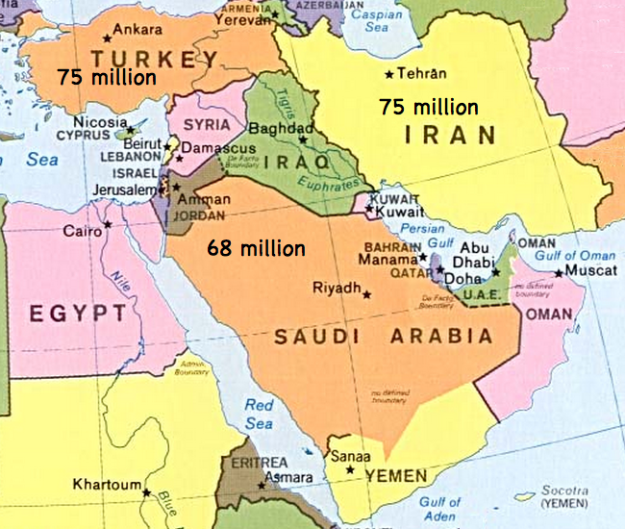
Turkey certainly has a role, with Syria melting down on their doorstep, and Iran views Syria as an ally, part of the Shia arc from the northeast Mediterranean to Iran’s eastern border. Egypt is bogged down with internal issues and the other player is a composite of the Saudis and the Qataris, both of whom fund radicalized Sunni groups. The 68 million population number is for all countries of the Saudi Arabian peninsula, not just the two who fund adventures.
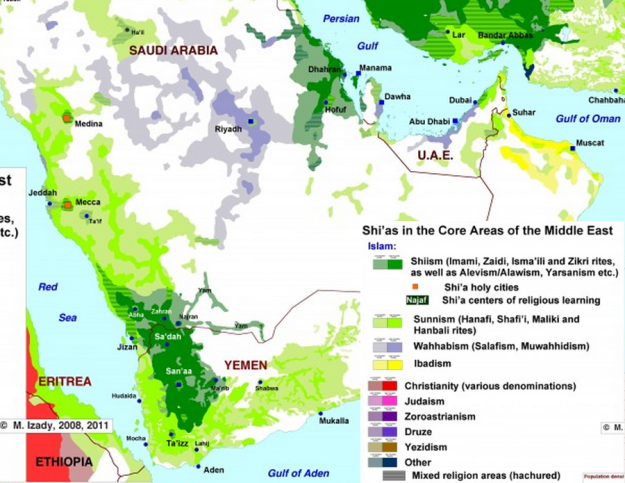
Twenty percent of Saudia Arabian peninsula residents are Shia. Tiny majority Shia Bahrain, home to the U.S. 5th Fleet, has simmered with dissent over injustice that flows from the Sunni dominated regime, and Saudi Arabia has intervened directly in order to keep the troubles from overflowing into their own Shia population, some 10% of the total, and concentrated in the provinces near Bahrain.
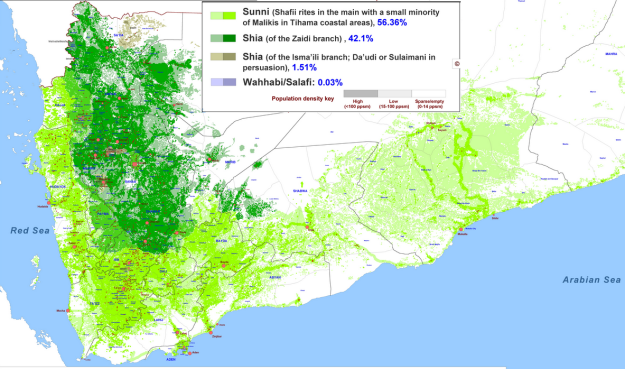
Yemen, formerly the nations of North and South Yemen, who merged in 1990, is evenly split between Shia and Sunni adherents, and has been at a rolling boil for the last four years. As recently as three weeks ago U.S. drones struck al Qaeda Arabian Peninsula (AQAP) leadership in Yemen.
I recently posted Bipartisan Opposition To Syrian Intervention, a report on both sides of Capitol Hill weighing in on their disinterest in an unsupervised adventure in Syria. Congressman Peter Welch had this to say:
Syria is in a brutal and tragic civil war the roots of which go back hundreds of years
Continue reading “Neal Rauhauser: Turkey – Iran – Saudi Arabia in Conflict”

Huh?
‘We should have talked to Taliban' says top British officer in Afghanistan
Exclusive: General Nick Carter says west could have struck a deal with Taliban leaders after they were toppled a decade ago
Emma Graham-Harrison in Kabul
The Guardian,
The west should have tried talking to the Taliban a decade ago, after they had just been toppled from power, the top British commander in Afghanistan has told the Guardian, barely a week after the latest attempt to bring the insurgent group to the negotiating table stuttered to a halt.
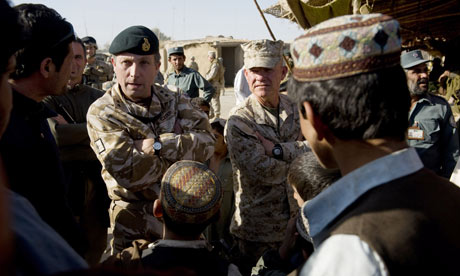
General Nick Carter, deputy commander of the Nato-led coalition, said Afghan forces would need western military and financial support for several years after western combat troops head home in 2014. And he said the Kabul government may have to accept that for some years it would have only shaky control over some remoter parts of the country.
Speaking exclusively to the Guardian, he said: “Back in 2002, the Taliban were on the run. I think that at that stage, if we had been very prescient, we might have spotted that a final political solution to what started in 2001, from our perspective, would have involved getting all Afghans to sit at the table and talk about their future,”
Acknowledging that it was “easy to be wise with the benefit of hindsight”, Carter added: “The problems that we have been encountering over the period since then are essentially political problems, and political problems are only ever solved by people talking to each other.”
Continue reading “Mini-Me: UK General “We Should Have Talked to Taliban” Decade Ago”
