SmartPlanet: Using salt water to power our batteries

05 Energy

Using salt water to power our batteries

By | October 1, 2012, 3:05 AM PDT

One of the main foundations of the electric battery packs powering our cell phones and electric vehicles is lithium, a pricey, lightweight metal that is one reason why electric batteries remain so expensive. According to an analyst for Toronto-based Byron Capital Markets, the price of lithium has risen 35 percent in the last 18 months.
Click on Image to Enlarge

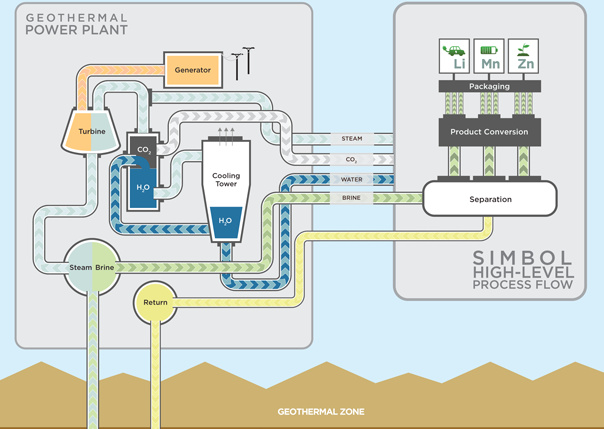
As a result, many companies are trying to find ways to reduce the cost of extracting lithium – it is usually mined from ore. Simbol Materials, based in Pleasanton, CA, believes that using evaporation to extract lithium from brine – salt water – could be a much more cost-effective means of obtaining the metal.

With projected annual sales of 3.9 million hybrids, 1.4, million plug-in hybrids, and 2.8 million full electric plug-in vehicles by 2020, according to Simbol’s CEO Luka Erceg, the demand for lithium will only rise. The company says it may increase its output from 8,000 tons a year to as many as 64,000 tons by 2020.

Simbol’s brine evaporation process takes the salty water from geothermal power plants and uses reverse osmosis to extract minerals. Simbol’s process takes between 90 minutes to 2 hours to complete – compared to a conventional evaporation process that can take up to 18 months.

With the earth’s massive supply of salt water, it could become the most abundant – and cost-effective – way to keep our cars and laptops powered.

Photo: Simbol

via [Autoblog Green]

Eagle: Oil Lies, Oil Spills – Technology Sucks, Human Intelligence Rules

05 Energy, Commerce, Corruption, Earth Intelligence, Government
300 Million Talons…

1)  All stakeholders in the Keystone Pipeline are lying to the public.  There are THREE sucking chest wounds in the Keystone Pipeline proposal:  a)  Canada cannot afford to use clean water it is running out of, to flush tar sands no one needs; and the USA does not need any more oil.  b)  The pipeline will NOT create jobs and it will be a curse to every community anywhere near it, externalizing costs to everyone along the way.  c)  The legacy refineries are lying in order to get the public to pay the cost of delivering very dirty crude that they will refine for EXPORT.

2)  Technology does NOT work as claimed.

3)  Human intelligence rules again.  What is LACKING is integrity at all points of the compass.

Few Oil Pipeline Spills Detected by Much-Touted Technology

InsideClimate News analysis of a decade of federal data shows general public detected far more spills than leak detection technology.

EXTRACT:

Between 2002 and July 2012, remote sensors detected only 5 percent of the nation's pipeline spills, according to data from the Pipeline and Hazardous Materials Safety Administration (PHMSA).

The general public reported 22 percent of the spills during that period. Pipeline company employees at the scenes of accidents reported 62 percent.

Anthony Swift, an attorney who has spent years researching pipeline safety for the Natural Resources Defense Council, was taken aback by the findings. Swift's organization opposes the Keystone XL, and he said he had always known that leak detection systems didn't catch most of the spills. But “the fact that 19 out of 20 leaks aren't caught is surprising, and certainly runs counter to a lot of rhetoric we hear from the industry,” he said.

Read full article.

Mini-Me: Sirius, Tesla, Free Energy, extraterrestrials, Secrecy….

05 Energy, Knowledge
Who? Mini-Me?

Huh?

– – – – – – – –

We discovered a brief film clip of one of Tesla's demonstrations. It is embedded in the trailer for Dr. Steven Greer's movie-in-progress Sirius,, beginning at 53 seconds in and lasting until 57 seconds. By rapidly double-clicking the pause button you can watch it in slow motion. No explosive phenomena are apparent to me, but the structure does seem to be made of metal. See if it doesn't remind you of anything.

Click start.  Then use mouse to move to 50-53 seconds, see the tesler enery pulverize rocks — very similar to what happened to the World Trade Center towers when combined with controlled demolitions.  http://www.sirius.neverendinglight.com/


See Also:

Wikipedia/Nikola Tesla

Tesla Generator Review

Smart Planet: In the Philippines, turning plastic waste into fuel

05 Energy, Commercial Intelligence, Earth Intelligence, Knowledge

In the Philippines, turning plastic waste into fuel

Plastic waste is a problem all over the world. And it is especially troubling in the Philippines where plastic waste piles up in Manila’s Payal landfill, unable to decompose. But one inventor thinks he might have found the answer to this chronic problem.

Jayme Navarro, founder of Poly-Green Technology and Resources is converting plastic waste into fuel through a process known as Pyrolysis.

ECO-Tech explains how it works:

“Pyrolysis is a fairly simple process, it starts by drying plastics to be processed. They are then shredded into smaller pieces, and heated in a thermal chamber. The melted plastic is continually heated until it boils and produce vapors. The vapor is passed into cooling pipes and distilled into a liquid, which is chemically identical to regular fuel.”

And one of the great benefits of converting plastic to fuel is that the fuel burns cleaner because of a low sulfur content. Navarro estimates that the fuel will be 10-20 percent cheaper because of the low production costs since the raw material is available in such large quantities.

The method has already been approved for industrial use and it is being tested for use in vehicles.

Reuters reporter Elly Park says: “While plastic fuel technology isn’t anything new, Navarro believes that an industrial scale version of his technology can not only help drivers on the road, but help the country dig itself out of its trash problem.”

Inventor turns plastic trash into liquid gold  [Reuters]

Filipino Inventor Turns Plastic Trash Into Liquid Gold  [ECO-Tech]

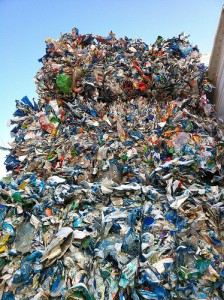
Photo via flickr/JMacPherson

See Also:

Paul Fernhout: Open Letter to the Intelligence Advanced Programs Research Agency (IARPA)

Video: Japanese Machine Making Fuel from Plastic, “Trash into Treasure”

Sepp Hasslberger: Solid-State Hydrogen Powers Laptops

05 Energy
Sepp Hasslberger

Novel fuel cell uses solid-state hydrogen to power laptops – Taipei Times

The nation’s Industrial Technology Research Institute (ITRI) on Friday unveiled a portable fuel cell that is believed to be the first in the world to use solid-state hydrogen. The device combines solid-state hydrogen fuel, water and a catalyst in a bottle the size of a beverage can, and it can generate sufficient electricity to power laptops and LED lights, the researchers said, demonstrating the product at a news conference held at an ITRI research park in Tainan.

See Also:

Sepp Hasslberger at Phi Beta Iota

Michel Bauwens: Renewables Changing Energy Market in 5 Years

05 Energy, Commercial Intelligence, Extraterrestial Intelligence
Michel Bauwens

How renewables will change electricity markets in the next five years

Ruggero Schleicher-Tappeser

Science Direct, 3 June 2012

Abstract

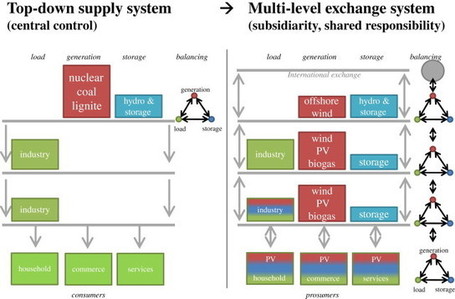
Photovoltaic (PV) cells, onshore wind turbines, internet technologies, and storage technologies have the potential to fundamentally change electricity markets in the years ahead. Photovoltaic cells are the most disruptive energy technology as they allow consumers of all sizes to produce power by themselves—new actors in the power market can begin operating with a new bottom-up control logic. Unsubsidised PV markets may start to take off in 2013, fuelling substantial growth where PV power is getting cheaper than grid or diesel backup electricity for commercial consumers.

Click on Image to Enlarge

Managing loads and achieving a good match between power consumption and weather-dependent power production will likely become a key issue. This consumption—production balance may trigger massive innovation and investment in energy management technologies involving different kinds of storage and controls. Increasing autonomy and flexibility of consumers challenges the top-down control logic of traditional power supply and pushes for a more decentralised and multi-layered system. How rapidly and smoothly this transformation occurs depends to a large extent on the adaptation speed of the regulatory framework and on the ability of market players to develop appropriate business models. The paper discusses conflicts of interest; hurdles and drivers; opportunities; and traps for this perspective.

See Also:

05 Energy (148)

Sepp Hasslberger: A Fuel Cell That Cleans Water and Makes Electricity—Simultaneously

05 Energy
Sepp Hasslberger

A Fuel Cell That Cleans Water and Makes Electricity—Simultaneously

A new design devised by a team of Penn State graduate researchers opens up a future of sustainable wastewater treatment.

The same kinds of bacteria used in wastewater treatment plants can also generate small amounts of electricity. But these two abilities have rarely been combined so cleverly.

In a study published last week, Penn State University researchers outlined a system called the microbial reverse electrolysis cell (MRC) that both cleans water and creates electricity.

Today it’s too expensive for practical applications in the field, but it opens up the possibility not only for more efficient wastewater cleanup, but also for hybrid water-treatment and power plants that can do both.

Read full article at Popular Mechanics

noble gold