I will not replicate all that is at www.oss.net and to a much lesser extent, www.earth-intelligence.net, but do want to recognize a handful of extraordinary individuals by isolating their especially meritorious contributiions to the long-running debate about national intelligence reform and re-invention.
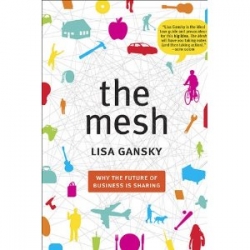
My friend Lisa Gansky has a new book out today. You can read a bit about it here.
I hope you'll buy a copy right now. It's that important and that valuable.
Amazon Page
Gansky has written the most insightful book about new economy business models since The Long Tail, and if you're not facile in understanding and working with the key concept behind this book, it's going to cost you time and trouble.
In short, the Mesh outlines how sharing resources and information creates an entirely new class of commerce. When you travel to another city, you don't buy a house. You stay in a hotel. A hotel, because it allows hundreds of people a year to share a single room, is a mesh business.
The thing is, the web has created thousands (probably more) of these businesses in areas you have never thought about. Zipcar, sure, and Netflix. But in all sorts of nooks and crannies as well. Lisa's online directory already lists thousands of these companies. Existing companies need to know about this, job seekers should be attracted to it, and for entrepreneurs, it really is a new frontier.
Manor, a small town in Texas a few miles from Austin, has become an unlikely star player in the new world of “Government 2.0.” This week Manor and GovFresh, an organization that provides news and information about technology innovation in government, joined forces to host a conference on “big ideas for local America.” The conference highlighted the work Manor, nearby DeLeon, and other small governments in the U.S. are doing to incorporate social media and open data approaches to provide better information and services to citizens, and to engage them more effectively. This is part of an open government trend that’s been brewing since the 1990s, but is catching fire with pervasive Internet adoption and digital convergence.
The field of knowledge management includes a wide variety of components and disciplines. Here is a list of 25 specialties practiced by those in the field, followed by Tara Pangakis list of 50 KM components across people, processes, and technologies.
Sharing, culture, organizational design, and change management
Innovation, invention, creativity, and idea generation
Reuse, proven practices, and lessons learned
Collaboration and communities
Learning, development, and training
Goals, measurements, incentives, and rewards
Social networks, organizational networks, value networks, and network analysis
One is gradually ending. This is the cyclical recession, we have them all the time, they come and they go. Not fun, but not permanent.
The other one, I fear, is here forever. This is the recession of the industrial age, the receding wave of bounty that workers and businesses got as a result of rising productivity but imperfect market communication.
. . . . . .
The networked revolution is creating huge profits, significant opportunities and a lot of change. What it's not doing is providing millions of brain-dead, corner office, follow-the-manual middle class jobs. And it's not going to.
Fast, smart and flexible are embraced by the network. Linchpin behavior. People and companies we can't live without (because if I can live without you, I'm sure going to try if the alternative is to save money).
The sad irony is that everything we do to prop up the last economy (more obedience, more compliance, cheaper yet average) gets in the way of profiting from this one.
Only 500 generations ago, hunter-gatherers began cultivating crops and forming their tiny communities into social hierarchies. Around 15 to 20 generations ago, industrial capitalism erupted on a global scale.
In the last generation, the entire human species, along with virtually all other species and indeed the entire planet, have been thrown into a series of crises, which many believe threaten to converge in global catastrophe: global warming spiraling out of control; oil prices fluctuating wildly; food riots breaking out in the South; banks collapsing worldwide; the spectre of terror bombings in major cities; and the promise of ‘endless war’ to fight ‘violent extremists’ at home and abroad.
Amazon Page
We are running out of time.
Phi Beta Iota: The entire article is a distillation of the author's new book, now at Amazon UK and soon at Amazon US. The article ends with a sensible coherent list of “must do's” that should be–but are not–understood by one and all.
Dr. Ahmed is interviewed on the BBC World News here.
Phi Beta Iota: This is a well-intentioned document that is government-centric, and as a result, completely overlooks and fails to examine alternative futures that include Panarchy, Epoch B leadership, waves of federal nullifications and hundreds if not thousands of non-violent secessions, and of course Open Everything. This document, to be useful, should be redone to add two more scenarios, one a Hybrid scenario, the other an Open scenario. At a fundamental level, the document fails to reflect the massive revolutionary changes being made possible by the revolution in communications, computing, and public intelligence.
Ever since Oracle got its hands on MySQL via the Sun acquisition, many in the open source community have been hoping for a new open source database champion to emerge, notes Alan Shimel. With the release of version 9.0, it looks like PostgreSQL is stepping into the void. Some say PostgreSQL is the world's most advanced open source database. Alan Shimel interviews two of the projects leading contributors. They discuss many of the latest, greatest features in 9.0.