How Moody's sold its ratings – and sold out investors
Kevin G. Hall
McClatchy Newspapers
October 21, 2009
A McClatchy investigation has found that Moody's punished executives who questioned why the company was risking its reputation by putting its profits ahead of providing trustworthy ratings for investment offerings.
. . . . . . .
“The story at Moody's doesn't start in 2007; it starts in 2000,” said Mark Froeba, a Harvard-educated lawyer and senior vice president who joined Moody's structured finance group in 1997.
Medard Gabel, #2 to Buckminster Fuller in creating the analog World Game, is a founding member of the board of Earth Intelligence Network (EIN), a 501c3 Public Charity, and has devised the preliminary architecture and cost estimate for creating the EarthGame, which we trademarked in his name.
Click on the logo below to read his two-page estimate, subject to inflation adjustment, of what it would take to create an EarthGame with “true cost” information on all elements and universal participation by all humans. This is infinitely scalable.
EarthGame Pleliminary Plan
The complete concept, unrealized and lacking funding amidst the global financial meltdown, is centered on the creation of a World Brain in which the EarthGame is the primary public policy-budgteting dialog tool, and all individuals are able to use hand-hell cell phones to both access all information in all languages all the time; and to play themselves at all levels, local to global (panarchy is the opposite of anarchy).
A scheme to flood the market with counterfeit stocks helped kill Bear Stearns and Lehman Brothers — and the feds have yet to bust the culprits
MATT TAIBBIPosted Oct 14, 2009
What really happened to Bear and Lehman is that an economic drought temporarily left the hyenas without any more middle-class victims — and so they started eating each other, using the exact same schemes they had been using for years to fleece the rest of the country. And in the forensic footprint left by those kills, we can see for the first time exactly how the scam worked — and how completely even the government regulators who are supposed to protect us have given up trying to stop it.
This was a brokered bloodletting, one in which the power of the state was used to help effect a monstrous consolidation of financial and political power. Heading into 2008, there were five major investment banks in the United States: Bear, Lehman, Merrill Lynch, Morgan Stanley and Goldman Sachs. Today only Morgan Stanley and Goldman survive as independent firms, perched atop a restructured Wall Street hierarchy. And while the rest of the civilized world responded to last year's catastrophes with sweeping measures to rein in the corruption in their financial sectors, the United States invited the wolves into the government, with the popular new president, Barack Obama — elected amid promises to clean up the mess — filling his administration with Bear's and Lehman's conquerors, bestowing his papal blessing on a new era of robbery.
In my opinion, it is now almost certain that Afghanistan will wreck the presidency of Barack Obama. As I feared, Mr. Obama has allowed the US military and its allies in the Democratic wing and Republican wing of the national-security apparat (there is no real difference between these wings) to ensnare him in the wreckage left by the Clinton/Blair/Bush not-so-grand strategy of “indispensable” power: coercive diplomacy punctuated by endless “[no-so] precision” warfare. Supporting Sources for this Comment at end of posting.
Spinney Comments Continue After the Highlighted Article
Case for escalating the war is based on premises that turn to dust on inspection
Johann Hari Independent Wednesday, 21 October 2009
Is Barack Obama about to drive his Presidency into a bloody ditch strewn with corpses? The President is expected any day now to announce his decision about the future of the war in Afghanistan. He knows US and British troops have now been stationed in the hell-mouth of Helmand longer than the First and Second World Wars combined – yet the mutterings from the marble halls of Washington DC suggest he may order a troop escalation.
Obama has to decide now whether to side with the American people and the Afghan people calling for a rapid reduction in US force, or with a small military clique demanding a ramping-up of the conflict. The populations of both countries are in close agreement. The latest Washington Post poll shows that 51 per cent of Americans say the war is “not worth fighting” and that ending the foreign occupation will “reduce terrorism”. Only 27 per cent disagree. At the other end of the gun-barrel, 77 per cent of Afghans in the latest BBC poll say the on-going US air strikes are “unacceptable”, and the US troops should only remain if they are going to provide reconstruction assistance rather than bombs.
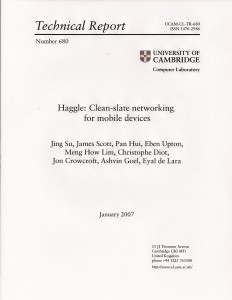
2007 Abstract: Haggle is a layerless networking architecture for mobile devices. It is motivated by the infrastructure dependence of applications such as email and web browing, even in situations where infrastructure is not necessary to accomplish the end user goal, e.g. when the destination is reachable by ad hoc neighborhood communication. In this paper we present details of Haggle's architecture, and of the prototype implementation which allows existing email and web applications to become infrastructure-independent, as we show with an experimental evaluation. [Emphasis added.]
A vulnerability in a Time Warner cable modem and Wi-Fi router deployed to 65,000 customers would allow a hacker to remotely access the device’s administrative menu over the internet, and potentially change the settings to intercept traffic, according to a blogger who discovered the issue.
Time Warner acknowledged the problem to Threat Level on Tuesday, and says it’s in the process of testing replacement firmware code from the router manufacturer, which it plans to push out to customers soon.
All of this means that a hacker who wanted to target a specific router and change its settings could access a customer’s admin panel from anywhere on the net through a web browser, log in with the master password, and then start tinkering. Among the possibilities, the intruder could alter the router’s DNS settings — for example, to redirect the customer’s browser to malicious websites — or change the Wi-Fi settings to open the user’s home network to the neighbors.