Review: Art, Politics and Dissent–Aspects of the Art Left in Sixties America

5 Star, Communications, Diplomacy, Politics

art politicsEarly Contribution Highly Relevant to Future of Public Diplomacy, August 13, 2008

Francis Frascina

This is a very special book, an early contribution that is sure to be built upon by others. We all urgently need more such books focusing on dissent everywhere, and the role that art, and especially street theater and “public” art as opposed to “commissioned” art, plays in representing the public consciousness and values that stand in opposition to dictatorships, abusive authority, and predatory operations (e.g. by corporations).

I am persuaded that we will finally create a prosperous world at peace when public art and public intelligence (decision support, collective intelligence, wisdom of the crowds) come together and create a public as an immovable object that no external authority can overthrow.

See also:
The Design of Dissent: Socially and Politically Driven Graphics
Cornucopia Limited: Design and Dissent on the Internet
Imagery of Dissent: Protest Art from the 1930s and 1960s (Chazen Museum of Art Catalogs)
Disturbing the Peace: A Conversation with Karel Huizdala
The Power of the Powerless: Citizens Against the State in Central-Eastern Europe
Improper behavior
From Art to Politics: How Artistic Creations Shape Political Conceptions

Review: Handbook of Data Visualization (Springer Handbooks of Computational Statistics)

5 Star, Communications, Decision-Making & Decision-Support

data visualoization935 pages, 569 Figures, 50 Tables, See Image, August 21, 2008

Chun-houh Chen

I gained access to this book free, via the sponsor of our non-profit's first year of operations, or I would not have bought it. It is a “great work” in the classic sense, and merits total respect. It must certainly be in the library of any university or college with ambitions to educate those who will lead the next wave moving us toward Web 3.0 and Web 4.0.

The publisher has been responsible about posting useful information (see inside the book, the second active link below the cover on this page) so I urge anyone thinking about this work, at this price, to print and attach the table of contents to their requisition.

The book does NOT make the leap to geospatially-referenced data or infinite end-user tagging of data, but it is certainly a foundation endeavor and I recommend it on that basis.

The other books being read by our senior “working” technologist include:
A New Ecology Perspective by Sven Jergensen et al (Elsevier, not on Amazon that I can find)
Information Visualization: Beyond the Horizon
Building Trustworthy Semantic Webs

Most of what we are reading these days are research reports that are outrageously priced and really should be affordable books and also free online, but most authors are too willing to give away their intellectual property for a pittance at tis time. Personally, I am betting on humans linked with low cost information sharing and group sense-making tools, and I am NOT holding my breath for automated fusion, machine learning, artificial intelligence, or machine sense-making.

I admire, very much, the more affordable books on visualization offered by Amazon, and urge the individual reader to spend on more of those than on this one overly expensive basic reference (I would have priced it at $90).

See the image I have loaded under book cover for a sense of the nuances Earth Intelligence Network is exploring.

Review: Building Trustworthy Semantic Webs

5 Star, Information Technology

semantic netsExtraordinary, Reasonably Priced, See Table of Contents & Image, August 21, 2008

Bhavani Thuraisingham

I gained access to this book free, via the sponsor of our non-profit's first year of operations, or I would not have bought it. It must certainly be in the library of any university or college with ambitions to educate those who will lead the next wave moving us toward Web 3.0 and Web 4.0. It is however reasonably priced and I recommend it for both library acquisition and deep reader purchase.

The publisher has been responsible about posting useful information (see inside the book, the second active link below the cover on this page) so I urge anyone asking that this work be acquired, at this price, print and attach the table of contents to their requisition.

The book is very well-organized with ample white space and excellent illustrative graphics and figures. I particularly liked the positioning of the references at the end of each chapter rather than grouped at the end.

The other books being read by our senior “working” technologist include:
A New Ecology Perspective by Sven Jergensen et al (Elsevier, not on Amazon that I can find)
Information Visualization: Beyond the Horizon
Handbook of Data Visualization (Springer Handbooks of Computational Statistics) (Springer Handbooks of Computational Statistics)

Most of what we are reading these days are research reports that are outrageously priced and really should be affordable books and also free online, but most authors are too willing to give away their intellectual property for a pittance at tis time. Personally, I am betting on humans linked with low cost information sharing and group sense-making tools, and I am NOT holding my breath for automated fusion, machine learning, artificial intelligence, or machine sense-making.

See the image I have loaded under book cover for a sense of the nuances Earth Intelligence Network is exploring.

Review: Information Visualization–Beyond the Horizon

4 Star, Communications, Decision-Making & Decision-Support

info visualizationEssential Reference, Slightly Disappointing for Me Personally, August 21, 2008

Chaomei Chen

I had already decided to grade this a four instead of five, in part because it makes me cranky when world-class authors such as the author of this book neglect other world-class pioneers because of their unwillingness to do a proper search outside their own narrow boundaries. I refer of course to Dick Klavens, Brad Ashford, and Katy Borner, whose Maps of Science are online and spectacular. Even Eugene Garfield, the inventor of citation analysis, gets short shrift.

That aside, the book is an essential reference. While it makes the needed point, that first generation visualization was about showing structure and relationships, and second generation visualization needs to be more dynamic and depict evolutionary and revolutionary changes and mutations (and I would add, provide early warning of anomalies and emergent patterns).

The last chapter, 8, on Detecting Abrupt Changes and Emerging Trends, is very interesting, but heavy on mathematics, and lacking in great detail, which reminds me this is really an overview text, and should be valued in that light. Two examples of fraud detection that I have personally seen as representative of the power of visualization include Dr. Bert Little's discover of $79 million in crop insurance fraud among roughly seven insurance agents and 20+ specific farmers; and the brilliant work of Dr. Simon J. Pak and Dr. John S. Zdanowicz who found $5o billion a year in import-export tax fraud (and Colombian coffee cans marked one pound and weighing 1.5 pounds) through their exploitation of public Department of Commerce databases.

This book has been assigned to our senior working technical person along with three others listed below.
A New Ecology: Systems Perspective, Sven Jorgensen et al (Elsevier, 2007), not on Amazon that I could find
Handbook of Data Visualization (Springer Handbooks of Computational Statistics) (Springer Handbooks of Computational Statistics)
Information Visualization: Beyond the Horizon
Building Trustworthy Semantic Webs

For myself, I put the book down thinking to myself, citation analysis is all well and good, but how do we integrate co-visualization of content, geospatial, money (e.g. “true costs” of each aspect or attribute)?

I continue to admire the work of Peter Morville, such as Ambient Findability: What We Find Changes Who We Become. His name does not appear in the index either. See also: Keeping Abreast of Science and Technology: Technical Intelligence for Business

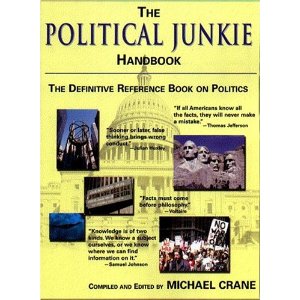
Review: The Political Junkie Handbook (The Definitive Reference Book on Politics)

4 Star, Politics

Amazon Page

Solid Four on Content, August 21, 2008

Michael Crane

The author is brilliant, and the cover quotes are phenomenal. Instead of my favorite quote for Thomas Jefferson (“A Nation's best defense is an educated citizenry”) the author uses one new to me, but I love it, “If all Americans know all the facts, they will never make a mistake.” Join that with Abe Lincoln's “cannot fool all of the people all of the time” and you have the Republic at its finest.

Reminding me of Dick “Vice” Cheney, the cover features also John Huxley's quote, “Sooner or later, false thinking brings wrong conduct.”

I list the table of contents for this marvelous (and very well-priced) huge (644 8.5 x 11 inch pages) volume. The publisher should have done this.

There are some troubling variations in the melange of what is covered for any given issue–some have Supreme Court ruling (e.g. abortionj others have pages of statistics. Standardization would have helped. Here are the topics covered, and I have not seen a finer single point of reference anywhere:

Aboriton
Affirmative Action
AIDS
Business
Communism
Courts
Supreme Court
Crime and Punishment
Death Penalty
Defense and the Military
Demographics
Disabilities
Drug and Alcohol Use
Economy
Educaiton
Elections
Energy
Environment
Family
Farm Policy
Federal Government
Feminism
Foreign Policy
Gay Rights
Global Warming
Gun Control
Health Care
The Homeless
Immigration
Labor
Media
Muslims
Political Correctness
Poverty
Race Relations
Regulation
Reparations
Social Security
Taxes
Terrorism and Home Security
Tort Reform
Trade
Welfare
Miscellaneous (from Girls of Clinton–guess which Clinton–to ….

Easily one of the most exciting parts of the above are the quotes with footnotes. This is a *killer* political research book.

Following the majority of the book are lists that are alone worth the price of the book and I am using them:

Senate Scorecard (Electoral Reform does not appear in this book)
Congress
100 Differences
Why Conservatives Hated the Clinton Administration
Why Liberals Hated the Reagan Administration
Celebrities (including quotes and contributions where available)
Economists
Books
Gore Misstatements (if McCain is a total idiot, Lieberman may be the first person in history to cost BOTH parties a presidential win)
Russell Kirk's Principles
Political Leaders of the Past
Political Talk Shows (with telephone numbers)
Lobbying and the Media
Polling Companies
Political Magazines
Political Groups
People
Federal Bureaucracy
Glossary

The Index is cursory, another reason I left it at four despite the deep respect I have for this endeavor.

Here is the book I would like to commission from him, covering at least five parties (Democrats, Republicans, Libertarians, Greens, Reforms, and of course Independents):

THREATS
Poverty
Infectious Disease
Environmental Degradation
Inter-State Conflict (including votes on defense budget)
Civil War
Genocide (including votes against intervention in Rwanda)
Other Atrocities (including votes against victim rights)
Proliferation (including votes for US nuclear arms industry)
Terrorism
Transnational Crime (should include white collar corporate crime)

POLICIES
Agriculture
Diplomacy (including votes against beefing it up)
Economy
Education
Energy
Family
Health
Immigration
Justice
Security (including water and food security, job security, etc)
Society (including subversion of our Christian culture)
Water

CHALLENGERS (including Senate and White House ignorance and neglect):
Brazil
China
India
Indonesia
Iran
Russia
Venezuela
Wild Cards (e.g. Congo, Malaysia, South Africa, Turkey)

I am an admirer of Paul Ray and a few others, I link to some below, but I am finding in this author real promise for enlightening all citizens, online, and exposing the platitudes being offered by Obama and McCain for what they are: empty promises with no foundation in a balanced budget or a serious (credible) story on where the revenue will come from. I for one believe that Gordon Norquist should demand a pledge to eliminate all individual income taxes and institute the Tobin Tax on all Federal Reserve transactions.

Put online, with an EarthGame(TM Medard Gabel), and all budgets online in advance of votes and without permitting secret earmarks, and we get our Republic back. Superb effort, it can be improved upon, and this needs to be done NOW.

See also:
The Nine Nations of North America
The Clustering of America
The Magic of Dialogue: Transforming Conflict into Cooperation
Running on Empty: How the Democratic and Republican Parties Are Bankrupting Our Future and What Americans Can Do About It
Breach of Trust: How Washington Turns Outsiders Into Insiders
The Broken Branch: How Congress Is Failing America and How to Get It Back on Track (Institutions of American Democracy)
Vice: Dick Cheney and the Hijacking of the American Presidency
The Bush Tragedy
The Tao of Democracy: Using Co-Intelligence to Create a World That Works for All
Society's Breakthrough!: Releasing Essential Wisdom and Virtue in All the People

Review: The New Age of Innovation–Driving Cocreated Value Through Global Networks

4 Star, Best Practices in Management, Change & Innovation

new ageBrilliant in Isolation, Annoying for Self-Referential Insularity, August 24, 2008

C.K. Prahalad

This book is certainly worth reading, and especially by those executives that do not read much (the ones with the big egos and short attention spans). I admire the authors, but I am also increasingly annoyed by the annoying self-referential insularity that charactizes “star” authors who seem to not have read much by anyone else. Publishers need to begin demanding a proper literature search and more due diligence in “connecting” the reader to dots created by others.

Let's be crystal clear: Stewart Brand, the original editor of the Co-Evolution Quarterly and the Whole Earth Review, and the founder of the Silicon Valley Hackers Conference, did more inthe 1970's and 1980's for the concept of co-creating value that this pair will ever achieve.

More recently, in the 1990's and the past ten years, Collective Intelligence, the Power of Us (a Business Week cover story 20 June 2005 that the author's do not deign to notice), Wisdom of the Crowds, Smart Mobs, and so on, have all focused on the core concept of co-creation of value.

This book loses one star for its pretentions as an immaculate conception of a core concept that has been understood by the rest of us for the past forty years.

Now, having vented in defense of other scholars and practitioners that the authors should have respected, here are my flyleaf notes that easily warrant a solid four.

+ Roadmap for business leaders that does a superb job of showing how strategy and business processes both need to receive more respect as well as deliberate management.

+ Every individual must be treated as a singular client, and no firm has the resources to do it all–being able to connect the single client with a need and the single third party able to meet the need may be the ultimate business process.

+ Most interesting to me, as a deep admirer of The Fortune at the Bottom of the Pyramid: Eradicating Poverty Through Profits, the book that showed me my final calling as intelligence officer to the public, for which I and 23 others created a non-profit, the authors drop the one billion extreme poor from their client list, and focus only on the 4 billion above that line.

+ Properly embraced, these four billion are billed by the authors–accurately and wisely in my view–as a major source of innovation and need that can power the global economy by 2015.

+ Role of Information Technology (IT), which Paul Strassmann has demonstrated is often a negative return on investment, is to bridge the gap between strategic intent and “capacity to act.”

+ Analytics in this book are primarily mathematic and data mining of existing digital information, with a token reference to external information. “Intelligence,” “decision support,” “competitive intelligence,” and “commercial intelligence” are not terms to be found in this book. The authors appear to be oblivious to the existence of the Society of Competitive Intelligence Professionals (SCIP) founded in 1986 and just now beginning to reach its potential.

+ The authors place great emphasis on the importance of the individual employee and customer, and again arouse my ire as they fail to refer back to such giants as Wilensky, Carkhuff, or Cleveland (see list of 10 books they either have not read or have chosen to forget).

+ Global standards plus local effectiveness is the key to mobilizing four billion new consumers.

+ They emphasize the importance of understanding the “hidden costs of the inflexible and archaic internal systems that exist in most firms.” They might also have thought to cite Ben Gilad on how most information reaching CEOs is late, biased, subjective, incomplete, and often wrong.

+ The three core concepts for the manager in a hurry to retain are: first, treat all others (consumers, employees, suppliers, regulators) as co-equals; second, do continuous analytics; and third, be ready to be turn on a dime. Efficiency is TIRED, flexibility (which means some redundancy) is WIRED.

For myself the real eye-opener in this book was the several case studies of what FedEx and others are doing with the detail that they amass from making their entire system transparent–not only are they tracking every package, but also every link and every inquiry–and then making sense of that to offer new services to specific INDIVIDUALs. I also appreciated the references to IBM's “ecosystem” of individuals and talents, and the emphasis on how many complex tasks can be “de-skilled” and migrated to very low-cost largely uneducated individuals, spreading the wealth while reserving the higher loads for increasingly scarce “full operational capability” programmers and managers.

I liked the authors' reference to A. V. Dhamakrishnan of Ramco India, and his focus on “evidence-based management” (page 165. I am considering publication of a work by many others on Health Intelligence, and the term I have found that rocks the health industry every time is “evidence-based medicine.”

The authors conclude that social networks are now moving into business-oriented collaboration platforms, and provide a listing of offerings that is long and interesting but not at all complete. Visit ArnoldIT.com for the real edge of the IT envelope.

This is a very fine book. It may be that publishers need to commission the literature survey, and then identify others to write forewords and afterwords that connect the dots. In no way do I demean the brilliant building block provided by this book–I am simply irritated that it hangs in space as an immaculate conception with no respect demonstrated for the considerable work by others–and to publish a book in 2008 and not even note the Business Week cover story of 20 June 2005 on “The Power of Us,” sorry, but that merits a spanking all by itself. Due diligence, anyone?

Other books, both old and new:
The exemplar: The exemplary performer in the age of productivity
The Knowledge Executive
Organizational Intelligence (Knowledge and Policy in Government and Industry)
Out of Control: The New Biology of Machines, Social Systems, & the Economic World
Smart Mobs: The Next Social Revolution
Wikinomics: How Mass Collaboration Changes Everything
The Wealth of Networks: How Social Production Transforms Markets and Freedom
Group Genius: The Creative Power of Collaboration
Collective Intelligence: Mankind's Emerging World in Cyberspace (Helix Books)
Collective Intelligence: Creating a Prosperous World at Peace

The authors might wish to demonstrate in their writing that which they preach so assidiously in this book.


Review: The Obama Nation–Leftist Politics and the Cult of Personality

4 Star, Politics

Obama NationPart of a Larger Story, Needs Filter AND Much Broader Reading, September 7, 2008

Jerome R. Corsi

EDIT of 20 Oct 08 to add link to even more detailed and philosophically grounded Barack H. Obama: The Unauthorized Biography

As reluctant as I was to engage with this author and this book, I have to confess that it is an essential point of view. The author and the “facts” as well as the “context” all require very rigorous filters, and cannot be taken at face value.

That having been said, I am one of those who was at first enthusiastic about Obama and then fell back for multiple reasons including the centrality of Dr. Bzezinski as his primary foreign policy advisor (Bzezinski is the guy who gave Pakistan the go on the Sunni nuclear bomb, and it is that, not the USA, that drives the Iranian Shi'ite nuclear program); the arrogance and unwillingess to meet in the center; the dependency on the Democratic party mafia; the one way “I talk you listen” attitude; and lastly, the gutless selection of a good but old man, Joe Biden, when curbing his insecurities and ego to select Hillary Clinton would have won it in a walk.

Below are reviews that will help put this book in context:

The OTHER two attack books on Obama, the first not noticed and VERY important to understanding why I finally went with McCain (pre-Palin):
Obama – The Postmodern Coup
The Case Against Barack Obama: The Unlikely Rise and Unexamined Agenda of the Media's Favorite Candidate

On how BOTH parties and Congress need draconian overthrow:
Running on Empty: How the Democratic and Republican Parties Are Bankrupting Our Future and What Americans Can Do About It
Breach of Trust: How Washington Turns Outsiders Into Insiders
The Broken Branch: How Congress Is Failing America and How to Get It Back on Track (Institutions of American Democracy)

My generally favorable reviews of Obama's two books (his only accomplishments to date other than co-sponsoring one piece of legislation with Senator Tom Coburn (R-OK):
Dreams from My Father: A Story of Race and Inheritance
The Audacity of Hope: Thoughts on Reclaiming the American Dream (Vintage)

In my view, America must vote for the team most likely to have both the strength to force the military-industrial complex to redirect jobs and production lines from war to peace (reform CAN be job and revenue neutral from district to district) and the strength to break the backs of both party mafias and restore participatory democracy. Only you can decide the answer to that objective, but I hope you all agree it is relevant.

Books with hope for our future:
The Tao of Democracy: Using Co-Intelligence to Create a World That Works for All
Society's Breakthrough!: Releasing Essential Wisdom and Virtue in All the People

noble gold