Review: The Limits of Power–The End of American Exceptionalism (American Empire Project)

4 Star, Culture, DVD - Light, Decision-Making & Decision-Support, Diplomacy, Strategy

Limits of PowerPragmatic, Philosophical, and Patriotic, September 7, 2008

Andrew Bacevich

The book is a combination of pragmatism, philosophy, and patriotism, and a major contribution. To balance it out, I would recommend General Tony Zinni's The Battle for Peace: A Frontline Vision of America's Power and Purpose; Professor Joe Nye's The Paradox of American Power: Why the World's Only Superpower Can't Go It Alone; and General Smedley Butler's War is a Racket: The Antiwar Classic by America's Most Decorated Soldier. Also The Fifty-Year Wound: How America's Cold War Victory Has Shaped Our World. And of course Chomsky and Johnson.

My notes:

“The United States today finds itself threatened bhy three interlocking crises. The first of these crises is economic and cultural, the second, political, and the third military. All three share this characteristic: They are of our own making.” (p. 6)

+ US short on realism and humility. See my reviews of The Eagle's Shadow: Why America Fascinates and Infuriates the World and Why the Rest Hates the West: Understanding the Roots of Global Rage

+ Citizenship is down, debt is up.

+ Book is a call to arms for citizens to put our own house in order–lest we miss this point, the author places “Set thine house in order” on the first page (2 Kings, chapter 20 verse 1).

+ The author credits the left, in general, with advancing rights and liberties in the USA.

+ He points out how we have been drowning in red ink from 1975 (and in fairness to the right, I believe we can now recognize that Bill Clinton's “surplus” was based on Wall Street fraud and fantasy, postponing our reconciliation with reality and the truth).

+ The author is at pains to address the hypocrisy of our Nation, see also: The Cheating Culture: Why More Americans Are Doing Wrong to Get Ahead and Fog Facts: Searching for Truth in the Land of Spin.

+ The author explores how the demise of the Soviet Union created a great deal of instability, including in particular in Central Asia but also elsewhere.

+ He explicitly identifies President Ronald Reagan's “Tanker War” (the reflagging of Kuwaiti ships) as setting the stage for today, and points out that not only was Iraq rather than Iran behind most of the attacks, but this also created the American delusion that it could force the oil pipe to stay open.

+ He slams Clinton and Albright for various good reasons.

+ Great quotes:

– “Long accustomed to thinking of the United States as a superpower, Americans have yet to realize that they have forefeited command of their own destiny.” (p. 65)

– “Rather than confronting this reality head-on, American grand strategy since the era of Ronald Reagan, and especially through the era of George W. Bush, has been characterized by attempts to wish reality away. Policy makers have been engaged in a de facto Ponzi scheme intended to extend indefinitely the American line of credit.” (p. 66)

+ The author joins a wide range of others in condemning all Washington institutions: DYSFUNCTIONAL.

The author points out that the ideology of national security is the key CONTINUITY across BOTH the dysfunctional parties.

On page 85 he addresses the cult of secrecy and the manner in which virtually all of our governmental agencies (not just the spies and the White House) evade public accountability.

The author addresses how our politicians and our senior civil servants and flag officers (generals and admirals) have come to feel IMMUNIZED from public accountability.

I smile on page 91, when John F. Kennedy concludes on the basis of the Bay of Pigs that he was set up, and that CIA is not only incompetent, but the Joint Chiefs of Staff are either stupid or untrustworthy, or both.

He spends some time on the bureaucracy as the enemy of Presidents, and I would beg to differ. Our bureaucracy's are quite valuable, but only if we respect their deep and broad knowledge.

On page 113 I am fascinated to see Nitze's contribution described as a “model” in which the enemy is demonized, “options” are offered that manipulate the decision, a “code language” is used to sway the public, and panic is promoted to sweep away reasoned inquiry. Then he caps this by pointing out that Wolfowitz is the heir to Nitze.

The author begins drawing to a conclusion by pointing out that we have been distracted from the real lessons of the Iraq war, and this begins the very rich final portion of the book.

LESSON ONE: Ideology of national security poses an insurmountable obstacle to sound policy making

LESSON TWO: Americans can no longer afford to underwrite a government that does not work.

LESSON THREE: The Wise Men concept is moose manure. “To attend any longer to this elite would be madness. This is the third lesson that the Iraq War ought to drive homo. What today's Wise Men have on offer represents the inverse of wisdom. Indeed, to judge by the reckless misjudgments that have characterized U.S. policy since 9/11, presidents would be better served if they relied on the common sense of randomly chosen citizens rather than consulting sophisticated insiders.” p 122-123.

He offers three illusions that took rote post Viet-Nam:

1) That we reinvented war in its aftermath (naturally, emphasizing extremely expensive stuff that does not always work)

2) That we could achieve “full spectrum warfare” while ignoring counterinsurgency and small wars and gendarme and so on.

3) Civilian and military leaders and staffs learned to make nice and work together. NOT SO.

Three more lessons that he caveats:

1) Civilians screwed up Iraq BUT our generals were mediocre and subservient

2) Commanders need more leeway BUT in fact they did not lack for authority, they lacked for ability (and I would add, integrity)

3) Need to repair the gap between the military and the public by reinstituting the universal draft BUT draft is not a good idea because it perpetuates the large one size fits all military

FINAL LESSONS:

1) War is war and we cannot simplify it or second guess chaos and friction

2) Utility of the Armed Forces is finite

3) Preventive war is lunacy

4) We have lost the art of strategy

I strongly recommend this book for the War Colleges and for thinking adults who may be very concerned about who is giving advice to the two presidential candidates: “the Wise Men” and the young wanna-be “wise boys” who are trying so desperately to be adults but do not read much and have not spent much time in the real world.

See also:
Wastrels of Defense: How Congress Sabotages U.S. Security
Breach of Trust: How Washington Turns Outsiders Into Insiders
Review: Just How Stupid Are We?–Facing the Truth About the American Voter

4 Star, Culture, Research, Democracy

How StrupidBest Depiction of Worst Case, Needs Sense of Best Case, September 12, 2008

Rick Shenkman

I cannot improve on the reviews by Kerry Walters and Retired Reader, in that order. I was drawn to this book by the fact that it is the “other” book that readers buy when considering Joe Trippi's great book, The Revolution Will Not Be Televised: Democracy, the Internet, and the Overthrow of Everything which will be out in a new expanded and revised edition at the end of this month (September 2008).

I am continually shocked by the ignorance and apathy as well as the growing obesity of the American people, and this book has shaken me to the roots. To not know three branches of government, and to be violently opposed to immigrants who do, turns my world upside down.

What I want to do here, subordinating my contribution to those of reveiewers Kerry Walters and Retired Reader, is list 9 books that illuminate 1) why our blue collar population is devastatingly sidelined; and 2) what the rest of us who have NOT sold out, are trying to do about it. Each of the books I list I have reviewed, and linked to other books.

On Being Sidelined (ignorance is imposed):
The Global Class War: How America's Bipartisan Elite Lost Our Future – and What It Will Take to Win It Back
Running on Empty: How the Democratic and Republican Parties Are Bankrupting Our Future and What Americans Can Do About It
State of the Unions: How Labor Can Strengthen the Middle Class, Improve Our Economy, and Regain Political Influence
Deer Hunting with Jesus: Dispatches from America's Class War
The Working Poor: Invisible in America

On Hope for the Collective:
The Tao of Democracy: Using Co-Intelligence to Create a World That Works for All
The Cultural Creatives: How 50 Million People Are Changing the World
Imagine: What America Could be in the 21st century
Collective Intelligence: Creating a Prosperous World at Peace

There are so many others–consider using my lists for broad exploration. I really admire the critical mass that reviewers now provide, especially those that provide summative reviews, not just critical reviews.

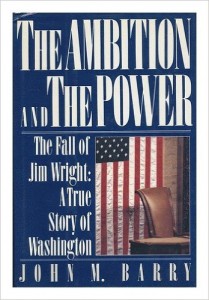
Review: The Ambition and the Power–The Fall of Jim Wright : A True Story of Washington

5 Star, Congress (Failure, Reform), Corruption, Politics, Power (Pathologies & Utilization)
Amazon Page
Amazon Page

John M. Barry

5 Stars Classic Detailed Study of Both Corruption and Abusive Power, September 18, 2008

This is the book whose account of what it takes to be a “Member” that so turned my stomach (i.e. the book is phenomenal) I concluded that no sane and honorable person should seek election.

On the one hand, it recounts in excruciating detail the degree to which then Speaker of the House Jim Wright had to be constantly on the go to collect (“raise”) funds for his future campaigns (every two years), while also illuminating the pathologies of House leadership processes.

On the other hand, it recounts in equal detail the deliberate and malicious manner in which future Speaker of the House Newt Gingrich set about to destroy Jim Wright–his reputation, his position, his office, his personna.

I am not sure which turned my stomach more–the two together are quite depressing.

I have since learned that the Democrats are much more practiced at electoral fraud and other connivances, and that the Republicans are now learning to match the Democrats and “level the playing field.” We need to take back the power, get the money out of politics, eradicate the rule by secrecy and information asymmetries between elites and the voters, and get our Republic back.

From a Constitutional point of view, this book also charts how Newt Gingrich destroyed Article 1 of the Constitution, and turned all Members into “foot soldiers” for the party — they vote the party line as bought by billionaires, or they get no nice offices, staff numbers, etcetera. He destroyed what was left of the bi-partisan balance of power aspect of the US Constitution.

This is a SUPERB reading for any university or college class studying the real world of politics as it is still practiced today on the Hill.

More recent books, also recommended:
Breach of Trust: How Washington Turns Outsiders Into Insiders

The Broken Branch: How Congress Is Failing America and How to Get It Back on Track (Institutions of American Democracy)
Tribes on the Hill: The United States Congress–Rituals and Realities, Revised Edition

Vote and/or Comment on Review

1998 Open Source Intelligence Executive Overview (Handbook)

Intelligence (Collective & Quantum), Intelligence (Commercial), Intelligence (Government/Secret), Intelligence (Public), OSINT Generic
OSS Academy Handbook 1998


Handbook Free Online

2004

US

Training Steele OSINT Executive Overview (Contents) in RTF

2004

US

Training Steele OSINT Executive Overview (Cover) in RTF

2004

US

Training Steele OSINT Executive Overview (Contents) in Word Doc

2004

US

Training Steele OSINT Executive Overview (Cover) in Word Doc

Review: A Consumer’s Dictionary of Household, Yard and Office Chemicals: Complete Information About Harmful and Desirable Chemicals Found in Everyday Home Products, Yard Poisons, and Office Polluters

5 Star, Environment (Problems), True Cost & Toxicity
COnsumer Dictionary
Amazon Page

One of several great books, only dictionary I could see, September 21, 2008

Ruth G Winter

This needs to be accessible via bar code scanback and cloud look up.

See also my more detailed reviews, and the books themselves:
High Tech Trash: Digital Devices, Hidden Toxics, and Human Health
How Everyday Products Make People Sick: Toxins at Home and in the Workplace
The Blue Death: Disease, Disaster, and the Water We Drink
Pandora's Poison: Chlorine, Health, and a New Environmental Strategy

Vote on Review

Review: Biomimicry–Innovation Inspired by Nature

5 Star, Environment (Solutions), Nature, Diet, Memetics, Design, Technology (Bio-Mimicry, Clean)

BIomimicryBook End for Zero Waste, Brilliant Introduction, September 23, 2008

Janine M. Benyus

I was introduced to this concept at BIONEERS, an annual event with satellite nodes convenient to all, and was just blown away. This book is a superb introduction to the common sense recognition that nature has over all the billions of years, figured out how to not only do stuff with energy efficiency, but also with a zero waste footprint.

Check out World Index for Social and Environmental Responsibility (WISER) for many other leads.

Other books that I recommend outside the standard ones that Amazon points to:
1491: New Revelations of the Americas Before Columbus
The Age of Missing Information
In the Absence of the Sacred: The Failure of Technology and the Survival of the Indian Nations
Getting to Zero Waste
High Tech Trash: Digital Devices, Hidden Toxics, and Human Health
High Noon: Twenty Global Problems, Twenty Years to Solve Them
The Future of Life

Review: Indexed

4 Star, Decision-Making & Decision-Support

IndexedOver-Priced, Under-Whelming BUT Entirely Acceptable, September 27, 2008

Jessica Hagy

This is a niche book for people with time, money, and curiosity about unconventional visualization simplified. Although it is overpriced (probably cost $1 to actually produce), there are no page numbers, and half the diagrams are quasi annoying (e.g ground chuck chart with cannibals on one axis and clumsy butchers on the other), there is just enough here to leave me okay with having paid for this to be sent to me.

A handful of the charts are clever and another handful are inspiring. That is what took this tiny little book from three to four stars.

The booklet is completely lacking in structure, another reason it almost dropped to a three. This was a fast print job with zero editorial brilliance. A brilliant editor would have divided the book into a matrix, sorted the sketches in relation to human, technical, global, local, whatever, and then presented them with a table of contents and pagination.

The author's website is provided on the back cover of the book (and I provide it in the comment), it may be that this was the sole intent of the book, to draw people there, in which case the book succeeds and with my comment below you don't have to buy it to achieve the book's purpose.

See these other books:
The Back of the Napkin: Solving Problems and Selling Ideas with Pictures
The Design of Dissent: Socially and Politically Driven Graphics

noble gold