
Anthony Judge: Big Data Reflections

Advanced Cyber/IO, IO Sense-Making
0Shares
Anthony Judge
Anthony Judge

My issue with any visualization, however brilliant, is that it assumes that it will engage consensus and action.

Missing is the recognition that even if we had a hard data visualization that one million people were to die tomorrow somewhere — even in New York — the level of engagement would be low. Who says so? Is it a scam? Is it spin? etc

There is a glass ceiling effect which is not addressed, irrespective of the nature of the crisis. Central Arica ciurrently offers an example. Increasingly, who cares, or why should I care? I walk pass beggars everyday. What is not evident from such visualization is what it is expected that anyone should do and why. My first take on this was:

Remedial Capacity Indicators Versus Performance Indicators

My second was:

Recognizing the Psychosocial Boundaries of Remedial Action constraints on ensuring a safe operating space for humanity

The Earth is not moved by good visualizations !

My think piece on big data:

Simulating a Global Brain

using networks of international organizations, world problems, strategies, and values

Abstract: The paper reports briefly on the ongoing process of systematic information collection and web presentation by the UIA of networks of over 30,000 international organizations, 56,000 perceived world problems, 32,000 advocated action strategies, and some 3,000 values — resulting in a total of 800,000 hyperlinks. These different entities constitute an interesting focal sub-system of whatever is to be understood by an emerging global brain – for which the “problems” might be understood as “neuroses”, if not “tumours”.
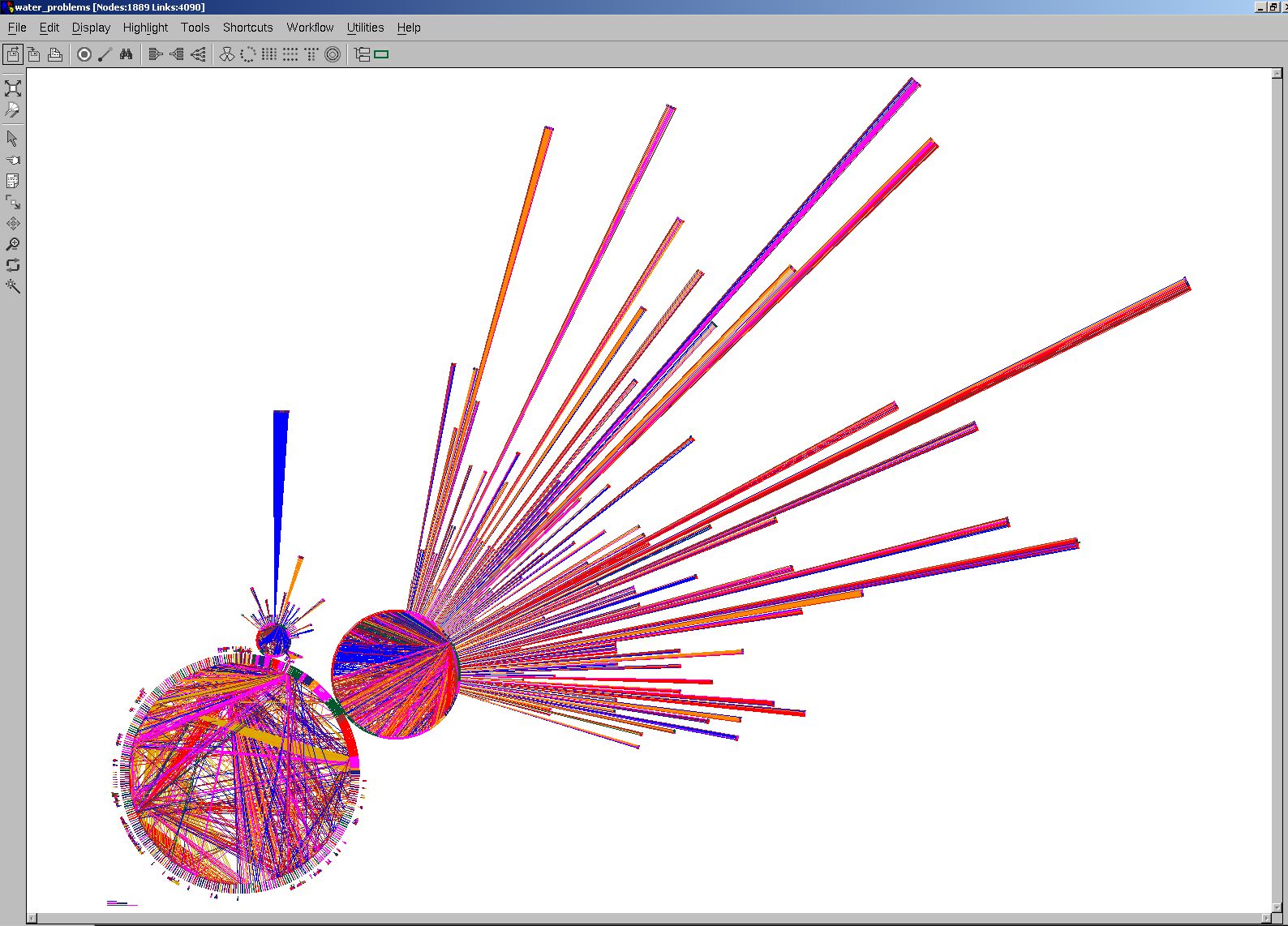
But I do think that the capacity to do anything with big data is very limited. We used fancy software — Netmap, as used by security services — but so what.See fancy graphic screenshots in:


Click on Image to Enlarge

Preliminary NetMap Studies of Databases on Questions, World Problems, Global Strategies, and Values

It is not so much about glass ceilings as (double) glazed eyes !

See Also:

Big Data at Phi Beta Iota

Stephen E. Arnold: Languages Supported by Google Translate Increase — But Not Farsi, Dari, or Pashto

Advanced Cyber/IO
0Shares
Stephen E. Arnold
Stephen E. Arnold

Languages Supported by Google Translate Increase

The article on eweek titled Google Translate Adds Support for More World Languages announces Google’s addition of nine languages to its service, making the total number 80 languages. These included several African languages spoken in Nigeria, Somalia and South Africa. There are motions in progress to add Mongolian, Nepali, Punjabi and Maori. The last was only made possible by New Zealanders, as the article explains:

Continue reading “Stephen E. Arnold: Languages Supported by Google Translate Increase — But Not Farsi, Dari, or Pashto”

Event: 26-29 MAR 14 ISA (Intelligence)

#Events
0Shares

Intelligence Studies Section Panels at ISA 2014
26-29 March 2014 in Toronto, Canada

See below for the program of the Intelligence Studies Section (ISS) at the annual International Studies Association (ISA) conference taking place 26-29 March 2014 in Toronto, Canada. ISS is one of 27 subject matter sections that make up the ISA. ISS has approximately 350 members, and has been sponsoring research about intelligence as a function of government since the mid-1980s. Additional information can be found here.  This ISS content (4 straight days…19 panels) is one small part of ISA’s much larger conference. The full conference program is 264 pages; find details at the full conference website here.

As the chair of the Intelligence Studies Section, if you have any questions please contact me at marrinsp@jmu.edu or spm8p@yahoo.com

Regards, Dr. Stephen Marrin
ISAT/Intelligence Analysis James Madison University

Continue reading “Event: 26-29 MAR 14 ISA (Intelligence)”

Berto Jongman: Bits, Bytes, & Stuff

Cultural Intelligence, Peace Intelligence
0Shares
Berto Jongman
Berto Jongman

CYBER: 2014 Top Cyber Security Threats

CYBER: Increasing Anti-Surveillance Momentum and the Necessary and Proportionate Principles (EFF)

CYBER: Russia Internet Extremism Bill

CYBER: Trojan.Skimer.18 Infects ATMs

CYBER: World's Biggest Data Breaches Visualized

OPEN: Iranian Nuclear Deal

OPEN: US, India, & Gulf (Cordesman)

OPEN: US & UK Close Relations with Gaddafi Intel

THREAT: CAR Humanitarian Crisis Testimony (Schneider)

THREAT: Iran Setad Arms Smuggling

THREAT: Multi-Vector Cyber

THREAT: Nigerian terrorism

Jean Lievens: Diana Filippova from Paris – Collective Intelligence or Digital Total War?

Collective Intelligence
0Shares
Jean Lievens
Jean Lievens

Of cooperation between men and machine

For a peer-to-peer approach to collective intelligence

It’s eight a.m. on a Monday morning in 2007. In the Arcueil examination centre, a thousand heads crane with difficulty over wooden desks that are damaged by pens scratching across thin sheets of paper. Railway lines surround the enclave; trains make the building shudder rhythmically; the heads lookup for a minute, distracted, then return to concentrate on the studious, urgent writing of their paper. Invigilators wander the rows, imperturbable, watching every head that turns, every hand hiding in jean pockets. Only the noise of crumpled paper can be heard and, when this fades away, the room is deathly silent. A thousand pupils have been gathered here for six hours to answer a difficult question. All interaction with their peers is forbidden and, if an unexpected memory lapse should halt their train of thought, they cannot consult their notes. The essays produced by the pupils will sink into oblivion, stored in a dedicated hanger that has housed examination papers for many generations.


A few years later, I’m facilitating an all-day workshop in a large white room with some twenty computers. Around me, groups of pupils talk, laugh and see-saw between a sheet of drawing paper and the computer screen. Some isolate themselves to code, others are hunched over a 3D printer producing an open source design that they’ve just downloaded. The pupils consult their teachers, ask advice from the experts present in the room and share their progress with the others. Some momentarily leave their own group to help their friends in a competing group. The workshop involves “remixing” artistic works that have come into the public domain or are open source. No assessment is planned; the reaction of those present is the only measure of the quality of their production. Watching them, I think that they are extremely lucky to be able to draw freely from all these wells of existing knowledge: their own intelligence, that of their peers and teachers, virtually everything that humanity has produced and, above all, the global knowledge which is within easy reach. At the end of the workshop, we find their work surprising and original and the quality exceeds all our expectations. Our doubts about the pupils’ capacity to open up the raw materials and extract a structured form from them were unfounded. Now they make us smile.


We are connected to an infinite number of individuals, organisations and machines. In my view, the cooperation of all of these entities, regardless of the nature of their intelligence, is what defines collective intelligence

Continue reading “Jean Lievens: Diana Filippova from Paris – Collective Intelligence or Digital Total War?”

Rickard Falkvinge: Today’s Technology Shift Has Parallels To When Universities Were Threatened By… Textbooks

Academia, Collective Intelligence, Cultural Intelligence
0Shares
Rickard Falkvinge
Rickard Falkvinge

Today’s Technology Shift Has Parallels To When Universities Were Threatened By… Textbooks

Infopolicy – Henrik Brändén:  Today’s technology shift has many parallels with the arrivals of mass-printed books at universities. At the time, teachers at universities were horrified that the availability of books undermined their ability to charge students for reading aloud. There is something to learn from history here.

523377_63619557

In the most recent issue of Respons, Peter Josephson writes about the university crisis right after the turn of the century in 1800. Developments in information technology had kept an enormous pace: the printing costs had fallen, and an increasing amount of teaching material was available in books. This had created a crisis for teachers at universities. As far as anybody could remember, they had held lectures where they had read aloud from some book or manuscript of their own, where students had had to pay a small admissions fee to the lectures. But apparently, disrespectful students had started to skip those lectures – they would sit down in libraries to read instead.

What to do about it?

Continue reading “Rickard Falkvinge: Today’s Technology Shift Has Parallels To When Universities Were Threatened By… Textbooks”

SchwartzReport: Truths That Matter

Cultural Intelligence, Earth Intelligence
0Shares
Stephan A. Schwartz
Stephan A. Schwartz

More on climate change. The Alps, as this report spells out, are undergoing fundamental never before seen changes, just as the same thing is happening at Glacier National Park in Kalispell, Montana, and Glacier Bay, Alaska.

Alps Warming At Double The Average Global Rate, New Study Confirms
ARI PHILLIPS – Think Progress

I know a number of you are planning to install solar, and I thought this might help your research.

Best and Worst Yelp Reviews of the Top 5 US Solar Installers
STEPHEN LACEY – GreenTech Solar

The paranoia, fear, and greed that created the national security state, like all things based on such base impulses has ultimately wounded the country and, as we have learned done very little to achieve the goals which were its premise.

Report Finds Police Intelligence Gathering Tactics Threaten National Security
CANDICE BERND – Truthout

Additional Found in Passing:

A study of fracking sites in Colorado finds substances that have been linked to infertility, birth defects and cancer.

Hormone-Disrupting Chemicals Found in Water at Fracking Sites