
Steven Aftergood: CRS Specials on Syria

07 Other Atrocities, 08 Proliferation
0Shares

Steven Aftergood
Steven Aftergood
RESOURCES ON CONFLICT IN SYRIA FROM CRS

Here are some new and updated reports on the conflict in Syria prepared by the Congressional Research Service:

Possible U.S. Intervention in Syria: Issues for Congress, September 3, 2013

As Members of Congress consider the merits of possible military intervention in Syria, they also are reengaging in long-standing discussions about the proper role for Congress in authorizing and funding U.S. military action abroad and the efficacy of the use of force in shaping global events or deterring dictatorships from committing atrocities. This report poses and attempts to provide answers to a number of policy questions for lawmakers grappling with these short- and long-term issues.

Syria: Overview of the Humanitarian Response, September 4, 2013

The ongoing conflict in Syria has created one of the most pressing humanitarian crises in the world. An estimated 6.8 million people in Syria, almost one-third of the population, have been affected by the conflict, including more than 4.2 million displaced inside Syria (estimate as of August 15, 2013). On September 3, the U.N. High Commissioner for Refugees (UNHCR) announced that the number of Syrians displaced as refugees exceeded 2 million, with 97% fleeing to countries in the immediate surrounding region, including Turkey, Lebanon, Jordan, Iraq, Egypt, and other parts of North Africa. The situation is fluid and continues to worsen, while humanitarian needs are immense and increase daily.

Syria's Chemical Weapons: Issues for Congress, August 30, 2013

U.S. government programs established to secure or remove chemical or other weapons of mass destruction through threat reduction or nonproliferation programs have focused on destruction or scientist redirection in an atmosphere of cooperation. At present, such programs are providing border security assistance to neighboring states. U.S. policymakers and Congress may wish to review and discuss authorities, funding, forces, and scenarios in advance.

NIGHTWATCH 4 SEP 13: Syria Unwrapped — US Lacks Credibility Across the Board, Russia Making Sense

04 Inter-State Conflict, 05 Civil War, 07 Other Atrocities, 08 Proliferation, Officers Call
0Shares

Russia-Syria: The Russian military news agency, Interfax-AVN, reported two more Russian ships are heading to the Mediterranean Sea. The destroyer Nastoychivyy of the Baltic Fleet and the patrol combatant Smetlivy of the Black Sea Fleet will join the Russian Navy's task force in Mediterranean in the next few days, Interfax-AVN was told at the Main Staff of the Navy on Wednesday, 4 September.

“The patrol combatant Smetlivy will enter the Mediterranean for combat duty in the next few days in accordance with operational command plans. The flagship of the Baltic Fleet, the destroyer Nastoychivyy, is expected to join the group of our ships,” a spokesman said.

The Russian Defense Ministry also said the patrol combatant Neustrashimyy and the large landing ships Aleksandr Shabalin, Admiral Nevelskoy and Peresvet are carrying out missions in the Mediterranean in accordance with operational command plans.

The large landing ships of the Black Sea and Baltic fleets, the Novocherkassk and the Minsk, will join them on 5-6 September. The medium reconnaissance ship SSV-21 Priazovye, which put out from Sevastopol on 1 September, is acting in accordance with special plans of the General Staff.

Comment: The Russian navy task force in the Mediterranean Sea is supposed to comprise 16 ships of various types. Eight of them are listed above. They have the capability to harass any US naval formation of destroyers.

Comments from Navy and Marine Corps veterans question the wisdom of using fleet defense assets – destroyers – in an offensive strike role. The key question is who or what protects the destroyers after they shoot, with Russian destroyers and patrol combatants around. Submarines presumably, but they are not effective in preventing harassment and disruption of surface formations.

Russia-US/France: President Vladimir Putin warned the West against taking one-sided action in Syria, but also said Russia ‘doesn't exclude' supporting a UN resolution on punitive military strikes if it is proven that Damascus used poison gas on its own people.

In a wide-ranging interview with The Associated Press and Russia's state Channel 1 television, Putin said Russia is developing a plan of action in case the United States does attack Syria without United Nations approval, but he declined to go into specifics.

He said he ‘doesn't exclude' the possibility of backing force against Syria, but at this stage he does not even accept that an alleged chemical weapons attack took place.”

Syria and Gas: Previously, the US, France and the UK published declassified documents about the 21 August gas attack and Syrian government forces use of gas in the past. Today, Russia published a summary of its findings about a prior attack that was alleged loudly and wrongly to be a Syrian government chemical attack.

This Russian study concerns a gas attack in Aleppo, also attributed to the Syrian government. The Russian document has received no coverage in Western media.

NightWatch reproduces the Russian report below.

Continue reading “NIGHTWATCH 4 SEP 13: Syria Unwrapped — US Lacks Credibility Across the Board, Russia Making Sense”

Berto Jongman: False Flag Nuke for Charleston SC?

07 Other Atrocities, 09 Terrorism
0Shares

Berto Jongman
Berto Jongman
Sen Graham Warns of Nuke Strike After Missing Warheads Report

Alex Jones and Anthony Gucciardi

Infowars.com, 5 September 2013

Senator Lindsay Graham has warned South Carolinians about the threat of a ā€˜terrorist nuclear attack’ on the same day that our exclusive high level military intel revealed to us that nuclear warheads were being shipped to South Carolina from a major Texas airforce base under an ā€˜off the record’ black ops transfer.

Watch short video.

Found in the CBS report entitled ā€˜Graham: Nukes In Hands Of Terrorists Could Result In Bomb Coming To Charleston Harbor’, the report details Graham’s warning that a lack of military action in Syria could result in a nuclear ā€˜bombing’ in Charleston, South Carolina — the very destination of the black ops nuclear transfer. The CBS report reads:

ā€œHe [Graham] says if there is no U.S. response [to Syria], Iran will not believe America’s resolve to block Iran from developing nuclear weapons. Graham also says those nuclear weapons in the hands of terrorists could result in a bomb coming to Charleston Harbor.ā€

Graham is quite literally saying that if we do not launch a war with Syria, South Carolina may be nuked. And this ultimately reeks of yet another false flag being orchestrated by the United States government in order to send us into war, or at the very least a threat. Except this time, we’re talking about nuclear weapons. Amazingly, we were the first to get intel on this from our credible and extremely high level military source, who told us the following:

ā€œDyess is beginning to move out nuclear war heads today. I got a tap from DERMO earlier. He said it was the first time they have been even acknowledged since being put there in the 80′s. No signature was required for transfer… There was no directive. He said that Dyess Commander was on site to give authority to release. No one knew where they were going really, but the truck driver said to take them to South Carolina and another pick up will take them from there.ā€

This was sent to us before the Graham report came out warning about the nuclear attack on South Carolina, and coincides exactly with what Graham is saying. I am deeply concerned by these findings, and ask everyone to spread the word on this information immediately. Whether or not Graham is receiving intel from higher ups and believes in a legitimate terror attack on the horizon is unknown, but the reality here is that we have intelligence that has linked the unsigned transfer of nuclear warheads to this exact location.

Continue reading “Berto Jongman: False Flag Nuke for Charleston SC?”

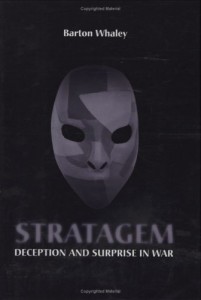
Review: Stratagem: Deception and Surprise in War

5 Star, Asymmetric, Cyber, Hacking, Odd War, Information Operations
0Shares
Amazon Page
Amazon Page

Barton Whaley

5.0 out of 5 stars Pioneeding, Deep, Essential, Needs 21st Century Follow-Up September 5, 2013

I borrowed this book from another officer, and have been quite delighted to spend time with it.

This is a much older book than most realize (1969) and its examples and case studies stop with the Six-Day War in 1967 and Czechoslovakia in 1968. It is certain a book that is worthy of being brought up to date through to the varied wars of the 21st Century; it is also a book that would merit a deeper look at the ethics, efficacy, and frequent perversion of deception operations, by which I mean both the mission and the mind-set creep from focused deception to what has been called “Strategic Communication,” or lies so broad and deep we believe them ourselves and want everyone else to believe them also. Apart from being dated, this is the books more important oversight – it does not offer the reader a balanced appraisal of when transparency, truth, and trust are a better investment than pervasive and pernicious deception of one's own public, global leaders, and global publics. The latter may be asking too much, I will soften it by strongly endorsing this book as a reader for war colleges around the world, with my own monographs (free online) from the U.S. Army Strategic Studies Institute (SSI), as the counterfoil.

Now for the good of this book, this is considerable. This book merits vastly more attention than it has been getting, in part because the US marketplace is dumbed down and drugged up, and the US military still has a “hey-diddle-diddle up the middle mind-set.” “Keep it simple” is often actually “keep it stupid.” In that context, this book could be used to teach both ethics and nuanced thinking at the war colleges. The book offers – and the author points out this is the least visible part of the book – “an original exercise in methodology – a method designed to unmask deception when it is present.”

The author's introduction to the 2007 reprint is BRILLIANT. I can do no better and therefore I keep the book at five stars and suggest that the introduction, and my extractive summary of the book provided here at Amazon, be used as handouts across the war colleges.

Continue reading “Review: Stratagem: Deception and Surprise in War”

SchwartzReport: Fallujah as Hiroshima, Great Lakes Shrinking

Worth A Look
0Shares

As we stand poised to get into yet another war in the Islamic world, this cautionary tale seems very apposite.

Toxic Legacy of US Assault on Fallujah ‘Worse Than Hiroshima
PATRICK COCKBURN – The Independent (UK)

Climate change does not just affect the oceans, as this story on the Great Lakes makes clear. This vast natural resource is undergoing fundamental change, although it is going almost entirely unremarked. Note that I had to find this story in a U.K. newspaper, no American paper is paying any attention.

Great Lakes Shrinking: What's the Business Cost?
RUSS BLINCH – The Guardian (U.K.)

SchwartzReport: Dirty Water, Dirty Democracy & Dark Science

Worth A Look
0Shares

schwartzreport new

Water is destiny. This report about China should be taken as a cautionary tale of what happens when that is not properly recognized.

China's Water Pollution off the Charts, Must Outsource Food Production
Daily Kos

Bill Moyers speaks the truth. The only people capable to changing this trend — ourselves. But can we develop the political will to do so?

The End Game for Democracy
BILL MOYERS & COMPANY – Truthout

We have endless money for war, and spend more each year for military-intelligence activities than the rest of the world combined. But, because facts do not matter to the Theocratic Right, we are cutting science. This trend, which is gaining momentum, has painful long range consequences.

A Dark Future for Science
DAVID FIRESTONE – The New York Times
