Donate for Books Here Half-Price, Inscription Option

Books w/Steele
0Shares

All donations receive specified book, shipping, emailed non-profit (tax deductible) receipt, and inscription if desired as specified in purpose line at PayPal.  

– + – + – + – + – + – + – +
Amazon Page

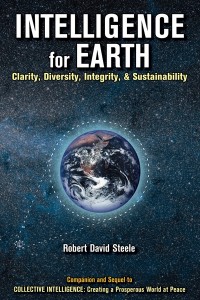
2010 INTELLIGENCE FOR EARTH: Clarity, Diversity, Integrity & Sustainability

Capstone book on hybrid governance based on shared information and ethical evidence-based decision-making

A massive cultural tsunami is sweeping round the world as the five billion poor acquire Information and Communication Technologies (ICT), and the one billion rich realize that the era of Empire Rule Of, By, and For the Few is over. Happily, this is a revolution in human affairs that will be non-violent for the simple reason that no redistribution of existing wealth can match the infinite new wealth that the entrepreneurial poor can create for themselves when empowered with ICT.

We are entering an era in which global networks and the sharing of information can create revolutionary wealth at the micro-level, while enabling the harmonization of investments at the macro-level. This is an era in which transparency of cost and effect will eradicate corruption, fraud, waste, and abuse at the same time that it makes possible global to local engagement and collaboration such that we can create a prosperous world at peace. This is an era in which we will see a bottom-up conscious evolution of humanity that liberates and leverages the one inexhaustible resource we have: the human brain.

In 2004 the Secretary-General s High-Level Panel on Threats, Challenges, and Change published its findings as A more secure world: our shared responsibility. Unlike other extraordinary books this remarkable endeavor not only achieved consensus among diverse contributing Members, but actually prioritized the ten high-level threats to humanity as follows:
01 Poverty
02 Infectious Disease
03 Environmental Degradation
04 Inter-State Conflict
05 Civil War
06 Genocide
07 Other Atrocities
08 Proliferation
09 Terrorism
10 Transnational Crime

Inspired by this analytically-robust identification and prioritization of the ten high-level threats to humanity, the author funded and organized Earth Intelligence Network (EIN), a 501c3 Public Charity, to provide the United Nations (UN) and its Member states, all private sector and civil society organizations, and the public at large, with a strategic analytic model suitable for creating public intelligence in the public interest.

This book is intended to be a catalyst for the creation of the United Nations Open-Source Decision-Support Information Network (UNODIN), and the establishment of the Office of the Assistant Secretary General for Decision-Support (ASG/DS). Should a sufficiency of the Member nations concur, this book also provides a model for creating a Multinational Decision-Support Centre (MDSC) using the military as a hub for global access to unclassified information from the other seven tribes of intelligence [academia, civil society, commerce, government, law enforcement, media, and non-profit or non-governmental] combined with multinational sense-making and unclassified decision-support for stabilization & reconstruction, humanitarian assistance, and disaster relief operations.

EIN has achieved several modest breakthroughs that are outlined within this book, which is a capstone work, completely original but deeply rooted in thirty years of professional experience and intellectual reflection. The ideas in this book are implementable today.

– + – + – + – + – + – + – +
Amazon Page
Amazon Page

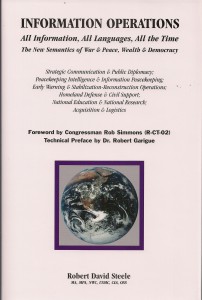
2006 INFORMATION OPERATIONS: All Information in All Languages All the Time
Still the best overview of “real” Information Operations, vice cyber-idiocy

This book is the third in the series to date. The first, ON INTELLIGENCE: Spies and Secrecy in an Open World, documented in great detail all that is wrong with the predominantly secret U.S. Intelligence Community–virtually none of the problems have been fixed in the aftermath of 9-11. The second book, THE NEW CRAFT OF INTELLIGENCE: Personal, Public, & Political, outlined a new method of achieving public collective intelligence by harnessing the distributed knowledge of the seven tribes of intelligence (government, military, law enforcement, business, academia, ground truth–non-governmental organizations & the media, and civil–citizens, labor unions, and religions. The secret government intelligence tribe continues to ignore the other six tribes and waste close to $60 billion a year doing things the old way, only with greater waster. This third book is a technical manifestation of the Brahimi Plan, and shows the way to create a World Brain that allows for the optimal access by all citizens and their organizations–including rather uninformed governments–to all information in all languages all the time. As with the first two books, the annotated bibliography is a book unto itself.

– + – + – + – + – + – + – +

Amazon Page
Amazon Page

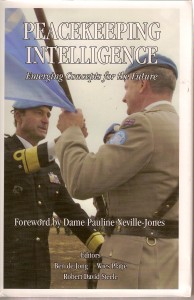
2003 PEACEKEEPING INTELLIGENCE: Emerging Concepts for the Future
Still the best book on information peacekeeping and peacekeeping intelligence

Each year millions of people die, are displaced, become diseased, or suffer severe depravations at the hands of rogue states, predatory ethnic groups or tribes, or ruthless terrorist and criminal organizations. Around the globe, while recognizing the important efforts of selected Nation-States and selected Non-Governmental Organizations, only one organization can be said to be truly concerned with global security and global prosperity in the common interest of all mankind: the United Nations. Unfortunately, the United Nations has chosen to ignore the proven process of “intelligence” by confusing it with espionage. Intelligence is not about espionage, it is about rationalized decision-support in which global sources of information in many languages and many mediums (oral, written, imaged) are deliberated collected, processed, analyzed, and presented to decision-makers in order to reduce uncertainty, suggest alternatives, and otherwise make instability more manageable. This book is the first book to bring together a combination of experienced United Nations military commanders, experienced national intelligence leaders, and scholars of United Nations and insurgency history. It combines the results of the first annual conference on peacekeeping intelligence help in The Netherlands in November 2002, with eight seminal works from the past, and three vital references for the future–extracts from the Brahimi Report with intelligence-related footnotes; a completely new Peacekeeping Intelligence Leadership Digest 1.0 distilled from the entire book into 35 pages; and pointers to both the three North Atlantic Treaty Organization (NATO) doctrinal documents on Open Source Intelligence (OSINT), and to a selective group of recent references, most available online. This book is, in essence, “Ref A” for the future of intelligence at the United Nations.

– + – + – + – + – + – + – +

Amazon Page
Amazon Page

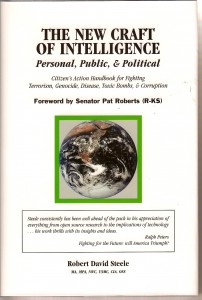
2002 THE NEW CRAFT OF INTELLIGENCE: Personal, Public, & Political
Donate $25.  Still the one best book for any citizen not trusting their government to be honest

This book is the sequel to ON INTELLIGENCE: Spies and Secrecy in an Open World (AFCEA International Press, 2000). That book, written largely for government and corporate intelligence professionals, remains the basic reference volume for the future of global intelligence enterprises. This book, by contrast, is a completely new effort that is written for every citizen of every country—the “intelligence minutemen” of the 21st Century. In the aftermath of the 11 September 2001 attacks on the World Trade Center and the Pentagon, attacks carried out by a non-state actor skilled at asymmetric warfare and using our own capabilities against us—attacks followed quickly by a nation-wide anthrax assault that closed Congress and terrified the U.S. Postal Service—it is imperative that every citizen have a clear-headed understanding of what is at stake and what needs to be done to keep not only America, but all civilized communities safe. It is especially imperative that citizens understand that the world is already at war, with millions of refugees in 67 countries, plagues sweeping across 59 countries, mass starvation in 27 countries, and deliberate genocide campaigns in 18 countries. These are “facts of life” that our schools, our media and even our intelligence communities have been unwilling and unable to represent intelligently to the public. It is against this backdrop of global chaos that terrorism rises.

– + – + – + – + – + – + – +

Amazon Page
Amazon Page

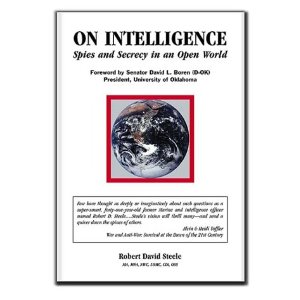
2000 ON INTELLIGENCE: Spies and Secrecy in an Open World
Still the best tough love critique and prescription for the future.  Collector's item.

The author of this book has produced one of the very best and most interesting books to date on intelligence reform and transformation. It is extremely well written and provokingly thoughtful on many critical issues as we decide what we want from our Intelligence Community in the 21st Century and how we want to achieve those results. His economic, business and organizational logic is right on track for a wide range of relevant and timely topics. One is amazed at how much detail the author provided without getting the reader “lost in the trees with no sense of the forest”. His reference approach is also outstanding in two regards: (1) he carefully documents the source of many of the great authors and thinkers and practitioners sited, and (2) he gives the reader access to a much broader set of view points (some of which no doubt conflict with his own views). Whether you agree with all of Steele's ideas or not is irrelevant. This is just excellent stuff and should be required reading for all members and staff of all of the Congressional oversight committees as well as the various commissions that review aspects of one sort or another of our national intelligence community. Beyond that it will undoubtedly be of interest to anyone who is concerned about the role of Intelligence in National Security.

– + – + – + – + – + – +

Pick your book, donate at least $30, and identify the book you want. In a confirming email you will be consulting on an inscription if one is desired.

Theophillis Goodyear: Abstract Wealth Destroying Real Wealth

Cultural Intelligence
0Shares
Theophillis Goodyear

The Solution is the Systems Perspective—-the Key Component Is Human Compassion—-and Common Sense Tells Us That It's Best to Keep Networks Intact and Change How They Function, Rather Than Destroy Them and Star from Scratch.

Lately I've been thinking about two realities:

1. When the economy crashes, there's no traditional solution to the problem because the scale and complexity of the global interdependence of national currencies is unprecedented.

2. Networks can take a long time to form, so it's generally a bad idea to eliminate them and start from scratch, especially if you try to eliminate all of them at once and start all of them from scratch. That's a recipe for disaster. That's what happened in the Russian Revolution, and look how that turned out. That's what Mao tried to do, and look how that turned out.

So I've been trying to understand this looming crisis from the standpoint of banking, since banks are the institutions that control and manage money. So I'm doing some research so I can understand the problem, when it occurs to me that people who are already in the banking industry could show us all the solution if they had the proper mindset—-the mindset which this blog is devoted to exploring.

If someone in the banking industry could be made to see what you and I can see—-if they could be trained to see humanely, ethically, and holistically, and to start seeing things from the systems perspective and the perspective of complexity—-then they would probably instantly see the solution to the currency and banking problem, because they know the system. And if their creativity was inspired by the same mindset that your creativity and my creativity are inspired by, they could write a better book about it, instantly, than you or I could in a dozen years. And they could see concrete solutions, where you and I would only see abstract solutions.

The Deep Need:

Continue reading “Theophillis Goodyear: Abstract Wealth Destroying Real Wealth”

Marcus Aurelius: Army of None — Pentagon Loses Best & Brightest

Corruption, Military
0Shares
Marcus Aurelius
Marcus Aurelius

Unusually interesting article.  Some aspects of problem I was aware.  Disagree with several of proposed fixes.  Understand Air Force has had some success with running an open bid system on upcoming assignments.

An Army Of None

Why the Pentagon is failing to keep its best and brightest.

Tim Kane

ForeignPolicy.com, January 10, 2013

As the war in Iraq wore into its most corrosive years, a problem began to emerge — the military, and especially the U.S. Army, was losing its young officers. Editorials were published and examples cited, and by early 2011, the crisis had been recognized at the military's highest levels. But the young captains and lieutenants whose departures at the height of the Iraq war caused this soul-searching at the Pentagon are only half of the story, the superficial half; these are young warriors in harm's way with young spouses and toddlers back home. The military's retention crisis cuts deeper into the heart of the Army. The more complicated and more important half of the story is about the colonels.

Getting a great first assignment after commissioning is essential in climbing the professional military ladder, especially given the nature of Army promotions. Soldiers need to check exactly the right boxes — get the right jobs, go to the right professional schools on time, earn “distinguished graduate” from those schools — to prove themselves. And getting into the infantry, armor, or other combat-arms branches is considered important. If one is “going infantry,” the ideal path is to get light but not too light. Specialized units such as the Navy SEALs or the Army's Delta Force might be too light, whereas mechanized infantry might be a shade too heavy.

Dick Hewitt graduated near the top of the class from West Point. His first assignment was with the legendary 82nd Airborne Division at Fort Bragg, North Carolina. Hewitt, like many of the young officers that received so much attention at the height of the Iraq war, also decided to leave the Army a few years after the 9/11 attacks. But here's the difference: Hewitt had served a full 20-year career. He had checked all the right boxes, even getting tapped to command a battalion when he was just a major. So when Hewitt decided to leave, it was not because the Army had a minor morale problem causing retention heartburn, but rather it was because of a deeper and more nuanced institutional dysfunction.

Read full article.

Tim Kane, the chief economist at the Hudson Institute, is the author of Bleeding Talent: How the U.S. Military Mismanages Great Leaders and Why It's Time for a Revolution, from which this article was adapted. He blogs at balanceofeconomics.com.

Continue reading “Marcus Aurelius: Army of None — Pentagon Loses Best & Brightest”

Chuck Spinney: Arab Spring Act II — Near Enemies Falling First?

Cultural Intelligence, Peace Intelligence
0Shares
Chuck Spinney
Chuck Spinney

Arab spring, act two

Are the Arab monarchies next?

As the chaotic transition towards democracy continues in North Africa and Yemen, the fighting in Syria is intensifying. And, less noticed, opposition to the Arab monarchies is growing.

by Hicham Ben Abdallah El Alaoui

Le Monde Diplomatique, January 2012

The Arab Spring is not an outcome, it is a process. For those countries at the forefront of regional transformation, the fundamental question is can democracy become institutionalised? Though progress has been uneven and the outcomes of many state-society struggles have yet to be resolved, the answer is a cautious yes. In at least a few countries, we are witnessing the onset of democratic institutionalisation: whether the process of reform and transformation spreads to other parts of the Middle East depends on many factors — religious tensions, political mobilisation, regime adaptations, geopolitics. Meanwhile North Africa provides the most promising preview of the future.

Democratic institutionalisation means the healthy convergence of politics around three arenas of competition: elections, parliaments and constitutions. When these institutions are robust and durable, then the democratic governments they engender are relatively safe from radical groups, reactionary forces and authoritarian backsliding (due to alternation: democracies that uphold the rule of law and hold regular elections require that power alternates between competing parties).

Read full article.

Continue reading “Chuck Spinney: Arab Spring Act II — Near Enemies Falling First?”

Chuck Spinney: Afghan Fraud, Permanent War, VERY Expensive – Robert Steele: $2 Trillion a Year for DoD is Criminally Insane

Commerce, Corruption, Government, Military, Peace Intelligence
0Shares
Chuck Spinney
Chuck Spinney

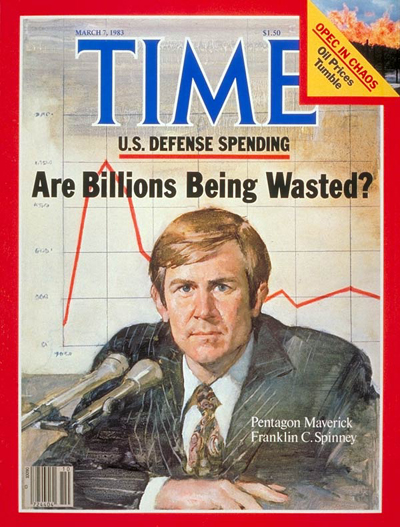
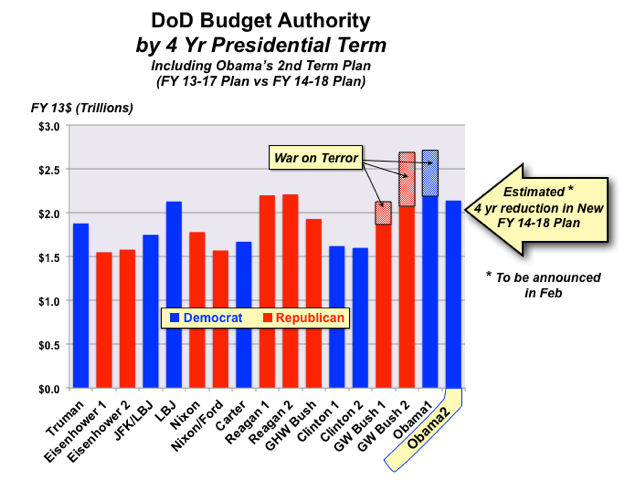
Obama may want out of Afghanistan, but he is under to pressure to stay, and the Military – Industrial – Congressional Complex (MICC) still has a budgetary interest in maintaining perpetual war, be it cold or hot ( for reasons I explained here).

The bloom is off the Karzai rose (as Amy Davidson explained in her 11 Jan New Yorker blog), but when one combines

  • (1) the not-so-zero option explained by Kate Clark  in the very important report attached below, with
  • (2) the no-so-different high-cost plan for waging the American style of high-tech war described by General Barno in Ms. Clark's report (note: contrary to Barno's claim, his is hardly a new idea; in fact, the Pentagon has been flogging this this idea since McNamara's Electronic Line failed so disastrously in Vietnam), and
  •  (3) the possibilities of a new cold war implied by Obama's (really the MICC's) “pivot” to China,
Click on Image to Enlarge
Click on Image to Enlarge $2 T

The sum 1+2+3 makes it easy to understand why Obama's new (albeit still unauditable*) budget plan, if executed perfectly, will result in the biggest eight year boom to the defense industry (including foreign military sales) since since the golden years of Ronald Reagan.

And … as indicated this chart (which I explained in latter part of this essay), this measure of the MICC's golden cornucopia would be true out to 2017,* even if a real zero option for the Afghan war and the war on terror, took place tomorrow!

Zero or Zero Plus? US-Afghan negotiations over the war

Presidents Obama and Karzai are due to start the wrangling over their countries’ post-2014 military relationship during the Afghan president’s current visit to Washington. US soldiers, bases, training, equipment, money, immunity all need to be hammered out, although no-one is expecting results just yet. Figures floated in recent days by US government and military officials speak of plans for anything from 20,000 to zero US troops to be left behind after 2014. Talk of the ‘zero option’ on troops might just be a bargaining ploy to put pressure on President Karzai, although as AAN senior analyst, Kate Clark, reports, it needs taking seriously, as does the possibility of a ‘zero plus’ option, ie a full withdrawal of troops which would still leave intelligence agents and military contractors fighting the Taleban. 

Kate Clark, Afghan Analysts Network, 11/01/13

Read full article.

Continue reading “Chuck Spinney: Afghan Fraud, Permanent War, VERY Expensive – Robert Steele: $2 Trillion a Year for DoD is Criminally Insane”

Anthony Judge: Flatulence is a Problem Aired Resmelling the stench of past undertakings (personal, organizational, and national)

Corruption, Idiocy, Ineptitude
0Shares
Anthony Judge
Anthony Judge

Flatulence is a Problem Aired: Resmelling the stench of past undertakings

Introduction
Resmelling the stench of past undertakings — review and commentary
Flatulence | Internationalism | Absurdity of the global problematique
Unusual smells | Crisis of crises | Irrelevance | Mediocrity | Connectivity
Collective impotence | Questions and answers | Plethora of potential possibilities
Decision-making perfumery of the future | Blaming the messenger
Conclusion

Introduction

The third edition of the Encyclopedia of World Problems and Human Potential (1990) was reviewed for The Guardian by John Vidal under the title Flatulence is a Problem Aired (The Guardian, 7 February 1992). The review was introduced by the phrase: John Vidal finds the authors of a definitive guide to all the world's ills treading an ever thinner line between the sublime and ridiculous. The author of the review is a renowned editor on environmental matters, most notably for The Guardian. At that time the review could be seen as a highly skillful journalistic exercise in what has since been recognized as characteristic of negative campaigning — although the intention in so framing the undertaking was unclear at the time.

Continue reading “Anthony Judge: Flatulence is a Problem Aired Resmelling the stench of past undertakings (personal, organizational, and national)”

Patrick Meier: Lessons Learned on Public Use (or Non-Use) of Social Media During Disasters

Crowd-Sourcing
0Shares
Patrick Meier
Patrick Meier

Why the Public Uses Social Media During Disasters (and Why Some Don’t)

The University of Maryland has just published an important report on “Social Media Use During Disasters: A Review of the Knowledge Base and Gaps” (PDF). The report summarizes what is empirically known and yet to be determined about social media use pertaining to disasters. The research found that members of the public use social media for many different reasons during disasters:

  • Because of convenience
  • Based on social norms
  • Based on personal recommendations
  • For humor & levity
  • For information seeking
  • For timely information
  • For unfiltered information
  • To determine disaster magnitude
  • To check in with family & friends
  • To self-mobilize
  • To maintain a sense of community
  • To seek emotional support & healing

Continue reading “Patrick Meier: Lessons Learned on Public Use (or Non-Use) of Social Media During Disasters”