Journal: Your car computer may kill you

03 Economy, IO Sense-Making
0Shares
Full Story Online

By John C. Dvorak

BERKELEY, Calif. (MarketWatch) — As more research is done into the recall of certain vehicles made by Toyota Motor Corp., the more likely it is that the sudden-acceleration phenomenon due to supposedly faulty gas pedals may actually be a software glitch.

Phi Beta Iota: The US Government has never taken electronics as seriously as the Soviet Union or more recently China and India (and probably Russia and Brazil).  Soviet emission standards were known in the 1980's to be ten times tougher than ours.  Our lack of code documentation was known to be a major problem in the 1980's, and in the 1990's the USAF and CIA both knew that our drone communications could be hacked easily.  Now we find out that car computers (not just Toyota, all car computers–in fact all computers that are not subject to open source software safeguards)–can kill us.  Why is this not a surprise?

Journal: Knives Out for the Chicago Gang

Uncategorized
0Shares

Core Chicago Team Sinking Obama Presidency

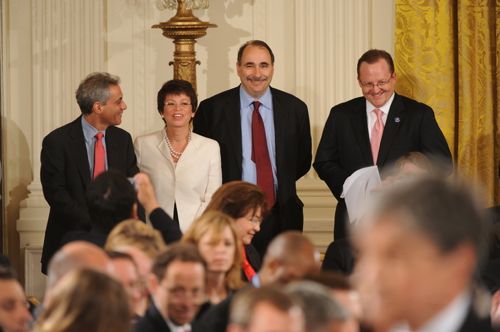
Financial Times Washington Bureau Chief Edward Luce has written a granularly informed insider account about those who hold the keys to the inner most sanctum of Obama Land — Rahm Emanuel, Robert Gibbs, Valerie Jarrett and David Axelrod.

See also:

Journal: Wall Street Dumps Democrats

Journal: From Rhetoric to Reality–Four in Power

Journal: Pentagon Using Bacteria to Clean Water

12 Water, Earth Intelligence, Peace Intelligence
0Shares
Full Story Online

Pure Water for Haiti, Afghanistan:

Just Add Bacteria

WIRED

Katie Drummond

10 February 2010

Scientists at Sam Houston State University (SHSU) have successfully designed portable, efficient, bacteria-based water treatment units. Two of the devices are on their way to Army bases in Afghanistan, and the research team is in talks with the Pentagon about sending a working prototype to help relief efforts in Haiti.

Journal: Haiti Update of 10 February 2010

Commercial Intelligence, Cultural Intelligence, Peace Intelligence
0Shares

Majnolita Louisome holds her brother Iverson outside their damaged home in Port-au-Prince. 2010 Getty Images

Good intentions gone wrong

Too many aid organizations and an inept government have created a chaotic relief effort in Haiti

“The aid machinery currently at work in Haiti keeps too much for overhead for its operations, and still relies overmuch on NGOs or contractors who do not observe the ground rules we would need to follow to build Haiti back better.”

Phi Beta Iota: This is the single best over-all description of how the USA–despite its massive presence–has failed  to provide the two things we have plenty of and everyone in Haiti needs:  mobility into all six air and sea points (12 entry points instead of two now being used) and the kind of multinational decision-support that STRONG ANGEL pioneered so able.  Haiti appears to be chaotic–out of control–and the problem will be made vastly worse if we allow US contractors to take the place over much as Naomi Klein anticipates in The Shock Doctrine–The Rise of Disaster Capitalism.  Haiti appears to be a disaster converted into a catastrophe now well on its way to pillaging and looting by American contractors who will make Haiti's own gangs look like “the little rascals.”

Continue reading “Journal: Haiti Update of 10 February 2010”

Journal: Approaching Economic Disaster on Epic Scale

03 Economy, 08 Wild Cards, 10 Transnational Crime
0Shares
Chuck Spinney

Testimony submitted to the Senate Banking Committee, hearing on

“Implications of the ‘Volcker Rules’ for Financial Stability”

Thursday, February 4, 2010

Submitted by Simon Johnson, Ronald Kurtz Professor of Entrepreneurship, MIT Sloan School of Management;Senior Fellow, Peterson Institute for International Economics; and co-founder of http://www.BaselineScenario.com

Phi Beta Iota: The bottom line is discussed in more digestible form at Revised Baseline Scenario: February 9, 2010 which ends as follows:

22)  We are steadily becoming more vulnerable to economic disaster on an epic scale.

By Peter Boone, Simon Johnson, and James Kwak