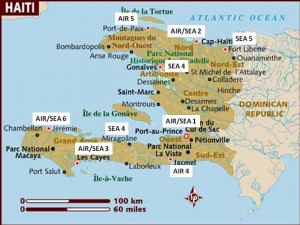
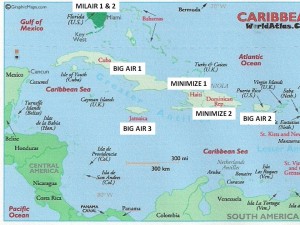
Here are the viable air and sea landing points for Haiti, trying to leave Dominican Republic out of it, they have enough problems.
Below are a few “Big Air” triage points, with corresponding seaport triage that can then be migrated to small boats, landing craft, etcetera.
So here is the silly question…has anybody thought to set up a regional traffic management plan that triages big air into little air and big boats into small boats?
Click to See Full Slide
Has anyone set up a bottom-up Range of Needs Table?
Has anyone convened a Haitian Population Resettlement Council that goes straight to moving 400,000 to new zones where free lumber, bricks, cement and so on can be brought in by landing craft?
This would appear to be a huge opportunity to think before acting, and to then execute several strategic moves that lift Haiti out of poverty rather than just covering up the mess in the short term. Civil Affairs Brigade could really make a difference here, along with STRONG ANGEL It is very rugged terrain but the ocean is open and people can be moved by landing craft and ambhibious ships. IOHO.
The earthquake in Haiti has left an estimated 1.5 million people homeless and tens of thousands without access to food, water and medical supplies. The UN says the scale of the disaster is “historic”, with its staff confronting devastation and logistical problems on a scale never seen before.
Port-de-Paix Airport (IATA: PAX, ICAO: MTPX) is in passenger numbers, the third airport in Haiti[1] and is located in the city with the same name, Port-de-Paix, on the north coast of Haiti.
Jacmel Airport: The airport is able to handle smaller commercial aircraft, but not large aircraft.[2]. However, a C-130 Hercules aircraft can land with utmost difficulty. Prior to the 12 January 2010 quake, there was no control tower at the airstrip, and its ramp area could only accommodate five aircraft at a time, [3] the runway also did not have lights,[4] and with no control tower, no radar to go with it. As such, it can only support good weather daylight operation.[5]
20 Jan: Army Maj. Gen. Daniel Allyn, deputy commander of the military operation in Haiti, said a runway in the town of Jacmel, on the south coast, will open for C-17 flights in 24 hours, and another field in the neighboring country of the Dominican Republic would also be used, though the timing was uncertain.
PORT-AU-PRINCE, Haiti — Haitian officials are planning a massive relocation of 400,000 people from makeshift camps to the outskirts of the capital as the U.S. government tackles repairs to the damaged main port — dual efforts to help residents survive the aftermath of the catastrophic earthquake.
The plan to temporarily relocate thousands is aimed at staving off the spread of disease at hundreds of squalid settlements across the city where homeless families have no sanitation and live under tents, tarps or nothing at all.
Phi Beta Iota: The port “re-opening” is so severely over-stated as to call into question the sanity of those implying this to the media (if they did–if not, this should be publicly corrected. One pier with cracks handling one truck at a time and extremely limited fuel bunkerage is not “open.” ) All of this was known when we posted CAB 21 Peace Jumper Sequence of Events. The US military appears to be treating this as a casual “one thing at a time” series of decisions instead of doing what we suggested in the first place: get a grip on reality, open two C-130 airfields, do massive airdrops of water, food, plastic, and lumber, and think creatively–for example, roll out every Sea Bee, Red Hat, and Army engineering unit, ramp up the second port on the far end of the island and start moving people in that direction, finish Route 9 the way we promised and then reneged ten years ago, triage all cargo at point of loading (push the information perimeter out and create a needs-driven bottom-up Reverse TIPFID). And so on. False reassurances at this point are going to assure a plague-ridden calamity in the next few weeks. From where we sit it is obvious the US Intelligence Community is as useless in Haiti as it has been in Afghanistan. It's time for DoD to try something new, what we have is not working. Haiti is an open source information problem. Haiti is also a Strategic Communications and Multinational Engagement challenge, a rare opportunity to test drive STRONG ANGEL for real and set the stage for truly multinational Stabilization & Reconstruciton operations on a come as you are basis.
Lovely to see a search like this. Here are the core references and then a comment and then a number of other references, but the reality is that this entire website is about creating a smart nation, and world brain, and four reforms: electoral, intelligence, governance, and national security.
Afterthought: all the references from the early 1990's are sad but still relevant. 99% of our “managers” have been repeating the same year's experience each year for the past 20-30 years. There has been no cumulative learning, no strategic development, and that is why we need the four reforms and a smart nation–all of which is rooted in creating a defense open source intelligence grid that is capable of Multinational Engagement that leverages 90 militaries to create two-way reachback across all eight tribes in all languages all the time.
This is both a very intelligent search and a very funny search. CIA and the rest of the IC do not have a “method” because they do not do “learning” in the classical sense. It is virtually all “on the job” training and the culture across the board is one of hubris as in “we know best, if you have time for training–which we consider a vacation–then you must not be essential or having anything urgent to do.”
The National Intelligence University has taken a few baby steps, perhaps moving the US Intelligence Community from the first grade to the fourth grade, absolutely no further. The legal, security, management, budget, and cultural mind-sets are simply too daunting.
The ONE THING that could be taught early, and is not, because all of the management levels crush it along with creativity and freedom of expression, is INTEGRITY. The truth at any cost reduces all others costs. Most managers in most of the secret agencies believe they are the sole arbiters of the truth, the truth must by definition be secret, and anyone who disagrees with them is a traitor, stupid, or a loose-cannon.
Is America going to hell? After a year of economic calamity that many fear has sent us into irreversible decline, the author finds reassurance in the peculiarly American cycle of crisis and renewal, and in the continuing strength of the forces that have made the country great: our university system, our receptiveness to immigration, our culture of innovation. In most significant ways, the U.S. remains the envy of the world. But here’s the alarming problem: our governing system is old and broken and dysfunctional. Fixing it—without resorting to a constitutional convention or a coup—is the key to securing the nation’s future.
Full Feature Online
Image credit: Seamus Murphy
Since coming back to the United States after three years away in China, I have been asking experts around the country whether America is finally going to hell. The question is partly a joke.
. . . . . .
How should we feel? I spoke with historians and politicians, soldiers and ministers, civil engineers and broadcast executives and high-tech researchers. Overall, the news they gave was heartening—and alarming, too.
. . . . . .
One Reason Not to Worry: We Have Been Here Before
Another Reason Not to Worry: The Irrelevance of “Falling Behind”
The Crucial American Advantage
The Main Concerns
The full details are beyond us here, but the crucial point is that in principle, the United States itself has the power to correct what is wrong in each case.
The Biggest Problem
That is the American tragedy of the early 21st century: a vital and self-renewing culture that attracts the world’s talent, and a governing system that increasingly looks like a joke. . . . In 1994, Jonathan Rauch updated Olson’s analysis and called this enfeebling pattern “demosclerosis,” in a book of that name. He defined the problem as “government’s progressive loss of the ability to adapt,” a process “like hardening of the arteries, which builds up stealthily over many years.”
Scientists I spoke with said that as more and more research money is assigned by favoritism and earmark, it becomes harder for scientists to pursue the most-promising research opportunities.
What Is To Be Done?
I started out this process uncertain; I ended up convinced. America the society is in fine shape! America the polity most certainly is not.
. . . . . .
What are the choices? Logically they come down to these, starting with the most fanciful:
We could hope for an enlightened military coup, or some other deus ex machina by the right kind of tyrants. . . .
We could hope to change the basic nature of our democracy, so it fits the times as our other institutions do. But this is about as likely as an enlightened coup. . . .
Our government is old and broken and dysfunctional, and may even be beyond repair. But Starr is right. Our only sane choice is to muddle through. . . .