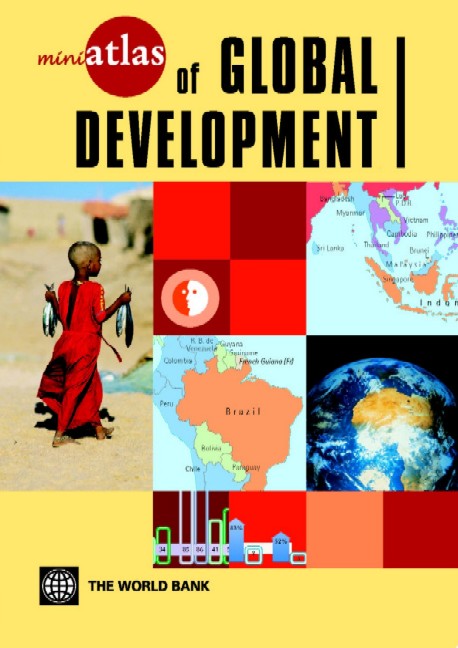
An at-a-glance guide to the most pressing development issues facing the world today. Highlights key social, economic, and environmental data for 208 of the world's economies.
Online Source
Green miniAtlas
A snapshot, presented in maps and charts, of the world's most urgent environmental challenges: increasing population, the rising demand for energy and food, declining biodiversity, and the pressure of water resources.
miniAtlas of Millennium Development Goals: Building a Better World
How far are we towards meeting the
Original Source Online
Millennium Development Goals? And what resources are needed to help those countries that are not on track? An insightful and practical guide to important contemporary global concerns.
Original Source Online
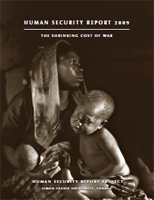
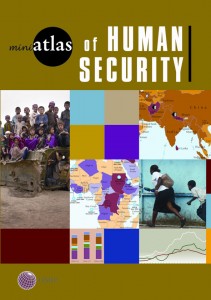
Human Security Report Project and the World Bank, this at-a-glance guide to global security issues provides a wealth of information on armed conflicts since 1946. It maps political violence, the links between poverty and conflict, assaults on human rights – including the use of child soldiers – and the causes of war and peace.
Extraordinary changes have taken place since the end of the Cold War. Despite the escalating violence in Iraq, and the widening war in Darfur, there has been a decline in armed conflict worldwide.
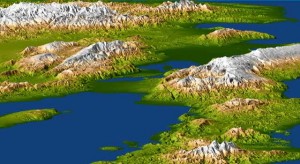
The fault responsible for the Jan. 12 magnitude 7.0 earthquake that devastated Haiti is visible in images created using NASA radar topography data acquired in 2000.
This perspective view of the pre-earthquake topography of the area, created using data from the Shuttle Radar Topography Mission that flew aboard Space Shuttle Endeavour in February 2000, clearly shows the Enriquillo fault that is apparently responsible for the earthquake. The fault is visible as a prominent linear landform that forms a sharp diagonal line at the center of the image. The city of Port-au-Prince is immediately to the left (north) at the mountain front and shoreline.
Original Source Online
Elevations in the image are color coded from dark green at low elevations to white at high elevations, and the topography is shaded with illumination from the left. The topography in this image is exaggerated by a factor of two.
Original Source Online
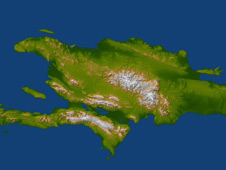
The key question from a strategic point of view ought to be: where is everyone now, and where do we want to encourage them to move to by providing a rich flow of community building materials properly located in relation to available potable water, arable land, etcetera. Below is the population density image.
PORT-AU-PRINCE, Haiti – Haitians are fleeing their quake-ravaged capital by the hundreds of thousands, aid officials said Friday, as their government promised to help nearly a half-million more move from squalid camps on curbsides and vacant lots into safer, cleaner tent cities.
Aid officials said some 200,000 people have crammed into buses, nearly swamped ferries and set out even on foot to escape the ruined capital. For those who stay, foreign engineers have started leveling land on the fringes of the city for tent cities, supposedly temporary, that are meant to house 400,000 people.
The goal is to halt the spread of disease at hundreds of impromptu settlements that have no water and no place for sewage. Homeless families have erected tarps and tents, cardboard and scrap as shelter from the sun, but they will be useless once the summer rainy season hits.
With much of Port-au-Prince in ruins, there are about 600 impromptu settlements with a population of about 1 million scattered around Haiti, said Dr. Jon Angrus, deputy director of the Pan American Health Organization.
Getting the people to safer quarters could take weeks.
“These settlements cannot be built overnight. There are standards that have to be designed by experts. There is the leveling of the land, procurement and delivery of tents, as well as water and sanitation,” said Vincent Houver, the IOM's mission chief in Haiti.
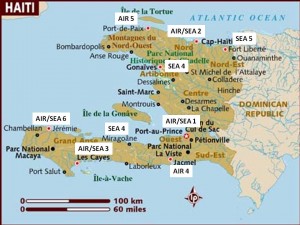
Phi Beta Iota: First off, Haiti is mountaneous, most of the options are in the narrow strip of land that is waterfront, but there are two big options, both on the tips of land furthest awar from Port au Prince. Second off, “built by experts” is a death wish. These folks are old school. We should be air dropping manna from heaven where we want them to move to, and get out of the way.
Cars are evil, right? But what if they ran on hydrogen, did 300 miles per gallon, were leased rather than owned, and were produced under an open source business model…
Riversimple’s network electric car is a hydrogen fuel cell powered car, with unique technologies that enable it to run on a 6kW fuel cell, with a fuel consumption equivalent to 300 miles per gallon and greenhouse gas emissions at 30g per km, well-to-wheel – less than a third of that from the most efficient petrol-engine cars currently available.
It also has the potential to be 10 times cleaner still if the hydrogen is produced from renewable energy.
Phi Beta Iota: “Open Everything” is not just a meme, it is the gameplan for the simple reason that open everything abolishes scarcity and makes it possible to create a prosperous world at peace. Intelligence-driven peace and prosperity. What a concept.
NEW YORK (AP) — Egypt, Russia, Saudi Arabia and the United Arab Emirates are the first countries to win preliminary approval for Internet addresses written entirely in their native scripts.
Since their creation in the 1980s, Internet domain names have been limited to the 26 characters in the Latin alphabet used in English, as well as 10 numerals and the hyphen. Technical tricks have been used to allow portions of the Internet address to use other scripts, but until now, the suffix had to use those 37 characters.
An announcement Thursday by the Internet Corporation for Assigned Names and Numbers, known as ICANN, paves the way for an entire domain name to appear in Cyrillic or Arabic by the middle of this year. Applications for strings in other languages are pending.