IC's Language, Linguistic Shortfalls Under Scrutiny
by Anthony L. Kimery
Thursday, 21 January 2010
The IC still has important pockets of critical intelligence analysis that continue to suffer.
The rank and file analysts at the CIA, NSA and elsewhere throughout the Intelligence Community (IC) are patriotic, dedicated … hardworking. But they have long been hampered by a lack of both linguists and language proficient subject matter experts to help them make sense of the overwhelming storm of intelligence that is routinely siphoned from the air and gathered by human intelligence sources every day. This blizzard of information is blinding.
According to IC sources HSToday.us talked on background, the IC’s failure to detect the recent attempted terrorist attacks on the US homeland wasn’t just about the failure to connect the existing dots – of which there were many – but also was because of the inability to quickly and effectively interpret country-language specific intelligence, such as that which was collected in Yemen.
. . . . . . .
Last July, the Senate Select Committee on Intelligence reported that it “is concerned about the abysmal state of the Intelligence Community’s foreign language programs.”
The Committee’s report noted that “the collection of intelligence depends heavily on language, whether information is gathered in the field from a human source or from a technical collection system. Even traditionally nonlinguistic operations such as imagery rely on foreign language skills to focus and direct collection efforts.”
However, the Committee concluded, “almost eight years after the terrorist attacks of September 11th and the shift in focus to a part of the world with different languages than previous targets, the cadre of intelligence professionals capable of speaking, reading, or understanding critical regional languages such as Pashto, Dari, or Urdu remains essentially nonexistent.”
Continuing, the report stated that “the Intelligence Reform Act required the DNI [Office of the Director of National Intelligence] to identify the linguistic requirements of the Intelligence Community, and to develop a comprehensive plan to meet those requirements.”
But “five years later, the ODNI has still not completed an IC-wide comprehensive foreign language plan that designates specific linguist or language requirements, lays out goals or timelines, or designates specific actions required to meet them.”
As Nokia takes on Google with turn-by-turn voice navigation on select smartphones, the worst nightmares of GPS device makers are coming true.
Nokia and Google are both using free GPS applications as a lure to their products. That means they're competing, which means those free applications will get better. As that happens, it'll be harder for TomTom, Garmin and Magellan to make their paid software or hardware seem attractive.
Already, Nokia claims to have one-upped Google in the crucial area of pre-loaded maps. While Google Maps Navigation requires a data connection, Ovi Maps uses a combination of pre-loaded and online maps, but can load directions even in a dead zone. When it does need to load information, Nokia says it's more efficient than Google's application, requiring only 200 KB of data over a 12-mile stretch of road compared with 2 MB for an Android phone.
The Washington Post (headline and link below) purports to explain how the CIA fell victim to a series of miscalculations that make it vulnerable to the devastating attack on Forward Operating Base (FOB) Chapman, a CIA base in Khost Province, Afghanistan, but it does not pass the smell test. Of course, coming from the Washington Post, we should not be surprised if it emits the oder of a CYA leaking operation by an agency or agencies of the US government. The report is nevertheless revealing, because it goes to the heart of the strategic confusion that originates in the US Government's simplistic conflation of the goals of the Pashtun tribal chieftains and warlords (e.g. Mehsud/Haqqani clans), nationalist insurgents (e.g., Afghan Taliban), and those of the Paki military's Inter Services Intelligence (ISI, including those related to the Kashmir Question) with those of an amorphous al Qaeda in a strategy now known as the AFPAK strategy.
It appears that most of the information in the Post's report comes from Jordanian intelligence (GID) and CIA sources who are anxious to preserve a special relationship between GID and the CIA. Note particularly how a tone of threat inflation permeates its discussion al Qaeda's intelligence abilities, especially how difficult is to penetrate the inner circles of al Qaeda. This sounds a little like the hoary portrayals of the omniscient, centrally-directed, all-powerful Soviet KGB that we were subjected to during the Cold War. After over eight years of a so-called long war on terror and the expenditure of more than one trillion dollars in the targeting of al Qaeda (which is alleged to be the central objective of the war, be it in Iraq, Afghanistan, Pakistan, Yemen, or Somalia), the continued existence of al Qaeda is embarrassing, and perhaps can only be explained to a fear-numbed, tired public by assigning al Qaeda solomon-like intelligence and attack capabilities.
According to the Post report, the GID sent Dr. Balawi, the Jordian suicide bomber, to Pakistan to get inside al Qaeda's inner circles. Note, however, the relative absence of any discussion of Pashtun networks or the Pakistan Army's notorious ISI organization. Citing CIA/GID sources, the Post intimates the CIA was subjected to a sophisticated bait and switch operation by al Qaeda, wherein Balawi provided high quality “actionable” intelligence to convince the CIA that Balawi as reliable double agent who has inserted himself into al Qaeda. Yet according to a large number of news reports over the last two years, almost all of the targeting has been against Pashtun targets in border areas between Pakistan and Afghanistan, particularly in North and South Waziristan. Moreover, the overwhelming majority of these so-called decapitation attacks on Pashtun leadership targets over the last two years failed to hit their designated targets, but have killed hundreds of innocent men, women, and children, thus enraging an ever growing number of Pashtuns.
This line of thinking begs some questions: What kind of actionable intelligence was Balwai providing? Was it directed at al Qaeda or a variety of Pashtun clan chieftains or warlords? And who was feeding Balawi the targeting intelligence? Or more precisely, given the internecine character of the Pashtun culture, its vendetta code of honor, and the conflicting goals of the various insurgent/criminal groups, what group or alliance of convenience was providing the targeting info that the CIA/GID believed to be confirmation of Balawi's bona fides?
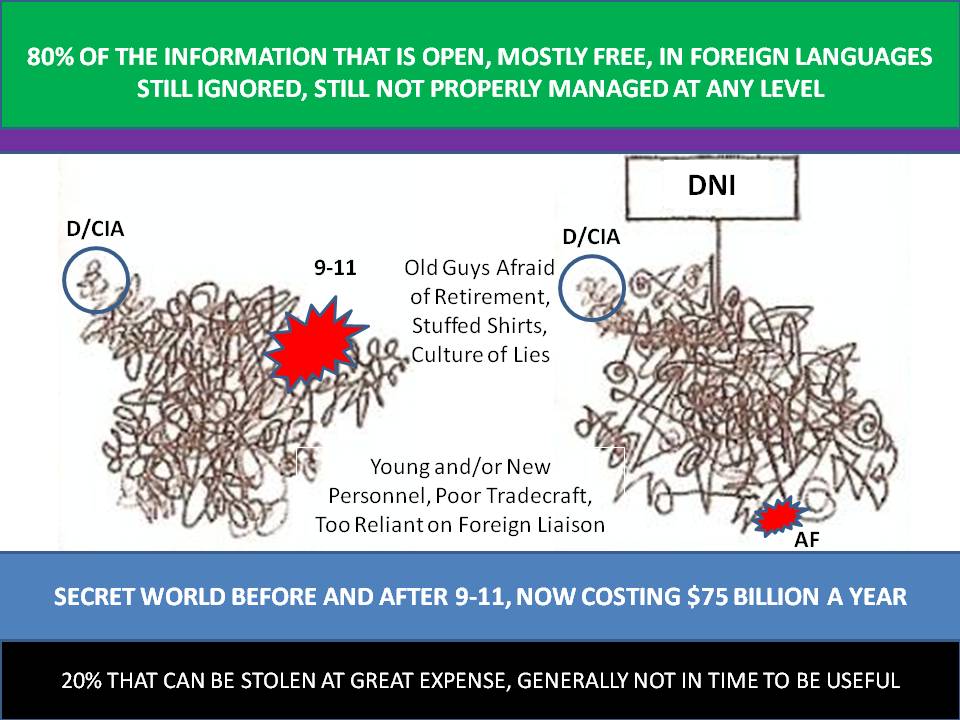
Phi Beta Iota Graphic
The intrigues implicit in these questions are the same as those that bedeviled Alexander the Great (330-327 BC), the British in the 19th Century, and the Soviets in the 20th Century; and they suggest an alternative hypothesis to the FOB Chapman capejob: Namely that wily Pashtuns may have viewed a self-starting Arab Salafi Jihadi, like Balawi, as manna from heaven that would enable them to infiltrate FOB Chapman, the source of so many drone attacks on Pashtun targets. The CIA went for a red cape constructed by one or more groups of Pashtuns (possibly with help from the Paki Army's ISI), who knowingly exploited US (and Jordanian?) obsessions with al Qaeda as a weakness to be used in getting revenge for the killings of a few Pashtun chieftains (like the elder Baitullah Mehsud), not to mention the hundreds of innocent Pashtun civilians who are deemed to be acceptable collateral damage by the “strategists” designing the drone war on Pakistani extremists.
The bottom line is that we still don't know what happened at Forward Operating Base Chapman beyond the first order effects of the killings, and the Post report does little to clear the cobwebs. Yet understanding motives that led the disaster at FOB Chapman is inextricably tied up with understanding the strategic and grand strategic ramifications of President Obama's increasing reliance on a decapitation strategy in AFPAK To date, this strategy has yielded few dividends at an increasing cost: A bankrupting war with no end in sight, because the few leaders we have killed have been easily replaced, and their martyrdom, coupled with a culture that makes it a matter of personal honor to seek revenge for the killing of hundreds of innocents, is generating an increasing flood of recruits. On the other hand, blaming the attack on al Qaeda, and by extension, evoked the fears generated by 911, has the effect of directing attention away from an intractable strategic and grand strategic debacle of our own making.
Commandant: Marine Corps Seeks Solutions to Naval Surface Fires ‘Void’
In a recent article from “Inside the Navy.com”, the Marine Corps expressed continued concern for the lack of naval surface fires support that only the DDG-1000 offers. According to this published report, Marine Corps Commandant, Gen. James Conway, referred to the truncation of the DDG-1000 destroyer program to only three hulls as leaving “a serious void” in the Navy's ability to provide surface fires support. The Advanced Gun System (AGS) on the DDG-1000 would provide the protection needed for his Marines to safely and successfully maneuver.
NSFS analysis remains ongoing Commandant: Marine Corps Seeks Solutions to Naval Surface Fires ‘Void’
The Marine Corps remains concerned about how it will mitigate the lack of a naval surface fires capability in light of the truncation of the DDG-1000 destroyer program to three hulls, which carry the Advanced Gun System designed to provide Marines fires to allow for maneuver ashore.
Below the Fold: Rest of Summary and Links to USMC 1989-1990 Study, Current Facts on Navy's Non-Responsive Showboat, and GAO Study. Known gap since 1989–and no one with the integrity to challenge Navy's decisions–decisions based on ideology, not solid decision-support. This is the primary reason we folded both the Inspector General (IG) and Operational Test & Evaluation (OT&E) into our 21st Century Full Spectrum Human Intelligence (HUMINT) –the Undersecetary of Defense for Intelligence and Warfighting Support needs to “get a grip” on all information across the spectrum (green, red, yellow, white) and on all of the tools and technologies that carry information–the systems is the message, and right now the message is not getting there.
Chuck Spinney is still the best “real” engineer in this town–almost everyone else is staggering after fifty years of government-specification cost-plus engineering. Also, as Chuck explores in the piece on Complexity to Avoid Accountability is Expensive we in the “requirements” business are as much to blame–Service connivance with complexity has killed acquisition from both a financial inputs and a war-fighting relevance outcome point of view. The Services have forgotten the basics of requirements definition and multi-mission interoperability and supportability.
The Marine Corps Intelligence Center (MCIC) was created by General Al Gray, USMC (Ret), then Commandant of the Marine Corps, for three reasons:
1. Intelligence support to constabulary and expeditionary operations from the three major services was abysmal to non-existent.
2. Intelligence support to the Service level planners and programmers striving to interact with other Services, the Unified Commands, and the Joint Staff was non-existent–this was the case with respect to policy, acquisition, and operations. The cluster-feel over Haiti and the total inadequacy of our 24-48 hour response tells us nothing has changed, in part because we still cannot do a “come as you are” joint inter-agency anything.
“Consulted this app, while trapped under Hotel Montana in Haiti earthquake, to treat excessive bleeding and shock. Help me stay alive till I was rescued 64 hours later. God saved me, and this app was one of the tools He gave me.”
The app is Pocket First Aid & CPR from Jive Media. I checked with Jive founder Doug Kent about it, and he e-mailed that “all of the content is loaded upon installation, including the videos and illustrations. Internet access is not needed to access any of the features.”