Phi Beta Iota: First, tip of the hat to the New York Times for open persistent URLs. Bravo! We strongly recommend a reading of the entire pieceat the NYT website. Shame on the USA for not living up to the Founding Father's aspirations for a wise government and an engaged public. No one now working for the White House can recite the ten high-level threats, the twelve core policies that must be harmonized, or the eight demographic challengers–including China–who we should be helping devise the World Brain with embedded EarthGame. US voters are slow to anger, but that anger will rise in 2010 and crest in 2012.
Op-Ed Contributor: Eight Idas Behind China's Success
By ZHANG WEI-WEI, Published: September 30, 2009
EXTRACT: Critics of China like to claim that despite its economic success, the country has no “big ideas” to offer. But to this author, it is precisely big ideas that have shaped China’s dramatic rise. Here are eight such ideas:
In 1988 a global campaign started at the Marine Corps Intelligence Center (MCIC) with the discovery that 80% or more of what the Marine Corps needed to do policy, acquisition, and operations support for this unique expeditionary and constabulary force, was not secret, not expensive, but also not known to anyone in Washington, D.C. Thus was the modern discipline of Open Source Intelligence (OSINT) inspired.
This is year 21 in a 25 year fight for the public interest, and although the USA remains “severely deficient” (as stated by the Aspin-Brown Commission in 1996), the US secret world refuses to act on the findings that also called for OSINT to be a “top priority” for both funding and for DCI/DNA attention. Neither of the last have been forthcoming, and it can be fairly said that until an Open Source Agency is established, as called for on pages 23 and 423 of the 9-11 Commission Report, the USA will continue to spend $75 billion a year on the 20% it can capture with secret sources and methods (less than 5% of which is actually processed, i.e. 1% of the totality), all to produce, “at best” 4% of what the President and many others now not served “need to know.”
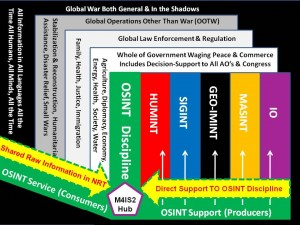
The Nordic nations, and Sweden in particular through the Folke Bernadotte Academy, have led the way in conceptualizing M4IS operational and intelligence networks:
UN-SPIDER aims at providing universal access to all types of space-based information and services relevant to disaster management by being a gateway to space information for disaster management support; serving as a bridge to connect the disaster management and space communities; and being a facilitator of capacity-building and institutional strengthening.