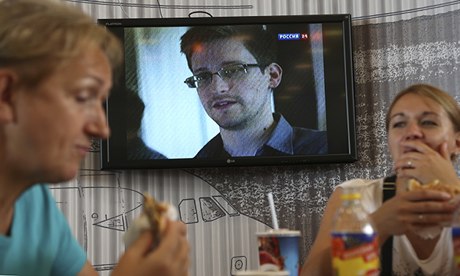
Edward Snowden's revelations exposed a terrifying level of ‘passive acceptance' of surveillance. Photograph: Sergei Grits/AP
One of the most disturbing aspects of the public response to Edward Snowden‘s revelations about the scale of governmental surveillance is how little public disquiet there appears to be about it. A recent YouGov poll, for example, asked respondents whether the British security services have too many or too few powers to carry out surveillance on ordinary people. Forty-two per cent said that they thought the balance was “about right” and a further 22% thought that the security services did not have enough powers. In another question, respondents were asked whether they thought Snowden's revelations were a good or a bad thing; 43% thought they were bad and only 35% thought they were good.
Writing in these pages a few weeks ago, Henry Porter expressed his own frustration at this public complacency. “Today, apparently,” he wrote, “we are at ease with a system of near total intrusion that would have horrified every adult Briton 25 years ago. Back then, western spies acknowledged the importance of freedom by honouring the survivors of those networks; now, they spy on their own people. We have changed, that is obvious, and, to be honest, I wonder whether I, and others who care about privacy and freedom, have been left behind by societies that accept surveillance as a part of the sophisticated world we live in.”
I share Henry's bafflement. At one point I thought that the level of public complacency about the revelations was a reflection simply of ignorance. After all, most people who use the internet and mobile phones have no idea about how any of this stuff works and so may be naive about the implications of state agencies being able to scoop up everybody's email metadata, call logs, click streams, friendship networks and so on.
The public sphere has been effectively stripped of everything but corny, irritatingly hammy political theater.
All we have left in the U.S. is a deeply impoverishing Political Theater of the Absurd. Policy, theory and governance have all been reduced to competing stage performances in the Theater of the Absurd. The actors are transparently given to farcical overacting in exaggerated dramas drained of meaning; they proceed through the cliched motions as if the audience hadn't seen the same charades overplayed dozens of times before.
“Government shutdown” and “debt ceiling” may have engaged audiences starved for entertainment in a bygone age, but now they exemplify a theater that is so impoverished it can only re-stage tired formulaic dramas with a savage appetite for incompetence and buffoonery.
Phi Beta Iota: This is important not as a recommendation of a rotten book (it properly skewers the author) but rather for its utility in pointing out that most successful authors are themselves captives of the very goliath we seek to put down. Like CNN anchors, they are corrupt shills for the status quo ante, doing all they can to distract and mislead, rather than spark the creation of public intelligence in the public interest.
Something’s awry when fewer than three riders on a metropolitan train car are thumbing through Blinkor Outliers, two of Gladwell’s earlier collections. Moreover, suburban mega-stores such as Costco, Target and Walmart devote entire displays to each new addition to Gladwell’s canon.
I’ve never met Gladwell, but through his writing and speaking, he comes across as incredibly pleasant. Perhaps he has better evolved brain chemistry than the rest of us.
With his move from TheWashington Postto The New Yorker in 1996, Gladwell was cast as a literary wonder boy, a gifted explainer, enthusiastic to find real men and women who substantiate statistics. Now 50, he still looks like a teaching assistant (he wore jeans, sneakers and a sportcoat during this recent David and Goliath-themed TED talk). Even his name has a pair of calming adjectives — I can picture a woman in Lamaze class being instructed to inhale (hold, two, three), and exhale, “Glad-well.”
The most common publishing refrain is probably “If it ain’t broke, don’t fix it,” which is odd since book publishers tend to appreciate good grammar. Nevertheless, I’m tired of the Gladwell formula.
Phi Beta Iota: Most big data is crap. You analyze crap, you get crap analysis. Without a holistic analytic model, a deep commitment to true cost economics, and the ability to collect AND PROCESS all relevant data, big data is nothing more than NSA waste writ large…yes, big data can yield short-term advantage in manipulating consumers, stopping fraud, and so on, but what we have now in the way of big data thinking is elementary at best.
Phi Beta Iota: Anyone contemplating a tank as the solution to terrorism has issues to0 large to solve in this space. COIN is fraud. Terrorism is not a threat, it is a tactic. Terrorism, like soldier suicide, is the canary in the coal mine. It is an intelligence and information operations challenge and can only be addressed via non-kinetic means. Anyone that does not get that is part of the problem and one reason why terrorism continues to flourish.