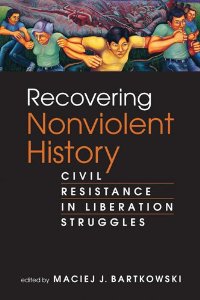
On November 29, 2013 colleagues from the International Center on Nonviolent Conflict (ICNC) learnt about Howard Clark’s passing.
Amazon Page
He left us much too early and too suddenly. And we lost not only a close, dear friend that could cheer and energize people around him but also an effective collaborator and a scholar-practitioner with a deep knowledge about and a sophisticated understanding of the field of nonviolent conflict.
I am writing to share with you my new article, “Russia, Iran and China in Latin America,” just published by the American Foreign Policy Committee in their e-journal “Defense Dossier.” The work comparatively examines the activities of the three extra-regional actors in Latin America and the Caribbean, including ways in which commercial and governmental initiatives by each compliment (and occasionally conflict or compete with) each other. I emphasize that each actor presents a different type of challenge to US interests in the region, on a different time-scale.
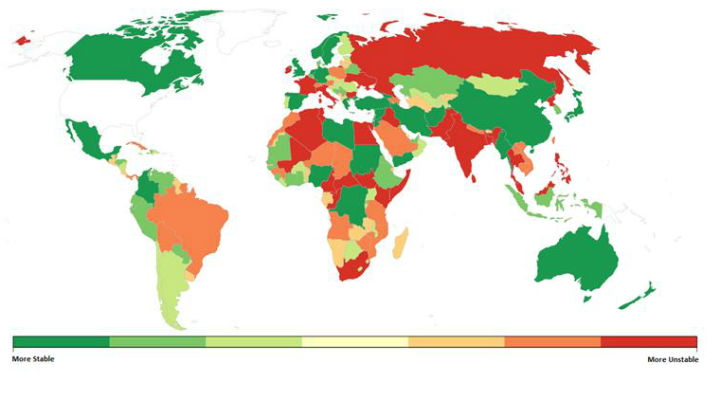
What big data tells us about next year’s crisis zones.
EXTRACTS:
….my 2011 “Culturomics 2.0” study demonstrated the unique insights gleaned from looking at how the media covers an event, rather than just what it covers.
Click on Image to Enlarge
The Global Database of Events, Language, and Tone (GDELT) project is the largest event database in the world, capturing over a quarter-billion events in every country, down to the city level — across 300 categories, from 1979 to the present, and with daily updates of 100,000 events a day.
. . . . . . .
Of course, the best part is being able to dive in yourself, so without further ado, download the complete 172-page report and take a look at the countries you are most interested in or check out how they compare in the master ranking table at the end of the report. Take a look through what a big data view of 675 million mentions of conflict tell us about how the world is changing. When you're done, sign up for the new GDELT Daily Trends Report email and get a miniature version of this delivered to your inbox each morning. Big data is giving us our first glimpse of a world in which we can map the Earth's riots as well as we can its earthquakes and hurricanes — and all from just reading the news a little more carefully.
Beyond the headlines of conflict and catastrophe, this year’s top stories offered us some powerful proof that the world can still change—for the better
Why have oppositions in the Arab world and beyond failed so absolutely, and why have they repeated in power, or in pursuit of it, so many of the faults and crimes of the old regimes? The contrast between humanitarian principles expressed at the beginning of revolutions and the bloodbath at the end has many precedents, from the French Revolution on. But over the last twenty years in the Middle East, the Balkans and the Caucasus the rapid degradation of what started as mass uprisings has been particularly striking.
. . . . . . .
The inability of new governments across the Middle East to end the violence can be ascribed to a simple-minded delusion that most problems would vanish once democracies had replaced the old police states. Opposition movements, persecuted at home and often living a hand to mouth existence in exile, half-believed this and it was easy to sell to foreign sponsors. A great disadvantage of this way of seeing things was that Saddam, Assad and Gaddafi were so demonised it became difficult to engineer anything approaching a compromise or a peaceful transition from the old to a new regime.
. . . . . . .
Click on Image to Enlarge
So the insurgencies in the Middle East face immense difficulties, and they have faltered, stalled, been thrown on the defensive or apparently defeated. But without the rest of the world noticing, one national revolution in the region is moving from success to success.
The Uri Avnery has written a simple and profound portrait of how the differing narratives have hijacked the Orientations in the OODA loops of all the players in the Arab – Israeli conflict, including particularly the self-styled ‘honest brokers' in the United States, as well as the belligerents in the Arab – Israeli Conflict. IMO, that is why he concludes the intractability of the conflict a fundamentally a psychiatric problem, at least in so far as one believes the fiction there such a thing as a ‘peace process' being promoted by the United States.
I agree with Avnery's diagnosis. His subject is one of incestuous amplification the OODA loop and how it guarantees at mad rush to folly — process that I explained and explored the consequences of in The Madness of King George Revisited. This goes to heart of America's problem that prevents American citizens from understanding the real conflict of interests that is driving this conflict. The author has credibility: Uri Avnery is Israel's leading peace activist, a former member of the Knesset, and a hero of the 1948 War. CS