Circulating Broadly
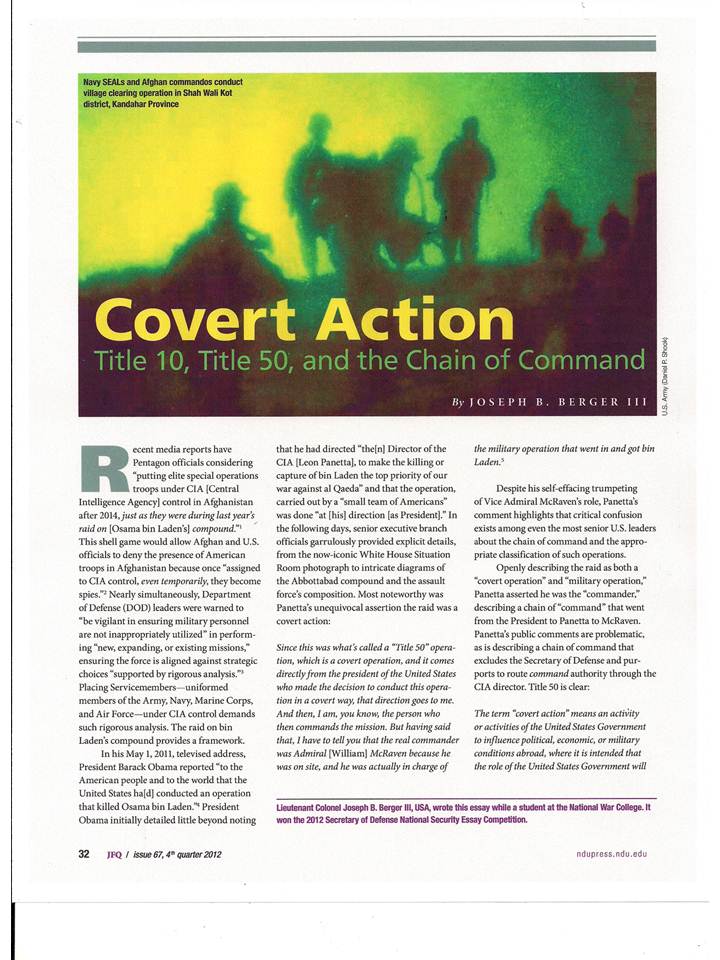
(U) Covert Action-T10, T50, and the Chain of Cmd (JFQ-67_32-39_Berger)

The truth at any cost lowers all other costs — curated by former US spy Robert David Steele.
Circulating Broadly
(U) Covert Action-T10, T50, and the Chain of Cmd (JFQ-67_32-39_Berger)

The Shocking Statistics Behind The Pentagon's Revolving Door ‘Policy'
Tyler Durden
ZeroHedge, 12/03/2012
High ranking generals and admirals earn their stars. They earn their stripes. Then, they earn their cash. New research by Citizens for Responsibility and Ethics in Washington (CREW) found 70% of the 108 three-and-four star generals and admirals who retired between 2009 and 2011 took jobs with defense contractor or consultants. In at least a few cases, the retirees have continued to advise the Department of Defense while on the payroll of defense contractors, suggesting the Pentagon may not always be receiving unbiased counsel.
A Boston Globe investigation revealed the number of retired three-and-four star generals and admirals moving into lucrative defense industry jobs rose from less than 50% between 1994 and 1998 to a stratospheric 80% between 2004 and 2008.
Two things seem clear to me: the Pentagon budget is going down, and pretty much no one in Washington wants to impose the three fundamental reforms needed to enable DOD to prosper in an era of lower budgets. I explain my point of view in a new article in Foreign Policy and below.
EXTRACT:
They are laying the groundwork for the same Pentagon as the one we have now, just at somewhat lower spending levels with several fewer programs — and more of the remaining ones funded at unrealistically lower levels than usual.
Amidst the many uncertainties and machinations in the negotiations in Washington on the “fiscal cliff,” a few things are beginning to emerge as certain. Among them: the defense budget will be going down. Another is that none of the parties to the negotiations is seeking the kind of change that the Pentagon must undergo to survive effectively, even prosper, under significantly reduced budgets.
The new, post-election reality of a declining Department of Defense (DOD) budget was signaled by a conglomeration of mainstream think tank pundits, Capitol Hill staffers from both political parties, industry and executive branch defense specialists, and retired military officers put together by the Center for Strategic and Budgetary Assessments: They opined on not whether the defense budget was about to decline significantly but on how to do it. (Some of them had some pretty horrible ideas; more on that later.) The new reality of less money for DOD was also made clear in a provocative summary of five different think tanks reports at Foreign Policy by Gordon Adams.
Continue reading “Winsdlow Wheeler: Post-Downturn Pentagon to be UGLY…”

Huh?
DIA sending hundreds more spies overseas
By Greg Miller
Washington Post, Saturday, December 1, 2012
The Pentagon will send hundreds of additional spies overseas as part of an ambitious plan to assemble an espionage network that rivals the CIA in size, U.S. officials said.
The project is aimed at transforming the Defense Intelligence Agency, which has been dominated for the past decade by the demands of two wars, into a spy service focused on emerging threats and more closely aligned with the CIA and elite military commando units.
When the expansion is complete, the DIA is expected to have as many as 1,600 “collectors” in positions around the world, an unprecedented total for an agency whose presence abroad numbered in the triple digits in recent years.
The total includes military attachés and others who do not work undercover. But U.S. officials said the growth will be driven over a five-year period by the deployment of a new generation of clandestine operatives. They will be trained by the CIA and often work with the U.S. Joint Special Operations Command, but they will get their spying assignments from the Department of Defense.
. . . . . . . . .
Former senior Defense Department officials said that the DIA now has about 500 “case officers,” the term for clandestine Pentagon and CIA operatives, and that the number is expected to reach between 800 and 1,000 by 2018.
Pentagon and DIA officials declined to discuss specifics. A senior U.S. defense official said the changes will affect thousands of DIA employees, as analysts, logistics specialists and others are reassigned to support additional spies.
The plan still faces some hurdles, including the challenge of creating “cover” arrangements for hundreds of additional spies. U.S. embassies typically have a set number of slots for intelligence operatives posing as diplomats, most of which are taken by the CIA.

No credit to the OSINT pioneers from 1969 onwards, but the slow are finally catching up. BUT they still think OSINT is a technical collection challenge rather than a HUMINT opportunity.
By Charles S. Clark
The digital information revolution has handed the U.S. intelligence community a slew of new challenges that are nowhere close to resolution, a new study says.
The 21st-century problems range from mountains of data to accelerated pace of change to competing information flow from nongovernmental sources to fears of violating privacy and civil liberties, according to a paper “Expectations of Intelligence in the Information Age,” released Thursday by the Intelligence and National Security Alliance, a nonprofit that brings together experts in the public, private and academic sectors.
The paper drew praise from Defense Intelligence Agency Director Lt. Gen. Michael Flynn, who spoke at a banquet in Arlington, Va., to mark the paper's release.
Continue reading “David Isenberg: Intelligence Community Must Adapt To Era Of Vast Data”
Syria: On 29 November, the administration of Damascus' airport cancelled all incoming and outgoing flights because rebel groups had cut the road from the airport to Damascus, for the first time.
Syrian rebels also used shoulder-fired anti-aircraft missile systems (MANPADs) that were captured from Syrian forces to shoot down a government helicopter and a fixed wing combat aircraft in a 24-hour period.
Comment: The Syrian uprising crossed an important strategic threshold with the first demonstrated capability to shoot down government aircraft. This is a major escalation of the threat to the Damascus government.
One news report stated an opposition group had captured 40 MANPADS in recent overruns of government air force bases. That number is enough to neutralize the government's air advantage, provided they are distributed adequately to trained shooters. A key question is who is providing the training. That is almost certainly US special forces.
The gradual loss of air superiority means the regime cannot survive, though its demise is not yet imminent.
Several other recent tactical successes by opposition fighting groups also almost certainly are the result of US and possibly other Western training, guidance and possibly leadership. Within four months of American announcements that US Special Operations Forces were providing training to opposition groups in camps in Jordan, the opposition groups suddenly have become tactically more effective. The targets of some of their attacks are more harmful to the Damascus regime and some groups have greater ability to coordinate their attacks.
These are the effects of superior outside military involvement. These same opposition groups fumbled around for 18 months with no significant impact on the stability of the regime. The US is involved in the fight, probably with special forces inside advising selected rebel groups.
The regime is falling back, trying to find a line it can hold. That presumably is the corridor from Damascus to Latakia, the Alawite homeland.
As noted above, policy choices have consequences. Should the Alawite government fall, Syrian Christians, Jews, Zoroastrians and other minorities will be killed and shrines destroyed. That is why the Syrian Kurds are opposing the Syrian opposition fighters and jihadists.
Continue reading “NIGHTWATCH: Syria at Risk — Own the Consequences”

Phi Beta Iota: We learn that the Army Corps of Engineers, which should be focusing on the Mississippi right now, has not one but three offices in Israel; and that it is acting as an agent of the Israeli government in obligating US taxpayer dollars for what is clearly a deeply religious construction, to which DoD is allegedly (and probably) not privy to the details. We do not make this stuff up. Penguin insists that we all acknowledge Brother Pincus' righteous contribution. So ordered! All hail Walter Pincus. Seriously.
Why Is The US Building A Secret $100 Million Underground Facility Outside Tel Aviv?
Robert Johnson
Business Insider, 29 November 2012
These mezuzas, notes the [US Army] Corps, “shall be written in inerasable ink, on . . . uncoated leather parchment” and be handwritten by a scribe “holding a written authorization according to Jewish law.” The writing may be “Ashkenazik or Sepharadik” but “not a mixture” and “must be uniform.”
