Steven Aftergood: Senate Slams Door on Defense Clandestine Service — Robert Steele Comments + DoD Clandestine RECAP

Advanced Cyber/IO, Corruption, Government, Ineptitude, Military
Steven Aftergood

Updated 11 Dec 2012 to add Graphic: Intelligence Requirements, Collection, Evaluation, and Capabilities Building

Senate Puts Brakes on Defense Clandestine Service

The Senate moved last week to restrain the rapid growth of the Defense Clandestine Service, the Pentagon’s human intelligence operation.

Under a provision of the FY2013 defense authorization act that was approved on December 4, the Pentagon would be prohibited from hiring any more spies than it had as of last April, and it would have to provide detailed cost estimates and program plans in forthcoming reports to Congress.

“DoD needs to demonstrate that it can improve the management of clandestine HUMINT before undertaking any further expansion,” the Senate Armed Services Committee wrote in a report on the new legislation.

Longstanding problems with defense human intelligence cited by the Committee include:  “inefficient utilization of personnel trained at significant expense to conduct clandestine HUMINT; poor or non-existent career management for trained HUMINT personnel; cover challenges; and unproductive deployment locations.”

The Committee noted further that “President Bush authorized 50 percent growth in the CIA’s case officer workforce, which followed significant growth under President Clinton. Since 9/11, DOD’s case officer ranks have grown substantially as well. The committee is concerned that, despite this expansion and the winding down of two overseas conflicts that required large HUMINT resources, DOD believes that its needs are not being met.”

Instead of an ambitious expansion, a tailored reduction in defense intelligence spending might be more appropriate, the Committee said.

“If DOD is able to utilize existing resources much more effectively, the case could be made that investment in this area could decline, rather than remain steady or grow, to assist the Department in managing its fiscal and personnel challenges,” the Senate Committee wrote.

The Washington Post published a revealing account of Pentagon plans to expand the size and reach of the defense human intelligence program in “DIA sending hundreds more spies overseas” by Greg Miller, December 1.

Along with overhead surveillance, bolstering human intelligence has been the focus of one of two major defense intelligence initiatives, said Under Secretary of Defense (Intelligence) Michael G. Vickers last October.  The Defense Clandestine Service “enable[s] us to be more effective in the collection of national-level clandestine human intelligence across a range of targets of paramount interest to the Department of Defense,” he said.

The latest issues of the U.S. Army’s Military Intelligence Professional Bulletin, released under the Freedom of Information Act, are available here (in some very large pdf files).

“A Short History of Army Intelligence” by Michael E. Bigelow of US Army Intelligence and Security Command, dated July 2012, is available here.

Newly updated doctrine from the Joint Chiefs of Staff includes Information Operations, JP 3-13, 27 November 2012, and Joint Forcible Entry Operations, JP 3-18, 27 November 2012.

Continue reading “Steven Aftergood: Senate Slams Door on Defense Clandestine Service — Robert Steele Comments + DoD Clandestine RECAP”

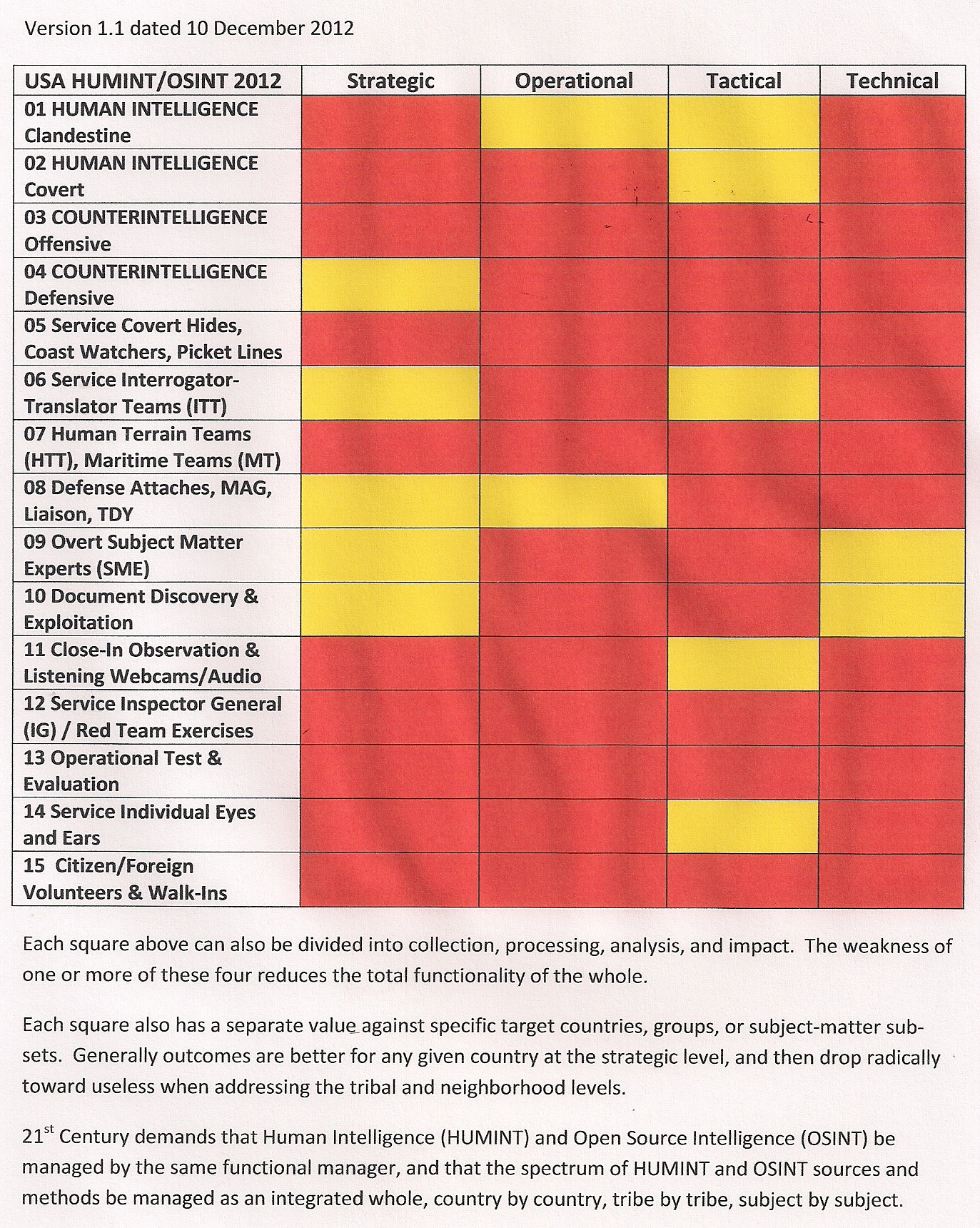
2012 USA Human Intelligence (HUMINT) Scorecard 1.1

Government, Ineptitude, Military
Click on Image to Enlarge

Document: USA HUMINT 1.1

This is tentative (new draft) pending additional feed-back from a handful of still-engaged colleagues.  It assumes CIA being dead in the water, reliant on foreign liaison and legal traveler debriefings for 90% of its “clandestine” Human Intelligence (HUMINT), and its OSC being totally out of touch with 80% or more of the relevant Open Source Intelligence (OSINT), for example, materials pertinent to Chinese submarines and their weapons systems.  It assumes that DIA and the Services are still playing patty-cakes with enlisted people playing case officer, and shallow historical, cultural, or linguistic capabilities for the circuit riders.  It also assumes that misplaced obession with security in Stone Age terms has blocked all new initiatives with respect to multinational collaboration and limited duty HUMINT assets (principal agents) that never come inside.

It integrates the following comments from Ralph Peters:

It was HUMINT operatives, running local agents, that have enabled us to target hundreds of terrorist leaders around the world.  Of course, HUMINT alone isn't responsible, and everything from phone intercepts to host-state information play roles, as you know…but our HUMINT, while it could be better, will always remain imperfect–because humans are imperfect.  The real problems we face in HUMINT are the limited number of dedicated, expert career agents with language skills and long stretches on the ground in target countries.  Then there are the political restrictions.  Also, as I can tell you from the experience of friends, military-run HUMINT (primarily spec ops) has made enormous strides.  While this is primarily tactical/operational HUMINT, it's pretty impressive.  The other key thing, though, to which I alluded above, has been the pretty successful integration of HUMINT with other disciplines to give us some genuine all-source intelligence.  I'm impressed with the targeting we've been able to do globally–although less impressed with our analytical ability to exploit the raw data and deliver successful, useful strategic forecasts.

See Also:

Continue reading “2012 USA Human Intelligence (HUMINT) Scorecard 1.1”

Penguin: Larry WIlkerson Skeptical About Politicization (aka Fabrication) of Syrian Chemical Weapons Reports

Corruption, Government, Media, Military
Who, Me?

Former Powell adviser ‘skeptical’ of ‘politicized’ US intelligence on Syria

RT, 08 December, 2012

Syria will never use chemical weapons against its own people, Lawrence Wilkerson, a retired US Army Colonel who was Chief of Staff to Colin Powell told RT. Instead, the reality is that US is “preparing the ground to intervene in Syria.”

­An act which would lead to a conflict “that would take at least a decade to settle – and there aren't going to be too many victors at the end of that decade, just losers,” Wilkerson says, as Washington's ultimate aim is to overthrow the Iranian leadership.

Simultaneously, some members of Congress are talking about “impeachment” of the US president for not consulting Congress before involving the country in conflicts.

RT: You were Colin Powell's chief of staff when the decision was made to invade Iraq. In 2003, Powell made a speech that laid out the case for that war. Let's take a listen to what he said. You helped prepare that speech, and have since described it as the biggest mistake of your life. Why?

Lawrence Wilkerson, former chief of staff to Secretary of State Colin Powell (AFP Photo / Chip Somodevilla)

Lawrence Wilkerson: Primarily because we – to the American people, to the international community and of course to the members of the US Security Council – presented that speech… it was not accurate, it was not true, it was not valid. We did not know that, but it was not just an intelligence failure. It was also the massive politicization of intelligence by the leadership in Washington.

RT: We're currently seeing very similar rhetoric in the US in relation to Syria.  Will it end in war again?

LW: I would be highly skeptical of any of the intelligence rendered by the $140-billion-plus US intelligence community as to weapons of mass destruction in possession of another country. Period.

Read full article.

Continue reading “Penguin: Larry WIlkerson Skeptical About Politicization (aka Fabrication) of Syrian Chemical Weapons Reports”

Mini-Me: Obama Approves CIA War on Syria, CIA & Arabs Arming Islamic Militants Instead — But Wait, Could This Be Smoke Related to Benghazi-Based Acts of War on Syria?

Corruption, Government, Ineptitude, Media, Military
Who? Mini-Me?

Huh?

New York Times: Arms Shipments ‘Secretly’ Approved by Obama Admin. Ended Up in Hands of Islamic Militants

Jason Howerton

The Blaze, 5 December 2012

U.S.-Approved Arms for Libya Rebels Fell Into Jihadis’ Hands

By , and

New York Times, December 5, 2012

WASHINGTON — The Obama administration secretly gave its blessing to arms shipments to Libyan rebels from Qatar last year, but American officials later grew alarmed as evidence grew that Qatar was turning some of the weapons over to Islamic militants, according to United States officials and foreign diplomats.

. . . . . . .

“To do this right, you have to have on-the-ground intelligence and you have to have experience,” said Vali Nasr, a former State Department adviser who is now dean of the Paul H. Nitze School of Advanced International Studies, part of Johns Hopkins University. “If you rely on a country that doesn’t have those things, you are really flying blind. When you have an intermediary, you are going to lose control.”

Read full article.

Tip of the Hat to Jaimi Miller and Richard Byrd at Google+.

Continue reading “Mini-Me: Obama Approves CIA War on Syria, CIA & Arabs Arming Islamic Militants Instead — But Wait, Could This Be Smoke Related to Benghazi-Based Acts of War on Syria?”

Chuck Spinney: Pentagon Escaping Fiscal Cuts — To No Good End

Commerce, Corruption, Government, Military
Chuck Spinney

TIME BATTLE BLOG: MILITARY SPENDING

Business As Usual Inside Obama’s Pentagon

By Chuck Spinney, Time.com, Dec. 06, 2012

Winslow Wheeler’s three-part series on the Navy that wrapped up on Battleland Wednesday shows that the sea service is up to its old tricks.

To wit, it is impregnating President Obama’s five-year defense program by front-loading today’s budget in a way that creates irresistible pressure to grow its future budgets –even if it takes a marginal reduction in the near term.

Think of this as an emerging right to programmatic life issue, because, for reasons explained by Wheeler, abortion is out of the question, even though a programmatic miscarriage is inevitable.

Any one who doubts this, or thinks this future pathway is unlikely or accidental, need only recall the braggadocio of Ronald Reagan’s chief navy stud, Navy Secretary John Lehman, when he told a seminar in January 1983 at the Brookings Institution, that it was “too late” to stop the buildup to a 600-ship navy.

“We’ve already accomplished it,” he continued, “because we front-loaded (emphasis added) the budget.”

Predictably, Lehman’ 600-ship navy miscarried a few years later in the late 1980s in terms of fleet size, if not money.

Read full article.

Chuck Spinney: Palestinian Endgame & Obama’s Quagmire

08 Wild Cards, Corruption, Government, Military, Peace Intelligence
Chuck Spinney

The author of this important opinion piece is a highly respected observer of politics in the Middle East with long standing connection in Israel as well as the Arab world.

Obama is Courting Danger in the Middle East

by Patrick Seale

Agence Global, 04 Dec 2012

U.S. President Barack Obama is behaving in the Middle East as if unaware of the dangers his policies are provoking. It is often said that big ships cannot easily or swiftly change course, but the U.S. ship of state is steaming headlong towards an iceberg. The collision could make 9/11 seem like a traffic accident. To protect America, its interests and its allies will require bold corrective measures — and the earlier in his second term the better.

Read full article.

The views of another seasoned observer.

What Exactly Would Israel Like to Do With Its Palestinian Population?

By William Pfaff, Truthdig, 4 December 2012

What exactly is it that Israel intends to do with the Palestinians now in the territories that it has just opened for home construction for Jewish settlers, thereby extending its policy of occupying and annexing what are legally Palestinian lands?

Read full article.

noble gold