Winslow Wheeler: Facts on US Military “Superiority”

Corruption, Idiocy, Ineptitude, Military
Winslow Wheeler

Are US armed forces “the best in the world”?  What makes you think so?

Not All That It Can Be

The myth of American military superiority.

WINSLOW WHEELER

Foreign Policy | OCTOBER 11, 2012

EXTRACT:

We also heard a lot of bombast after the first war with Iraq, Operation Desert Storm in 1991; then, the technologists declared a “revolution in military affairs.” The Government Accountability Office (GAO) spent two years looking at that: The air campaign should more accurately be characterized as bombing a tethered goat led by a military jackass, and even then, the air campaign did not live up to the hype. The high-cost “silver bullet” of the war, the F-117 stealth light bomber, badly underperformed its puffery. For example, in contrast to claims that “alone and unafraid” it destroyed Saddam's air defense system in the first hours of the first night, the F-117s actually had help from 167 non-stealthy aircraft and were confirmed by the Defense Intelligence Agency's bomb-damage assessments to have effectively destroyed only two of the 15 air defense targets assigned to them that first night. Overall, the GAO found that effectiveness did not correlate with cost and that on many dimensions the ultralow-cost A-10 close-combat attack aircraft was the top performer.

Full article below the line.

Continue reading “Winslow Wheeler: Facts on US Military “Superiority””

Chuck Spinney: TIME Blog on Key Questions That Don’t Get Asked in Presidential Debates

Government, Ineptitude, Military
Chuck Spinney

Key Questions That Don’t Get Asked in Presidential Debates

By Chuck Spinney | October 11, 2012

For reasons that were quite clear well before the Afghan “surge” began (see here and here), America’s Afghan adventure is now ending without achieving its goals, despite Defense Secretary Leon Panetta’s claim Wednesday in Brussels that “significant progress” has been made in the war.

To the contrary, the Taliban have survived the U.S. troop surge with its fangs and shadow governments intact; they have no incentive to negotiate, and they are poised to launch a spring offensive in 2013.

The prospects for a civil life in Afghanistan are likely to become even more remote than they were before we intervened.

Indeed, some experts think the ground work has been laid for a disastrous civil war, perhaps even worse than that which occurred after the Soviets left Afghanistan in 1989 with their tail between their legs. Only time will tell how bad things will be, but a recent report by Gilles Dorronsoro for the Carnegie Endowment for International Peace explains quite persuasively why it is now virtually certain that events in Afghanistan will be ugly and murderous.

One would expect a healthy democratic government, one based on the principle of accountability, would be intent on learning from its errors and inclined to seek an understanding of how it got itself into such a mess.

Continue reading “Chuck Spinney: TIME Blog on Key Questions That Don't Get Asked in Presidential Debates”

Richard Wright: Jim Clapper Speaks to Excessive Dependence on Technical Intelligence, and the Evident Non-Existence of Human Intelligence in the Middle East

Corruption, Government, Ineptitude, Military
Richard Wright

Escaping Excessive Dependence on Technical Intelligence

Speaking at the GEOINT 2012 Symposium (09 October), Director of National Intelligence (DNI) General James Clapper (USAF ret.) argued that the attack that killed U.S. Ambassador Chris Stevens and three other U.S. citizens in Benghazi, Libya caught the U.S. by surprise because the attacks did not “emit or discuss their behavior” beforehand.  Colin Clark, editor in chief at AOL Defense has interpreted this to mean the attackers “apparently maintained web, cell, and radio silence” prior to the attack, giving the U.S. no prior warning.

If Clark’s interpretation is correct, the only conclusion that can be reached is that saving for technical intelligence (Signals Intelligence (SIGINT)) there is no serious U.S. effort to maintain contact with and develop an understanding of the various groups involved in the so-called Arab Spring anywhere. CIA apparently has not seen fit to even establish its now usual liaison relationship with the official Libyan National Security Establishment, let alone build up contacts with the various militias (and tribal leaders) who appear to dominate so much of Libya. It is of course possible that CIA was tracking the perpetrators of this attack as an  al Qaeda affiliate but was unaware of its intentions to attack embassy compound but this seems improbable.

Continue reading “Richard Wright: Jim Clapper Speaks to Excessive Dependence on Technical Intelligence, and the Evident Non-Existence of Human Intelligence in the Middle East”

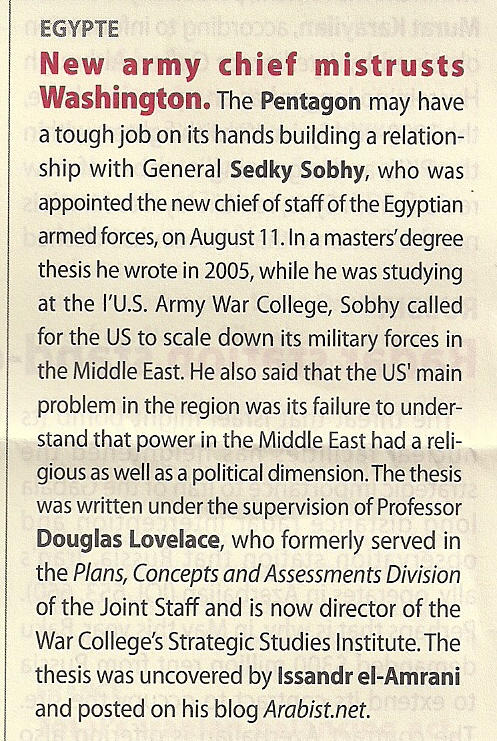
Intelligence Online: Egypt’s Army Chief US Army War College Thesis Critical of US for Being Blind to the Religious Dimension of Middle Eastern Power and Politics

Cultural Intelligence, Government, IO Impotency, Military
Click on Image to Enlarge

Sedky Sobhy's thesis makes the rounds

Glad to see that a bunch of news outlets picked up the thesis by Chief of Staff of the Egyptian Armed Forces Sedky Sobhy I highlighted a few days ago. Some wanted to interview me but unfortunately I was not available, but here's a couple of links.

Research paper offers insight into Egypt's new armed forces chief (McClatchy)

Professor Douglas Lovelace, the director of the Army War College's Strategic Studies Institute and Sobhy's adviser, remembered him as a “bold thinker,” charming and a “very impressive officer” who often offered thoughts counter to the conventional thinking at the time.

“I do recall he was provocative and an original thinker,” Lovelace said. “It was not surprising that he would either fail completely or rise to the top.”

Egypt general's paper offers insight into thinking (Reuters)

Continue reading “Intelligence Online: Egypt's Army Chief US Army War College Thesis Critical of US for Being Blind to the Religious Dimension of Middle Eastern Power and Politics”

Chuck Spinney: Questions Not Asked in Presidential Debates

Commerce, Corruption, Government, Military
Chuck Spinney

National Insecurity Questions That Won’t Be Asked in the Presidential Debates

How Bad Will Things Get in Afghanistan?

by FRANKLIN C. SPINNEY.

Counterpunch, October 08, 2012

For reasons that were quite clear well before the Afghan “surge” began (see here and here), America’s Afghan adventure is now ending without achieving its goals. The prospects for a civil life in Afghanistan are likely to become even more remote than they were before we intervened.  Indeed, some experts think the ground work has been laid for an even more destructive civil war than that which occurred after the Soviets left Afghanistan with their tail between their legs in 1989.  Only time will tell how bad things will be, but it is a virtual certainty that events will be ugly and murderous.

One would expect a healthy accountable democratic government, intent on learning from its errors, would be inclined to seek an understanding of how it got itself into such a mess.

For example, will there be soul searching lessons-learned exercise by a military that repeated most of the strategic and tactical blunders it made in Vietnam? To wit: it dumbed down strategy into a mindless attrition strategy driven by body counts and assassinations in the name of winning hearts and minds.  It substituted high-cost contractor-intensive technologies for low-cost tactical smarts in a guerrilla war.  It over-relied on air power and killing from a safe distance.  It allowed its reactive obsessions with force protection to the displace tactical initiative of small unit commanders.  And perhaps most decisively, it relied on a fatally flawed grand strategy to quickly create a huge, materiel-intensive, indigenous army out of whole cloth, trained and equipped in the US military’s image.  Don’t expect to hear any questions about these issues in the Presidential debates.  And don’t expect to see any serious introspection by a military – industrial – congressional complex (MICC) intent on perpetuating its lucrative business-as-usual.

Continue reading “Chuck Spinney: Questions Not Asked in Presidential Debates”

Marcus Aurelius: As Military Suicides Rise, DoD Focuses on Private Weapons

Ineptitude, Military
Marcus Aurelius

Troops' concerns are well-founded.   A few years ago, a company commander in the 101st Airborne Division at Fort Campbell, KY, developed his own multi-faceted program that caused a big flap.  He had his own policies, registration forms, etc.  Believe he was requiring troops living off-post and owning private weapons to turn those weapons into the company arms room for “secure storage,” etc.  Vastly exceeded both his authority and anything remotely reasonable.  Troops are right to be scared of stuff like this.

As Military Suicides Rise, Focus Is On Private Weapons

By James Dao

New York Times, October 8, 2012, Pg. 13

With nearly half of all suicides in the military having been committed with privately owned firearms, the Pentagon and Congress are moving to establish policies intended to separate at-risk service members from their personal weapons.

The issue is a thorny one for the Pentagon. Gun rights advocates and many service members fiercely oppose any policies that could be construed as limiting the private ownership of firearms.

But as suicides continue to rise this year, senior Defense Department officials are developing a suicide prevention campaign that will encourage friends and families of potentially suicidal service members to safely store or voluntarily remove personal firearms from their homes.

“This is not about authoritarian regulation,” said Dr. Jonathan Woodson, the assistant secretary of defense for health affairs. “It is about the spouse understanding warning signs and, if there are firearms in the home, responsibly separating the individual at risk from the firearm.”

Dr. Woodson, who declined to provide details, said the campaign would also include measures to encourage service members, their friends and their relatives to remove possibly dangerous prescription drugs from the homes of potentially suicidal troops.

Read full article.

Chuck Spinney: Predictable Meltdown in Afghanistan – Strategic Decrepitude and Lack of Integrity Go Hand in Hand

Corruption, Government, Ineptitude, Lessons, Military, Officers Call
Chuck Spinney

The below BBC report, Afghanistan's ‘green on blue' collapse of trust,  places the fatal flaw in the McChrystal plan used by Mr. Obama to justify the Afghan surge in 2010 — namely General McChrystal's failure to examine the strengths and weaknesses of the plan to rapidly build up the Afghan Army/police — into sharp relief.

This flaw was unconscionable for at least two reasons:
First, Obama's surge was premised on achieving quick results that would enable a rapid withdrawal of the “surge” force.  That withdrawal that has now take place, despite the fact the surge did not achieve its desired result, namely weakening the Taliban to a level where it would be forced to parley on our terms.
Second, our disastrous experience with South Vietnamese army should have taught the American military the fallacy of rapidly building up a huge army, cut out of whole cloth, in America's own high-cost, logistics-intensive image.  Armies — at least successful ones — take time to build and must be compatible with the culture from which they emanate.
That this fatal flaw was easy to see well before the fact. For example, I wrote about it  herehere,  here, and here in 2009 and early 2010, before the surge took effect — and I was not alone.  
This grotesque oversight proves the post-Vietnam reforms touted by the US military and the Reagan Administration (which chose to throw money at the problem) were entirely cosmetic and did not get to the roots of the malaise that led to our defeat in Vietnam, notwithstanding the parades, yellow ribbons, and juvenile braggadocio that accompanied  our rout of Saddam's tin pot army in 1991.  Kosovo (for reasons explained in Domestic Roots of Perpetual War), the 2nd Iraq War (the existence of which gave made a lie of our claim of a decisive victory in 1991), and now our clear defeat in Afghanistan are or ought to be lessons to the contrary.  They certainly would be treated as such in a healthy society that endeavors to correct its errors instead of compounding them by sweeping them under a rug.
noble gold