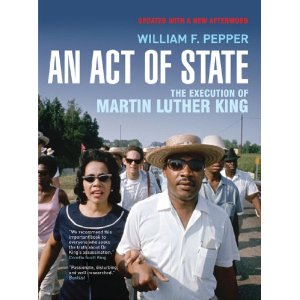
Host of Air America’s Clout, Richard Greene, hosts the author of An Act of State, William Pepper, who represented James Earl Ray on behalf of the Martin Luther King family and is now representing RFK patsy Sirhan Sirhan.
This is the antecedent to my previous post on Gen. Mattis.
The administration’s mishandling of Marine Gen. James Mattis
Posted By Thomas E. Ricks Friday, January 18, 2013 – 9:50 AM
Word on the national security street is that General James Mattis is being given the bum's rush out of his job as commander of Central Command, and is being told to vacate his office several months earlier than planned.
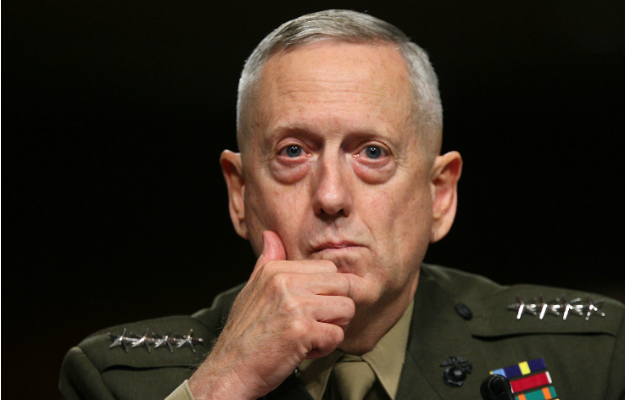
General James Mattis, USMC
Why the hurry? Pentagon insiders say that he rubbed civilian officials the wrong way — not because he went all “mad dog,” which is his public image, and the view at the White House, but rather because he pushed the civilians so hard on considering the second- and third-order consequences of military action against Iran. Some of those questions apparently were uncomfortable. Like, what do you do with Iran once the nuclear issue is resolved and it remains a foe? What do you do if Iran then develops conventional capabilities that could make it hazardous for U.S. Navy ships to operate in the Persian Gulf? He kept saying, “And then what?”
Inquiry along these lines apparently was not welcomed — at least in the CENTCOM view. The White House view, apparently, is that Mattis was too hawkish, which is not something I believe, having seen him in the field over the years. I'd call him a tough-minded realist, someone who'd rather have tea with you than shoot you, but is happy to end the conversation either way.
Presidents should feel free to boot generals anytime they want, of course — that's our system, and one I applaud. But ousting Mattis at this time, and in this way, seems wrong for several reasons:
TIMING: If Mattis leaves in March, as now appears likely, that means there will be a new person running CENTCOM just as the confrontation season with Iran begins to heat up again.
By Paul Goodsell and Joseph Morton, World-Herald Staff Writers
Former Nebraska Sen. Chuck Hagel faces a Jan. 31 confirmation hearing before the Senate Armed Services Committee for his appointment by the president as secretary of defense.
During his 12 years in the Senate — and the four years since he left office — Hagel has taken positions on a number of issues related to military policy.
Much of the public focus on Hagel recently has been on his initial support of and later opposition to the Iraq War, his caution about military intervention in Iran over its nuclear program, and the depth of his support for Israel. Senators are sure to ask Hagel about those issues.
But here are some additional areas that could come up:
Sen Hagel, if confirmed as SECDEF, may start firing Service Secretaries. Keeping Acquisition and Intelligence will be a sure sign that nothing is actually going to change.
Although the transition between presidential terms is usually marked by large-scale personnel turnover at politically appointed government posts, sources said that this time, many of the most important leaders at the Pentagon are likely to stay, creating continuity in a time of fiscal uncertainty.
Among them, Deputy Defense Secretary Ashton Carter is expected to stay on for at least one year following confirmation of the top Defense Department job, according to Pentagon sources.
While it appears more and more likely that former Sen. Chuck Hagel will be confirmed to replace Defense Secretary Leon Panetta, Hagel will likely inherit much of his predecessor’s team. Besides Carter, Frank Kendall, undersecretary of defense for acquisition, technology and logistics, and Robert Hale, Defense Department comptroller, are likely to remain, sources said.
According to a Pentagon official, the president asked Carter to stay in his current DoD post, a decision, sources added, was made easier because of the good relationship he has with Hagel.
Carter had been rumored as a candidate for Cabinet-level positions, but that possibility appears to have passed for the moment. Michael Vickers, who was considered for the job of CIA director, is thought likely to remain at DoD as well.
None of the decisions has been finalized, as Hagel will be given the option to push for his own people, but sources don’t expect Hagel to rock the boat. Change is more likely to occur at the service head level, said Loren Thompson of the Lexington Institute think tank. But those decisions are likely to wait until a new secretary is settled, Thompson said. And while the staffs may remain similar, there will be a distinction in mandate and ideology between the current and likely defense chiefs.
He was an Imperial Japanese Army general during World War II. In terms of battles he was most famous for conquering the British colonies of Malaya and Singapore.
But his historical legacy comes from being tried in late 1945 by an American military tribunal in Manila for war crimes relating to the massacre of civilians in Manila, and atrocities in Singapore against civilians and prisoners of war, such as the Sook Ching massacre.
Even though the massacre in the Philippines was carried out by a subordinate commander, Imperial Japanese Navy Rear Admiral Sanji Iwabuchi, against Yamashita’s specific order – and without his knowledge or approval – a U.S. military tribunal held Yamashita responsible for the conduct of his troops. He was executed on February 23, 1946.
Nowadays most legal scholars acknowledge that Yamashita’s execution was a case of victor’s, not legal, justice. Nevertheless his case become a precedent regarding the command responsibility for war crimes and is known as the Yamashita Standard.
An interesting tidbit of history, you’re thinking, but what’s its relevance to today’s U.S. military?
Phi Beta Iota: Morality is even more important in war than in peace. Extreme violations will have a lasting negative effect. The USS Liberty, 34 KIA, 171 WIA, is a classic modern example. No one is Israel has been held accountable for this atrocity, and for over 30 years no one in Washington has been held accountable for covering it up and abusing the surviving crew and families. We continue to recommend Truth & Reconciliation — educating the public on what has actually happened, why, and its consequences — rather than individual punitive measures that do nothing for the greater good of society.
The authors are described as leading experts in loyalty, and they discuss it from the point of view of philosophy, sociology, psychology, economics, and management.
Chapter 5 is called Toxic Loyalty. Eric Felten, in his book Loyalty: the Vexing Virtue, talks about how dictators and other unscrupulous people often use loyalty as a weapon of control, leading people to remain loyal when they probably should not, turning a person's sense of loyalty against them and in essence getting them to betray their own consciences. Chapter 9 of “Why Loyalty Matters” is called: Enlightened Loyalty. I imagine it's a discussion about how to temper one's sense of loyalty with wisdom. It sounds like a good book.
In Dante's Inferno, the lowest depth of hell is reserved for people who have betrayed some kind of special relationship. And it's obvious that throughout the evolution of humankind, loyalty has served a vital function. But like all of our psychosocial traits, loyalty can work against us and against the greater good of humanity. Obviously the loyalties of contemporary humans are often misplaced. We need to learn to be loyal to higher principles than always choosing in-group interests over out-group interests at all costs, because that cost just might be our extinction as a species. So obviously the social dynamic between loyalty and betrayal is a central concept and especially important to examine at this stage of human evolution. It's surprising that more has not been written about the subject.