Jean Lievens: The number crunch: Will Big Data transform your life – or make it a misery?

IO Impotency
Jean Lievens
Jean Lievens

The number crunch: Will Big Data transform your life – or make it a misery?

The age of Big Data is upon us. Fuelled by an incendiary mix of overblown claims and dire warnings, the public debate over the handling and exploitation of digital information on an astronomically large scale has been framed in stark terms: on one side are transformative forces that could immeasurably improve the human condition; on the other, powers so subversive and toxic that a catastrophic erosion of fundamental liberties looks inevitable.

Neal Rauhauser: GDELT’s Mysterious Demise

IO Impotency
Neal Rauhauser
Neal Rauhauser

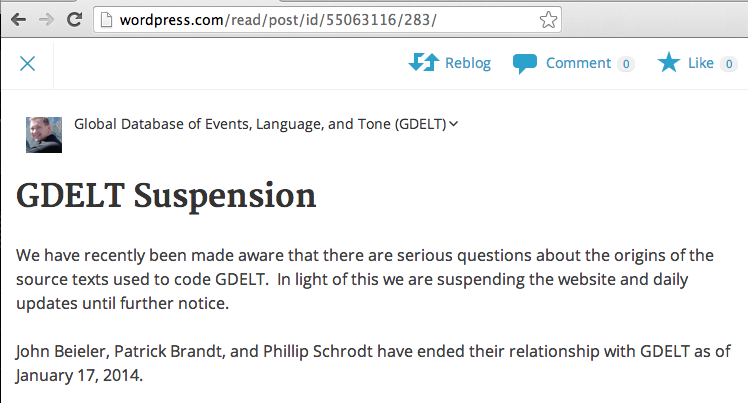
I wrote Foreign Policy's Global Conversation Infographic on New Year's Day. The content used to create the visualization was based on the Global Data of Events, Language and Tone, commonly referred to as GDELT. The effort was suspended during the week ending January 17th via this terse announcement.

Click on Image to Enlarge

. . . . . .

I believe this means that whomever created the CAMEO coding was either not credited appropriately, or there may be an issue with using it in a derivative product. I ran into this late last year – I was going to republish the Global Terrorism Database packaged for use with Sentinel Visualizer, but this was not allowed. I was free to publish a set of scripts to accomplish this task, the issue was that the entities that fund that effort wanted a count of total users, so any derivative work had to be post processing run by the user, rather than repackaging.

I hope what we are seeing here is some sort of pause to clean house and/or make things right with regards to whatever coding material was incorrectly used. The volume and quality of content was extremely promising and I hope the suspension is just some misunderstanding that can be quickly corrected. I kept the archive of the 1979 – 2012 data so I can continue working on something that will handle the live feed when it returns.

Read full post.

Mini-Me: Snowden as Russian Agent? Snowden as Joint Chinese-Russian Project?

IO Impotency
Who?  Mini-Me?
Who? Mini-Me?

Huh?

Guardian: Intelligence chair: NSA leaker Edward Snowden may have had Russian help

Last year, in an interview with the New York Times, Snowden said he did not take any of the documents he obtained to Russia, “because it wouldn’t serve the public interest”.  Snowden said there was “zero-percent chance” that Russia had received any documents and that he had handed all his NSA data to journalists from media outlets including the Guardian, before leaving Hong Kong. “What would be the unique value of personally carrying another copy of the materials onward?” he said.

New York Times: Congressional Leaders Suggest Earlier Snowden Link to Russia

A senior F.B.I. official said on Sunday that it was still the bureau’s conclusion that Mr. Snowden acted alone.

Continue reading “Mini-Me: Snowden as Russian Agent? Snowden as Joint Chinese-Russian Project?”

Stephen E. Arnold: Search Application Perspectives For 2014

IO Impotency, IO Tools
Stephen E. Arnold
Stephen E. Arnold

Search Application Perspectives For 2014


With 2014 well under way, search experts are trying to predict what will happen for enterprise search. Search Appliance World has an article that takes a look on enterprise search in the past and future called, “The New Search Appliance Landscape: Reflections And Predictions With MaxxCAT.” Basic search commands that come in out-of-the-box system are old school and do not provide the robust solution enterprise systems need.


Search appliances became enterprise users’ favorite toys and everyone had to have the Google Mini Search Appliance, but those days are gone. Other search developers, such as MaxxCat, stepped up to the plate.

Continue reading “Stephen E. Arnold: Search Application Perspectives For 2014”

Owl: Corry Doctorow – Is 2014 the Death of the Web to DRM and Government-Corporate Collusion and Corruption?

Commerce, Corruption, Government, Idiocy, IO Impotency
Who?  Who?
Who? Who?

Doctorow: 2014 is When We Lose the Web

Writer Corry Doctorow may be just suffering from deep winter blues, but if not, and he's correct, his brief musings on the near future of the net are ominous:

“Try as I might, I can’t shake the feeling that 2014 is the year we lose the Web. The W3C push for DRM in all browsers is going to ensure that all interfaces built in HTML5 (which will be pretty much everything) will be opaque to users, and it will be illegal to report on security flaws in them (because reporting a security flaw in DRM exposes you to risk of prosecution for making a circumvention device), so they will be riddled with holes that creeps, RATters, spooks, authoritarians and crooks will be able to use to take over your computer and f*ck you in every possible way.”

More:

We are Huxleying ourselves into the full Orwell.

Stephen E. Arnold: Only 58% of US-UK Companies and Information Governance Policies

IO Impotency, IO Privacy
Stephen E. Arnold
Stephen E. Arnold

Recommind Survey Shows Stats Related to Information Governance

January 16, 2014

The article titled Bridging the Global Information Governance Gap on IDM offers more governance advice from the findings of Recommind’s survey of US and UK companies. The survey posed questions related to information governance (IG), which is “a cross-departmental approach to optimising [sic] the value of information simultaneously associated risks and costs.” We had thought Recommind was a variant of the Autonomy type of system, we are learning new things every day. Their survey revealed that only 58% of companies in the US have an IG policy. The article quotes the global head of information governance at Recommind, Dean Gonsowski:

Continue reading “Stephen E. Arnold: Only 58% of US-UK Companies and Information Governance Policies”

Rob Dover: The NSA, Snowden and the Media

Ethics, Government, IO Impotency, Media, Military
Rob Dover
Rob Dover

The NSA, Snowden and the Media

By

e-International Relations on January 15, 2014

As Michael Goodman and I tried to whimsically note in the sub-title of our edited collection on intelligence and the media – media needs intelligence and intelligence needs the media. The symbiosis of this relationship can be partly found in common expertise and practices (investigative zeal and tradecraft around weeding out hidden empirical detail), but also in the political or normative function of intelligence agencies, namely to constrain and repel certain forms of political discourse and activity deemed to be abhorrent to the majority, but more particularly which is abhorrent to the established political elites. So, at a very basic level media outlets learn much from the activities of intelligence agencies and the business they engage in. Similarly the agencies have both used mainstream media to shape debates (the Cold War and the War on Terror were notable examples), and to position adversaries in a particular way (and this might apply to every conflict since the printing press was invented). But what I want to rehearse here are the particular ways in which mainstream and parallel media sources – with a particular emphasis on the UK – have coalesced and acted within the NSA/Snowden furore, and the lessons we can learn from this.

Continue reading “Rob Dover: The NSA, Snowden and the Media”

noble gold