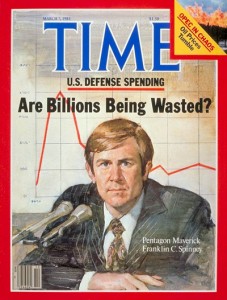
The Pentagon could wind up overpaying more than $100 million for spare aircraft parts because a contracting agent didn't check that he was getting the right prices, an investigative report found in May.
The $604 billion defense spending bill now nears passage with many billions of dollars in rampant defense waste scattered throughout. Aircraft waste on the pricey but flawed F-35, Navy waste on a next generation of nuclear submarines, and systemic waste in unchecked new weapons, all have found their costly places aboard the defense authorization bill.
It’s almost impossible to audit what taxpayers have spent to rebuild Afghanistan
Since 2002, Congress has set aside $104 billion specifically to rebuild Afghanistan. Of that, $66 billion went to the Pentagon. Recently, the Special Inspector General for Afghanistan Reconstruction asked the military to account for all that spending. It couldn’t. According to a new report from SIGAR, the Pentagon only knows how it spent a third of its reconstruction budget.
That’s $45 billion dollars the military can’t track and the reason is … ridiculous. According to SIGAR, the Pentagon didn’t check a box on an electronic form when it filed the information in government databases.
A senior union official has told New Matilda the company behind the port had anticipated a base for up to 80,000 US Marines as early as 2012, and the politician who represents the islands in the Northern Territory parliament expects a base to be built to “protect Australia from war in the future”.
Dear Bureau of Labor Statistics: please pay careful attention to this case study of how your CPI “inflation” gauge, hedonically, seasonally-adjusted or otherwise, is completely inaccurate, and how what you record as 0% inflation is really 72%. As Consumerist points out, for the latest example of “stealth inflation” we go to Sodastream, where as part of a redesign of its proprietary line of flavoring syrups which “cost the same” the actual bottle contents are now not only smaller but also diluted.
In the last week, much has been made of the leaked DoD briefing entitled ISR Support to Small Footprint (CT) Operations – Somalia and Yemen, dated February 2013. To date, all the reports I have read, save one, focus on the “critical shortfalls” of drone warfare revealed in these slides — see, for example The Intercept, which broke the story on October 15 and placed the slides on the net, and this report in Common Dreams, and anti-war progressive outlet. Both of these reports and the briefing slides contain a lot of useful information are well worth careful reading. But there is more.